Question: please summarize this chapter please summarize the chapter le Chapter 3: The Marketing Environment 1. Examining and Responding to the Marketing Environment The marketing environment
please summarize this chapter
please summarize the chapter
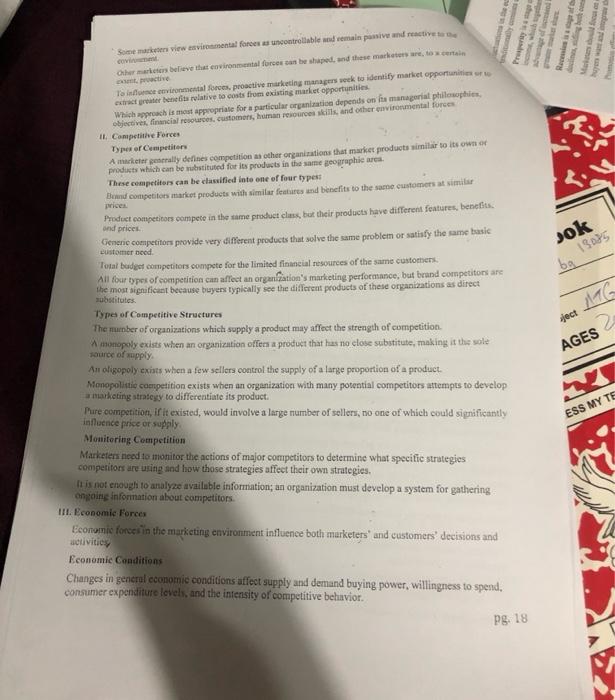
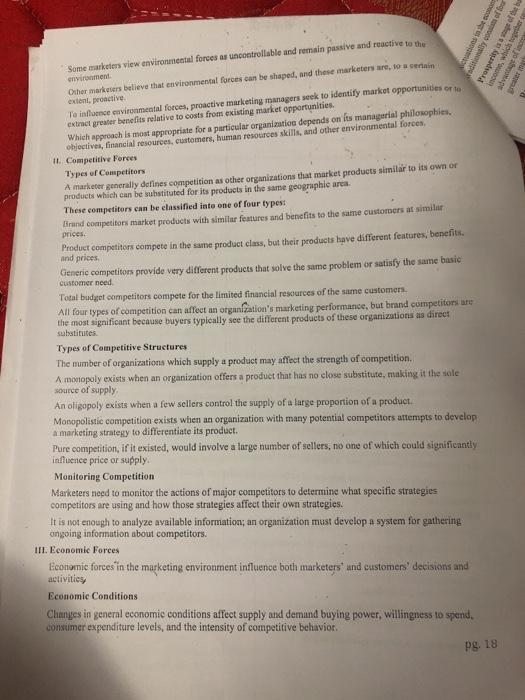
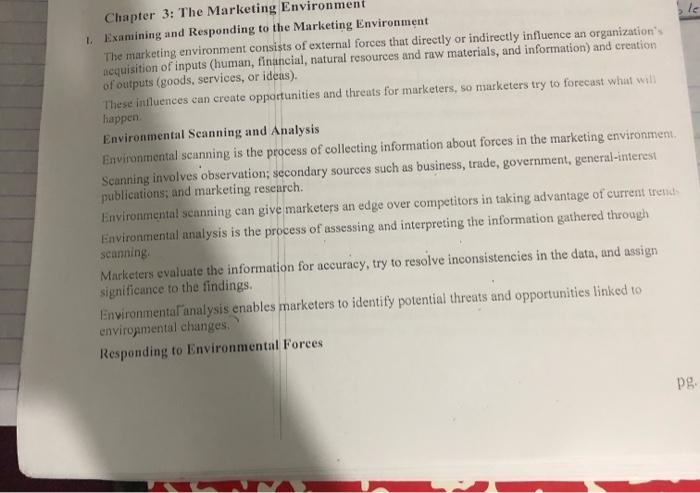
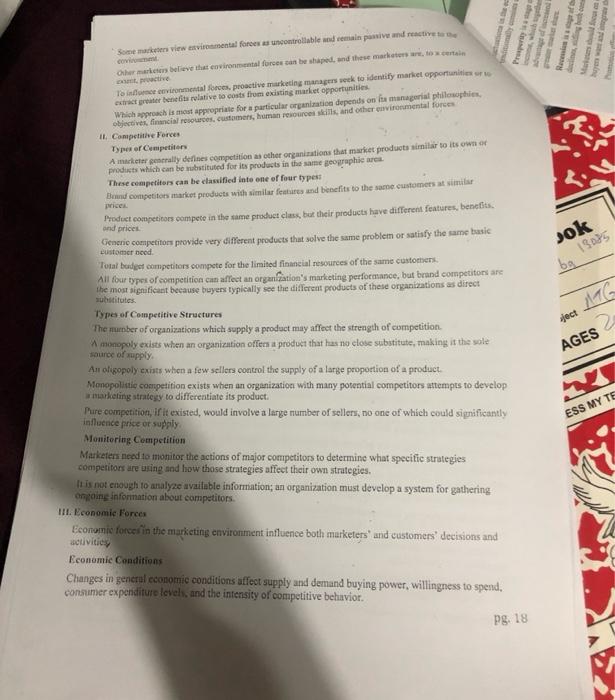
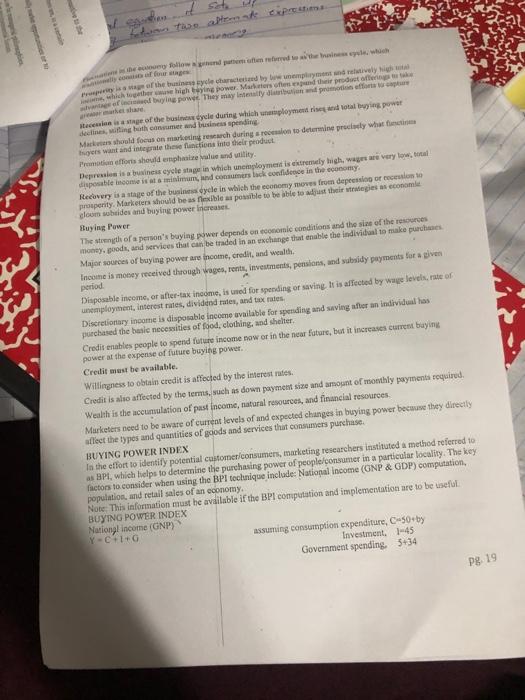
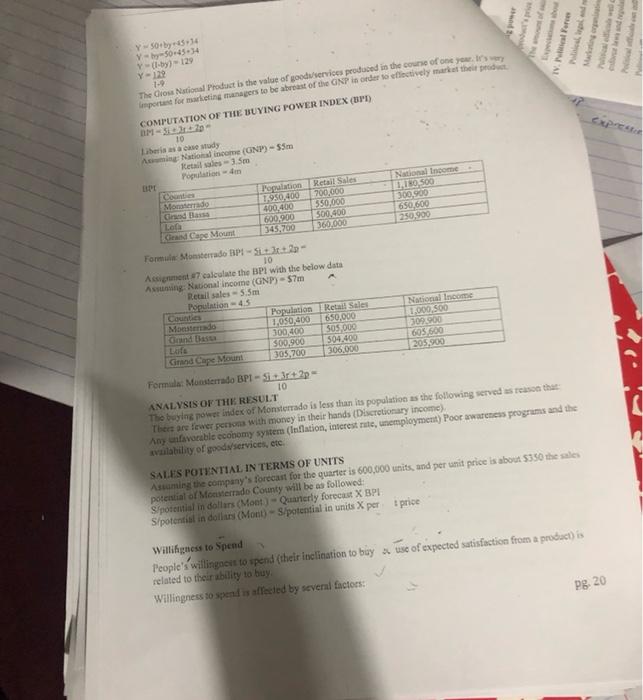
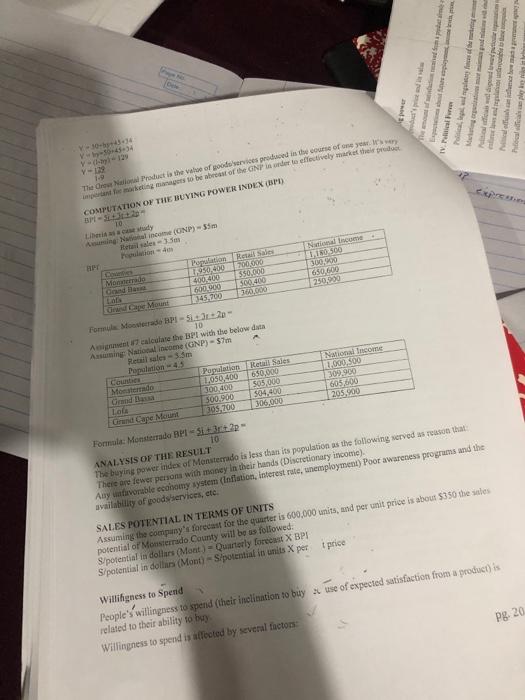
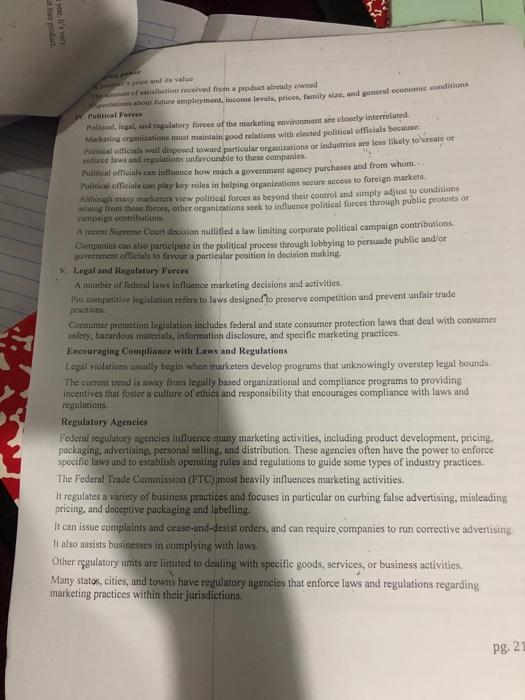
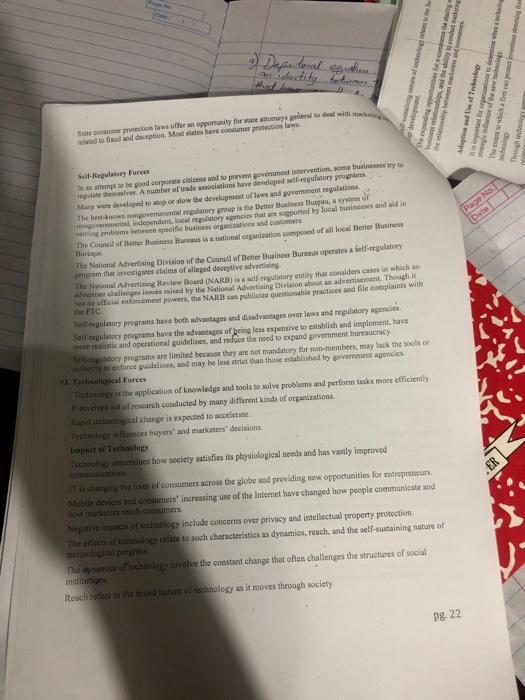
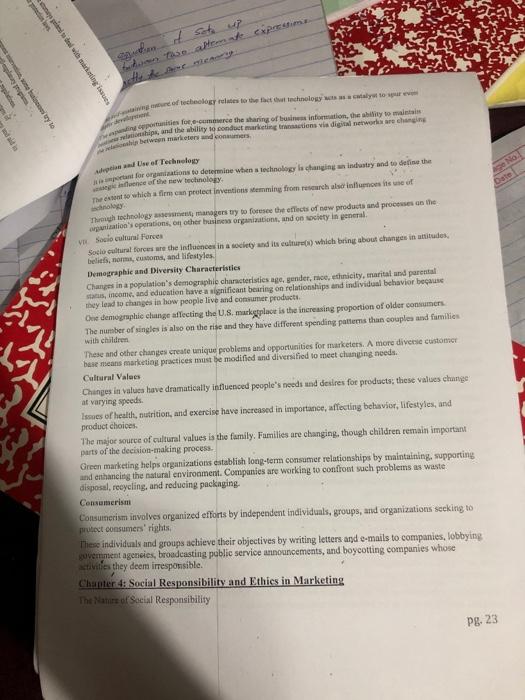
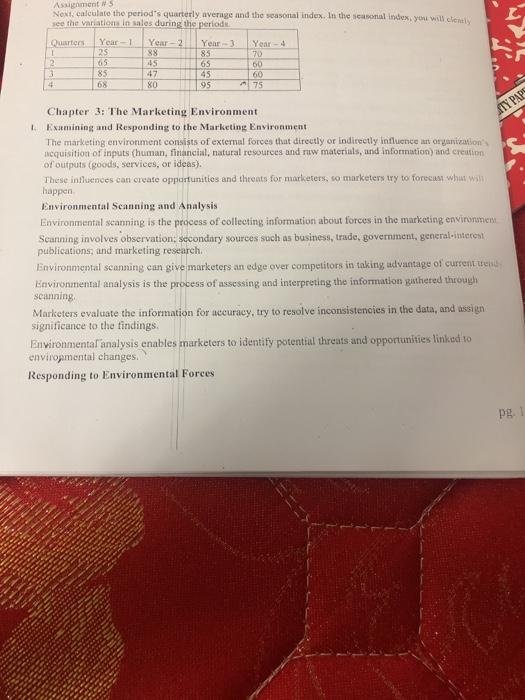
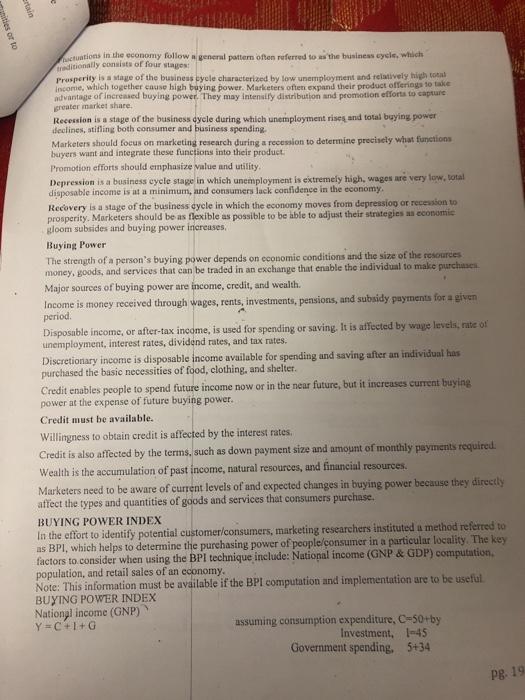
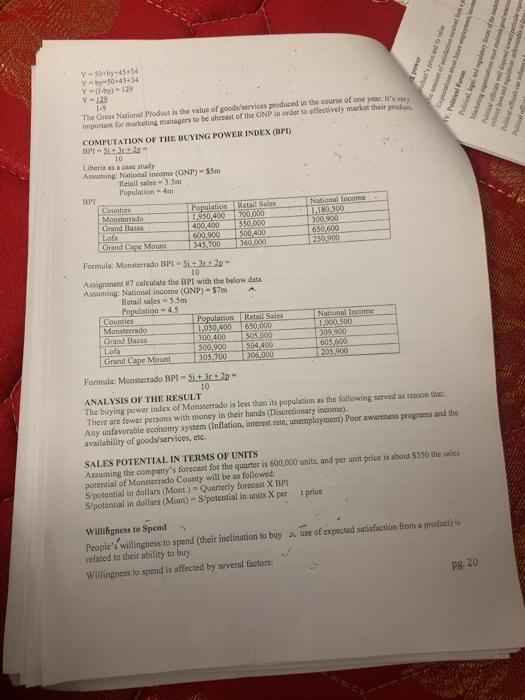
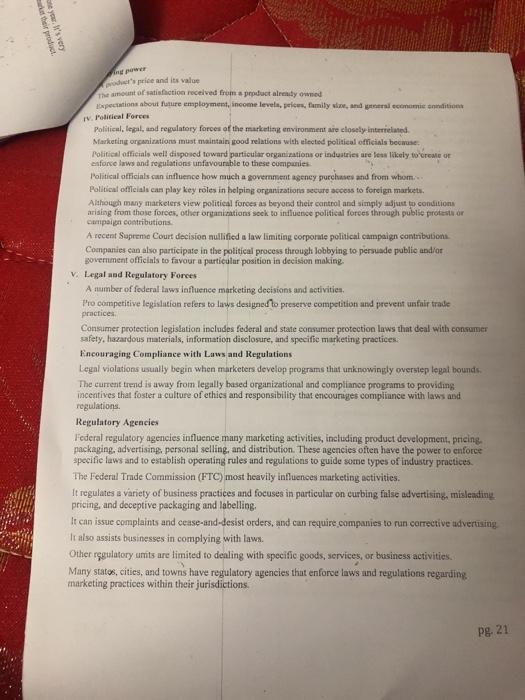
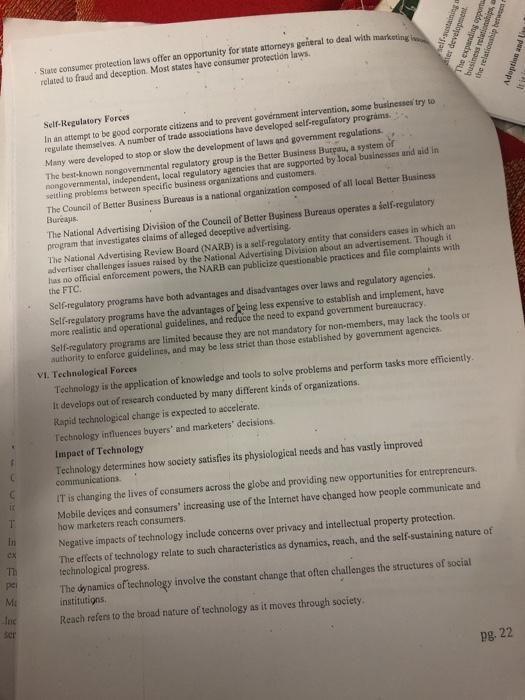
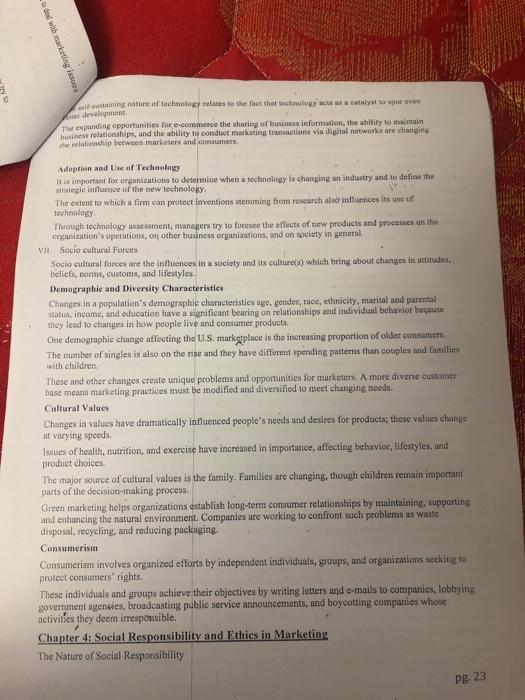
le Chapter 3: The Marketing Environment 1. Examining and Responding to the Marketing Environment The marketing environment consists of external forces that directly or indirectly influence an organization's acquisition of inputs (human, financial, natural resources and raw materials, and information) and creation of outputs (goods, services, or ideas). These influences can create opportunities and threats for marketers, so marketers try to forecast what will happen Environmental Scanning and Analysis Environmental scanning is the process of collecting information about forces in the marketing environment, Scanning involves observation; secondary sources such as business, trade, government, general-interest publications, and marketing research. Environmental scanning can give marketers an edge over competitors in taking advantage of current trends Environmental analysis is the process of assessing and interpreting the information gathered through scanning Marketers evaluate the information for accuracy, try to resolve inconsistencies in the data, and assign significance to the findings. Environmental analysis enables marketers to identify potential threats and opportunities linked to environmental changes Responding to Environmental Forces pg . Some makeview environmental forces as uncontrollable and remain partive and reaction Othere believe that covironmental forces can be shaped, and these market to certain Toineenvironmental forces, proactive marketing managers seek to identify market opportunities to extract ter benefits relative to costs from existing market opportunities Which approach is most appropriate for a particular organization depends on ta managerial philosophie eves financial resources customers, human resource skills, and other environmental forces Il Competithe Forces Types of Competitors A marketer generally defines competition as other organizations that market products similar to its owner products which can be substituted for its products in the same geographic area. These competitors can be claseified into one of four typest Bed competitors market products with similar features and benefits to the same customers at similar prices Product competitors compete in the same product class, but their products have different features, benefits. sok 19035 ba 116 ject AGES and prices Generic competitors provide very different products that solve the same problem or satisfy the same basic Lustomer need Total budget competitors compete for the limited financial resources of the same customers All four types of competition can affect an organGation's marketing performance, but brand competitors are the most significant because buyers typically see the different products of these organizations as direct substitutes Types or Competitive Structures The mumber of organizations which supply a product may affect the strength of competition monopoly exists when an organization offers a product that has no close substitute, making it the sole source of supply An oligopoly exists when a few sellers control the supply of a large proportion of a product Monopolistic competition exists when an organization with many potential competitors attempts to develop marketing strategy to differentiate its product. Pure competition, if it existed, would involve a large number of sellers, no one of which could significantly influence price or supply Monitoring Competition Marketers need to monitor the actions of major competitors to determine what specific strategies competitors are using and how those strategies affect their own strategies. fi is not enough to analyze available information, an organization must develop a system for gathering ongoing information about competitors. III. Economic Forces Economic forces in the marketing environment influence both marketers and customers' decisions and activities Economic Conditions Changes in general economic conditions affect supply and demand buying power, willingness to spend, consumer expenditure levels, and the intensity of competitive behavior. ESS MY TE Pg. 18 c. sale data apa Express con follow hundematen referred with inci ...com of the business cycle characted by ww unemployment and relatively ich others high in power. Morbitors of the face buying powe. They may internally and promotion for Hoci same of the business dycle during which nemployment and total buying power des, ifling theme and business spending Make should focus on marketing research during a roosion to determine precisely what gers want and integrate the functions into their product Promotion efforts should emphasize value and willity, Der is a business cycle stage in which unemployment is extremely high, wages are very low disposable contests minimum, and consumers lack confidence in the economy Recovery sa stage of the business dycle is which the economy moves from depressing or recension to prosperity Marketers should be as exibles posible to be able to wist their regies as economie cloon subuides and buying power increase Buying Power The strength of a person's buying power depends on economic conditions and the size of the more mon. pood, and services that can be traded in an exchange that enable the individual to make purchas Major sources of buying power are income, credit, and wealth Income is money received through wages, fonts, investments, pensions, and subsidy payments for a pive period Disposable income, or after-tax income, is med for spending or saving It is affected by wage levels, rue or unemployment interest rates, dividend rates, and tax rates Discretionary income is disposable income available for sending and saving after an individual hos purchased the base necessities of food, clothing, and shelter. Credit enables people to spend future income now or in the near future, but it increases current buying power at the expense of future buying power Credit mest be available. Willingness to obtain credit is affected by the interest rates Credit is also affected by the terms, such as down payment size and amount of monthly payments required, Wealth is the accumulation of past income, natural resources, and financial resources, Marketers need to be aware of current levels of and expected changes in buying power because they directly affect the types and quantities of goods and services that consumers purchase. BUYING POWER INDEX In the effort to identify potential customer consumers, marketing researchers instituted a method referred to - SP, which helps to determine the purchasing power of people/consumer in a particular locality. The key factors to consider when using the BPI toolunique include: National income (GNP & GDP) computation, population, and retail sales of an economy. Note: This information must be available if the BPI computation and implementation are to be useful. BUYING POWER INDEX Nationgl income (GNP) 8- ctito assuming consumption expenditure, C-50 by Investment, 1-45 Government spending. 5434 Pg. 19 Y-50by1314 y-hy-50-45-34 --- 129 IV. calore Y-129 The Cross National Product is the value of goodwervices produced in the course of one you. In Important for marketing managers to be abast or the GNP in order to sitively market their COMPUTATION OF THE BUYING POWER INDEX (BPI). 10 Liberia e study Nincome (GNP)-55m Retail des 3.5m Population National Income LABO 500 300.900 650,600 250.900 Population Retail Morado 11,950,400 700.000 400.400 350.000 600.900 500,400 Ceas Cape Mount 345,700 360.000 Formule omsterrado BPI- 10 Asimo calculate the BP with the below data Ang National income (GNP) - 57m Retail sales - 55m Population - 45 Counties Population Retail Sales 1.050,400 650.000 300 400 305.000 LO 300.900 504,400 Grand Cape Mount 305, 700 306.000 National Income 15.000 500 309.900 605,600 205.900 Forma Monsterrado BPI-S 2p - 10 ANALYSIS OF THE RESULT The buying power index of Monsterrado is less than its population as the following served as reason that There are fewer per with money in their hands (Discretionary income) Any unfavorable economy system (Inflation, interest rate, employment) Poor awareness programs and the valability of goods/services, etc. SALES POTENTIAL IN TERMS OF UNITS Asuming the company's forecast for the quarter is 600,000 units, and per unit price is about 5350 the sales potential of Monterrado County will be us followed: Spotential in dollars (Mont) - Quarterly forecast X SPI Sipotential in dollars (Mont) - S/potential in units X per price Willifigness to Spend People's willingness to spend their inclination to buy use of expected satisfaction from a product) is related to their ability to buy Willingness to spend is afected by several factors: Pg. 20 - I want - 03:34 | 45 Y-129 Y-129 The New Product is the value of good services produced is the one important for marketing managers to be best of the GN de to effectively market the COMPUTATION OF THE BUYING POWER INDEX (BP) income (ONP) - 5 Bases dhe Mode 2020 700.000 400.000 350000 600 900 300/400 630, 600 1345,200 30,000 250,000 Ford BPI- 520 10 A alculate the BP with the below data Ang National income (GNP) - 57m Retail salem Population - 45 Population Rent Sales National Income Mondo 1.050,400 650,000 1.000.500 Grand 100400 505.000 309.900 Log 300.900 504,400 605600 Grand Care Men 105,700 306,000 205,900 Format: Mondado BPI-53ct 10 ANALYSIS OF THE RESULT The buying power index of Monterrado is less than its population as the following served as reason that There are fewer persons with money in their hands (Discretionary income) Alyvonable economy system (Inflation, Interest rate, unemployment) Poor awareness programs and the availability of goods services, etc. SALES POTENTIAL IN TERMS OF UNITS Assuming the company's forecast for the quarter is 600,000 units, and per unit price is about $350 the sales potential of Mostrado County will be as followed: S potential in dollars (Mont) = Quarterly forecast X BP Sipotential in dollars (Mont) - Sipotential in units X per t price Willifigness to Spend People's willingness to spend their inclination to buy a tese of expected satisfaction from a product) is related to their ability to buy Willingness to spend is affected by several factors: Pg. 20 S. motion received from a product already owned restations about future employment income levels, prices, family site, and general economic conditions litical legal and regulatory forces of the marketing environment are closely interrelated Marketing organisations must maintain good relations with elected political officials because Political official well disposed toward purticular organizations or industries are less likely to create or ce laws and regulations unfavourable to these companies Political officials can influence how much a government agency purchases and from whom. Political officials can play key roles in helping organizations secure access to foreign markets. Although many marketers view political forces us beyond their control and simply adjust to conditions ating from those forces, other organizations seek to Influence political forces through public protests or campal contributions recent Supreme Court decision nullified a law limiting corporate political campaign contributions Companies can also participate in the political process through lobbying to persuade public and/or government officials to favour is particular position in decision making . Legal and Regulatory Forces A number of federal laws influence marketing decisions and activities. Pro competitive lojislation refers to laws designed to preserve competition and prevent unfair trade poctices Consumer protection legislation includes federal and state consumer protection laws that deal with consumer safety, hazardous materials, information disclosure, and specific marketing practices. Encouraging Compliance with Laws and Regulations Legal violations usually begin when marketers develop programs that unknowingly overstep legal bounds The current trend is away from legally based organizational and compliance programs to providing incentives that foster a culture of ethies and responsibility that encourages compliance with luws and regulations Regulatory Agencies Federal regulatory agencies influence many marketing activities, including product development, pricing, packaging, advertising personal selling, and distribution. These agencies often have the power to enforce specific laws and to establish operating rules and regulations to guide some types of industry practices. The Federal Trade Commission (PTC) most heavily influences marketing activities. It regulates a variety of business practices and focuses in particular on curbing false advertising, misleading pricing, and deceptive packaging and labelling It can issue complaints and cease-and-desist orders, and can require companies to run corrective advertising It also assists businesses in complying with luws Other rggulatory units are limited to dealing with specific goods, services, or business activities. Many states, cities, and towns have regulatory agencies that enforce laws and regulations regarding marketing practices within their jurisdictions. Pg. 21 ) Depoashioned og beatit je en Bremer aa naan er and Boerek tech Ndupired wifedale Theo chiaro Se potrete tres offer an opportunity for osteomyeliers out with me de freded deception. Most at have comer protection for Through Page Nos Date Safety Fores e empt to be good corporate cities and to prevent government intervention, combusty elitemes A number of trade asociation have developed self-gatory programs My were developed to stop or slow the development of laws and government regula The event regulatory proup is the better sien Burau, a system of tel. Independent, local testatory agencies that are supported by local business in problems between specific business organisations and to The Case of Beer Business Burous is a national organization composed of all local Better Busine The National Advertising Division of the Council of Better Business Bureaus operates a self-regulatory pram that investigates claims of alleged deceptive advertising The National Advertising Review Roard (NARD) is a self-reguliary entity that considers came in wich une social enforcement power, the NARB can publicat questionable practices and file complaints with the FTC Selfstory programs have both advantages and disadvantages over law and regulatory agencie Segulatory programs have the advantages of being leus expensive to establish and implement, have me realistic and operational guidelines, and reduce the need to expand government bureaucracy. Salon de programs are limited because they are not mandatory for non-members, may lack the tools or hot score guidelines, and may be lou strict than those established by government agencies V Teal Forces Tedule is the application of knowledge and tools to solve problems and perform tasks more efficiently delupa frescarch conducted by many different kinds of organizations Lipid tegical change is expected to accelerate Pathology infes buyers and marketers decision Impact of Techno Technology determines how society satisfies its physiological needs and has vastly improved ER thing the lives of consumers across the globe and providing new opportunities for entrepreneurs Mabile devices and comes increasing use of the Internet have changed how people communicate and Nives of technology include concerns over privacy and intellectual property protection Deelles et scorelate to such characteristics as dynamics, reach, and the self-sustaining nature of The dynamic tegy wolve the constant change that often challenges the structures of social institution Reachers to the broader of tochnology as it moves through society Pg. 22 withing hrase a expresim po of techno the fact ichnology wito e tyto pie forum thering of honom ships the buty conducting is video belwen markers com Use of Technology No Date Nastant for organisation to determine when a technology is changing an industry and to define the ce of the new technology The set to which a fim can protect inventions Memming from research also inces its use of The technology and managers try to foresee the effects of new products and processes on the anisation operations, or other business organization, and on society in general V Sociocultural Forces Solo cultural forces are the influences in a society and its culture) which bring about changes in attitudes beliels, norms, customs, and lifestyles Demographic and Diversity Characteristics Changes in a population's demographic characteristics age, gender, rice, ethnicity, marital and parental stus, income, and education have a significant bearing on relationships and individual behavior because they lead to changes in how people live and consumer products One demographic chunge adfecting the U.S. marketplace is the increasing proportion of older consumers The number of singles is also on the rise and they have different spending patterns than couples and families with children These and other changes create unique problems and opportunities for marketers. A more diverse customer huse means marketing practices must be modified and diversified to meet changing needs. Cultural Values Changes in values have dramatically influenced people's needs and desires for products, these values change af varying speeds Issues of health, nutrition, and exercise have increased in importance, affecting behavior, lifestyles, and product choices The major source of cultural values is the family, Families are changing though children remain important parts of the decision-making process. Green marketing helps organizations establish long-term consumer relationships by maintaining, supporting and enhancing the natural environment. Companies are working to confront such problems as waste disposal, recycling, and reducing packaging. Consumerism Consumerism involves organized efforts by independent individuals, groups, and organizations socking to protect consumers' rights These individuals and groups achieve their objectives by writing letters and e-mails to companies, lobbying government agencies, broadcasting public service announcements, and boycotting companies whose activities they deem irresponsible. Chapter 4: Social Responsibility and Ethics in Marketing The Name of Social Responsibility Pg. 23 Mafuta Sommer view environmental forces uncontrollable demain passive and react Ohr believe that covironmental forces can be shaped, and these market, to certain Tsine environmental forces, proactive marketing managers to identify market opportunities are extret greiter benefits relative to costs from existing market opportunities Which approach is most appropriate for a particular organization depends on ta managerial philosophie ve financial resources customers, human resources skills, and other environmental forces Il Competithe Forces Types of Competitors A marketer generally defines competition as other organizations that market products similar to its own or products which can be substituted for its products in the same geographic area. These competitors can be classified into one of four typest Bound competitors market products with similar features and benefits to the same customers at similar prices Product competitors compete in the same product class, but their products have different fontures, benefits. sok 19035 ba 116 ject AGES and price Generic competitors provide very different products that solve the same problem or satisfy the same basic customer beod Total budger competitors compete for the limited financial resources of the same customers All four types of competition can affect an organisation's marketing performance, but brand competitors are the most significant because buyers typically see the different products of these organizations as direct substitutes Types or Competitive Structures The manber of organizations which supply a product may affect the strength of competition. monopoly exists when an organization offers a product that has no close substitute, making it the sole source of supply An oligopoly exists when a few sellers control the supply of a large proportion of a product Monopolistie competition exists when an organization with many potential competitors attempts to develop marketing strategy to differentiate its product. Pure competition, if it existed, would involve a large number of sellers, no one of which could significantly influence price or supply Monitoring Competition Marketers need to monitor the actions of major competitors to determine what specific strategies competitors are using and how those strategies affect their own strategies i is not enough to analyze available information, an organization must develop a system for gathering ongoing information about competitors. III. Economic Forces Economic forces in the marketing environment influence both marketers and customers' decisions and wtivities Economic Conditions Changes in general economic conditions affect supply and demand buying power, willingness to spend. consumer expenditure levels, and the intensity of competitive behavior. ESS MY TE Pg. 18 Assignments Next, calculate the period's quarterly average and the seasonal index. In the seasonal index, you will come see the variations in sales during the periodu Quarters 1 2 3 4 Year 25 65 85 68 Year-2 88 45 47 80 Year-3 85 65 45 95 Year - 4 70 60 60 A 75 ATY PARE Chapter 3: The Marketing Environment Examining and Responding to the Marketing Environment The marketing environment consists of external forces that directly or indirectly influence an organizmin ncquisition of inputs (human, financial, natural resources and raw materials, and information and creation of outputs (goods, services, or ideas). These influences can create opportunities and threats for marketers, co marketers try to foreca who will happen Environmental Scanning and Analysis Environmental scanning is the process of collecting information about forces in the marketing environmem Scanning involves observation; secondary sources such as business, trade, government, general-interen publications and marketing research Environmental scanning can give marketers an edge over competitors in taking advantage of current trend Environmental analysis is the process of ussessing and interpreting the information gathered through scanning, Marketers evaluate the information for accuracy, try to resolve inconsistencies in the data, and assign significance to the findings. Environmental analysis enables marketers to identity potential threats and opportunities linked to environmental changes. Responding to Environmental Forces pg chat in the ditionally consists of fou Prosperity ago income, which the compe Some marketers view environmental forces as uncontrollable and remain passive and reactive to the viroment Other marketers believe that environmental forces can be shaped, and these marketers are, to sin extent, proactive To influence environmental forces, proactive marketing managers seek to identify market opportunities or to extract greater benefits relative to costs from existing market opportunities Which approach is most appropriate for a particular organization depends on its managerial philosophies objective, financial resources, customers, human resources skills, and other environmental forces 11. Competitive Forces Types of competitors A marketer generally defines competition as other organizations that market products similar to its own or products which can be substituted for its products in the same geographic area These competitors can be classified into one of four typest Brand competitors market products with similar features and benefits to the same customers at similar prices. Product competitors compete in the same product class, but their products have different features, benefits. and prices Generic competitors provide very different products that solve the same problem or satisfy the same basic customer need Total budget competitors compete for the limited financial resources of the same customers. All four types of competition can affect an organation's marketing performance, but brand competitors are the most significant because buyers typically see the different products of these organizations as direct substitutes Types of Competitive Structures The mumber of organizations which supply a product may affect the strength of competition A monopoly exists when an organization offers a product that has no close substitute, making it the sole source of supply An oligopoly exists when a few sellers control the supply of a large proportion of a product Monopolistic competition exists when an organization with many potential competitors attempts to develop a marketing strategy to differentiate its product. Pure competition, if it existed, would involve a large number of sellers, no one of which could significantly influence price or supply Monitoring Competition Marketers need to monitor the actions of major competitors to determine what specific strategies competitors are using and how those strategies affect their own strategies. It is not enough to analyze available information, an organization must develop a system for gathering ongoing information about competitors. III. Economic Forces Economie forces in the marketing environment influence both marketers and customers' decisions and activities Economic Conditions Changes in general economic conditions affect supply and demand buying power, willingness to spend, consumer expenditure levels, and the intensity of competitive behavior. Pg. 18 ities or to Mactations in the economy follow a general pattern often referred to as the business cycle, which traditionally consists of four stages Prosperity age of the business cycle characterized by low unemployment and relatively high to Income, which together cause high buying power. Marketers often expand their product offering to take advantage of increased buying power. They may intensity distribution and promotion efforts to capture preater market share. Recension is a stage of the business cycle during which unemployment rises and total buying power declines, stiling both consumer and business spending, Marketers should focus on marketing research during a recession to determine precisely what functions buyers want and integrate these functions into their product Promotion efforts should emphasize value and utility Depression is a business cycle stage in which unemployment is extremely high, wages are very low.total disposable income is at a minimum, and consumers lack confidence in the economy, Recovery is a stage of the business cycle in which the economy moves from depression or recession to prosperity. Marketers should be as flexible as possible to be able to adjust their strategies an economie gloom subsides and buying power increases Buying Power The strength of a person's buying power depends on economic conditions and the size of the resources money, goods, and services that can be traded in an exchange that enable the individual to make purchases Major sources of buying power are income, credit, and wealth. Income is money received through wages, rents, investments, pensions, and subsidy payments for a given period Disposable income, or after-tax income, is used for spending or saving. It is affected by wage levels, rute of unemployment, interest rates, dividend rates, and tax rates. Discretionary income is disposable income available for spending and saving after an individual has purchased the basic necessities of food, clothing, and shelter. Credit enables people to spend future income now or in the near future, but it increases current buying power at the expense of future buying power. Credit must be available. Willingness to obtain credit is affected by the interest rates, Credit is also affected by the terms, such as down payment size and amount of monthly payments required. Wealth is the accumulation of past income, natural resources, and financial resources. Marketers need to be aware of current levels of and expected changes in buying power because they directly affect the types and quantities of goods and services that consumers purchase. BUYING POWER INDEX In the effort to identify potential customer/consumers, marketing researchers instituted a method referred to as BPI, which helps to determine the purchasing power of people consumer in a particular locality. The key factors to consider when using the BPI technique include: National income (GNP&GDP) computation. population, and retail sales of an economy. Note: This information must be available if the BPI computation and implementation are to be useful BUYING POWER INDEX National income (GNP) Y=C+I+G assuming consumption expenditure, C-50+by Investment, 1-45 Government spending, 5+34 Pg. 19 wowa edes Map V Y-50by+5+34 y-by-50-45-34 Y-1-by) - 129 Y-129 1. The Crows National Product in the value of goods/strvices produced in the course of one year. I'VE inportant for marketing managers to be abreast of the GNP in order to effectively market their per COMPUTATION OF THE BUYING POWER INDEX (BPI) BPI- 520 10 Liberias se staly Auming National income (GNT) - 55m Retail sales 3.5m Population - 4 BP Counties Population metail Sales Nancome Monsterrado 1,950,400 700000 10.500 Grand Hassa 400/400 550.000 300.900 Lote 600.900 500,400 650.600 Grand Cape Mount 345.700 250,900 Formula Monstrado BP-51-2- 10 Assignment 7 calculate the BPI with the below data Assuming National income (GNP) - 57m Retail sales 5.5m Population - 45 Counties Population Retail Sales National Income Monsternado 1.030,400 650,000 1.000 500 Cand Bass 300 400 505.000 309.00 Lofa 300,900 504,400 605 600 Grand Cape Mount 305.700 306.000 205,900 Formula: Monsterrado BPI-Sit 10 ANALYSIS OF THE RESULT The buying power index of Monsterrado is less than its population as the following served as reason that There are fewer persons with money in their hands (Discretionary income) Any unfavorable conomy system (Inflation, interest rate, unemployment) Poor awareness programs and the availability of goods/services, cte. SALES POTENTIAL IN TERMS OF UNITS Assuming the company's forecast for the quarter is 600,000 units, and per unit price is about $350 the sales potential of Monsterrado County will be as followed Spotential in dollars (Mont) - Quarterly forecast X BPI Spotential in dollars (Mont) - S/potential in units X per price Willifigness to Spend People willingness to spend their inclination to buy su use of expected satisfaction from a product) is related to their ability to buy Willingness to spend is affected by several factors: Pg. 20 their product your it's very power spice and its value The amount of satisfaction received from a product already owned 2xpectations about future employment, income levels, plus, Cumily, and economic and IV. Policial Forces Political legal and regulatory forces of the marketing environment are closely interrelated Marketing organizations must maintain good relations with elected political officials bewus Political officials well disposed toward particular organizations or industries are less likely to create or enforce laws and regulations unfavourable to these companies Halitical officials can influence how much a government agency purchases and from whom Political officials can play key roles in helping organization secure access to foreign markets Although many marketers View political forces as beyond their control and simply adjust to conditions arising from those forces, other organisations seek to influence political forces through publie protests or certain contributions A recent Supreme Court decision nullified a law limiting corporale political campaign contribution Companies can also participate in the political process through lobbying to persuade public and/or government officials to favour a particular position in decision making. V. Legal and Regulatory Forces A number of federal laws influence marketing decisions and activities, Pro competitive legislation refers to laws designed to preserve competition and prevent unfair trade practices Consumer protection legislation includes federal and state consumer protection laws that deal with consumer safety, hazardous materials, information disclosure, and specific marketing practices. Encouraging Compliance with Laws and Regulations Legal violations usually begin when marketers develop programs that unknowingly overstep legal bounds. The current trend is away from legally based organizational and compliance programs to providing incentives that foster a culture of ethics and responsibility that encourages compliance with laws and regulations Regulatory Agencies Federal regulatory agencies influence many marketing activities, including product development, pricing packaging, advertising, personal selling, and distribution. These agencies often have the power to enforce specific laws and to establish operating rules and regulations to guide some types of industry practices. The Federal Trade Commission (FTC) most heavily influences marketing activities. It regulates a variety of business practices and focuses in particular on curbing fulse advertising, misleading pricing and deceptive packaging and labelling, It can issue complaints and cease-and-desist orders, and can require companies to run corrective advertising It also assists businesses in complying with laws. Other regulatory units are limited to dealing with specific goods, services, or business activities. Many statos, cities, and towns have regulatory agencies that enforce laws and regulations regarding marketing practices within their jurisdictions Pg. 21 selfining er development The expanding opport * Sid KS the relationship between business Adoptions and Se consumer protection laws offer an opportunity for state attorneys perierul to deal with marketing in related to fraud and deception. Most states have consumer protection laws. Self-Regulatory Forces In an attempt to be good corporate citizens and to prevent government intervention, some businesses try to regulate themselves. A number of trade associations have developed self-regulatory programs Many were developed to stop or slow the development of laws and government regulations The best-known nongovernmental regulatory group is the Better Business Burpau, a system of nongovernmental, independent, local regulatory agencies that are supported by local businesses and aid in eitling problems between specific business organizations and customers The Council of Better Business Bureaus is a national organization composed of all local Better Business Bureais The National Advertising Division of the Council of Better Business Bureaus operates a self-regulatory program that investigates claims of alleged deceptive advertising The National Advertising Review Board (NARBS) is a self-regulatory entity that considers cases in which an advertise challenges issues raised by the National Advertising Division about an advertisement. Though it has no official enforcement powers, the NARB can publicize questionable practices and file complaints with the FTC Self-regulatory programs have both advantages and disadvantages over laws and regulatory agencies. Self-regulatory programs have the advantages of being less expensive to establish and implement, have more realistic and operational guidelines, and reduce the need to expand government bureaucracy Self-regulatory programs are limited because they are not mandatory for non-members, may lack the tools or Authority to enforce guidelines, and may be less strict than those established by government agencies VI. Technological Forces Technology is the application of knowledge and tools to solve problems and perform tasks more efficiently It develops out of research conducted by many different kinds of organizations Rapid technological change is expected to accelerate, Technology intluences buyers' and marketers' decisions Impact of Technology Technology determines how society satisfies its physiological needs and has vastly improved communications IT is changing the lives of consumers across the globe and providing new opportunities for entrepreneurs. Mobile devices and consumers' increasing use of the Internet have changed how people communicate and how marketers reach consumers. Negative impacts of technology include concerns over privacy and intellectual property protection. The effects of technology relate to such characteristics as dynamics, reach, and the self-sustaining nature of technological progress The dynamics of technology involve the constant change that often challenges the structures of social institutions Reach refers to the broad nature of technology as it moves through society TO In cx Th pel MI Inc ser pg.22 to deal with marketing issues development vastaining ture of technology rules to the fact that technology cssctly to preven The expanding opportunities for e-commerce the sharing of business information, the ability to maintain siness relationships, and the ability to conduct marketing transactions in digital networks are changing the relationship between marketers and consumers. Adoption and Use of Technology Its important for organizations to determine when a technology is changing an industry and to define the strategie influence of the new technology The extent to which a firm can protect Inventions stemming from research also influences its use of technology Through technology assessment, managers try to foresee the effects of new products and processes on the organization's operations, on other business organizations, and on society in general VII Sociocultural Forces Sociocultural forces are the influences in a society and its culture(i) which bring about changes in attitudes, beliefs, nors, customs, and lifestyles Demographie and Diversity Characteristics Changes in a population's demographic characteristies age, gender, race, ethnicity, marital and parental status, income, and education have a significant bearing on relationships and individual behavior because they lead to changes in how people live and consumer products, One demographic change affecting the U.S. markgtplace is the increasing proportion of older consumers. The number of singles is also on the rise and they have different spending patterns than couples and families with children These and other changes create unique problems and opportunities for marketers. A more diverse customer base means marketing practices must be modified and diversified to meet changing needs. Cultural Values Changes in values have dramatically influenced people's needs and desires for products, these values change af varying speeds. Issues of health, nutrition, and exercise have increased in importance, affecting behavior, lifestyles, and product choices The major source of cultural values is the family. Families are changing, though children remain important parts of the decision-making process. Green marketing helps organizations establish long-term consumer relationships by maintaining, supporting and enhancing the natural environment. Companies are working to confront such problems as wusto disposal, recycling, and reducing packaging. Consumerism Consumerism involves organized efforts by independent individuals, groups, and organizations seeking to protect consumers' rights. These individuals and groups achieve their objectives by writing letters and e-mails to companies, lobbying government agencies, broadcasting public service announcements, and boycotting companies whose activities they deem irresponsible Chapter 4: Social Responsibility and Ethies in Marketing The Nature of Social Responsibility pg. 23









 Study Help