



Question: complete solutions and if handwritten make sure its clear. thank you Instructions: Write the letter of the correct answer. 1. How many percent corresponds P25
complete solutions and if handwritten make sure its clear. thank you
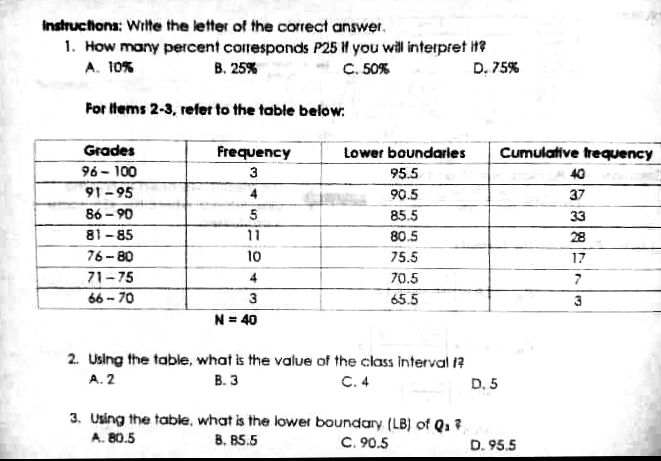
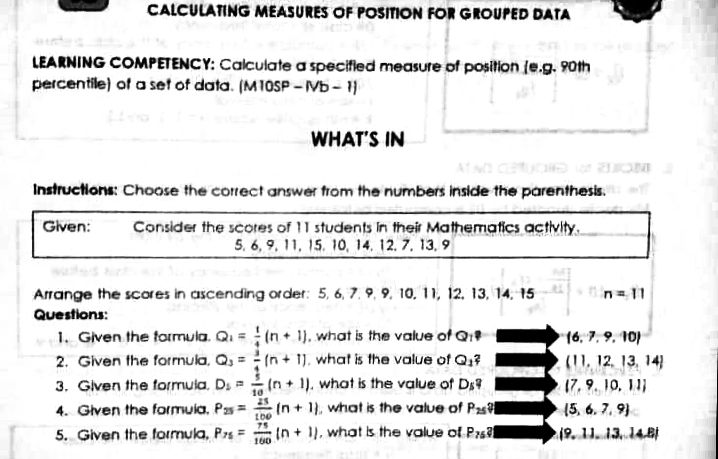
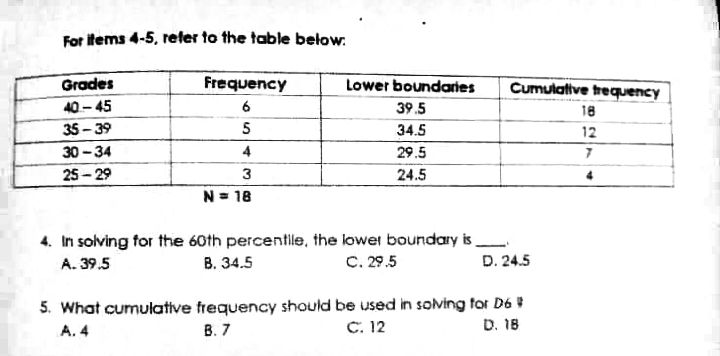
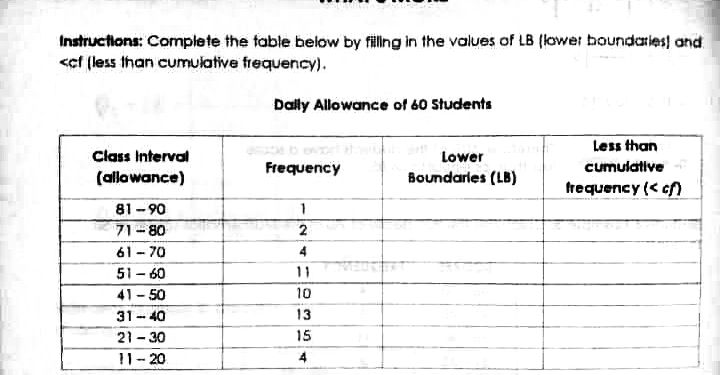
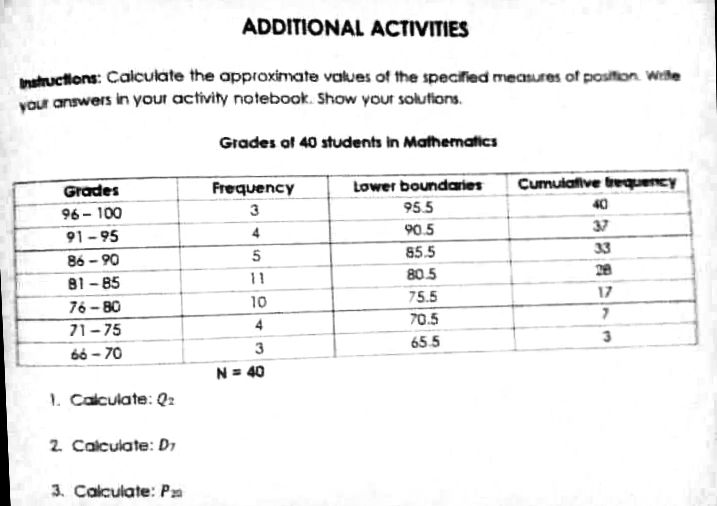
Instructions: Write the letter of the correct answer. 1. How many percent corresponds P25 If you will interpret it? A. 10% B. 25% C. 50% D. 75% For Items 2-3, refer to the table below. Grades Frequency Lower boundaries Cumulative frequency 96 - 100 3 95.5 & 40 91 -95 90.5 37 86 -90 5 85.5 33 81 -85 11 80.5 28 76 -80 10 75.5 17 71-75 70.5 66-70 3 65.5 N = 40 2. Using the table, what is the value of the class Interval /? A. 2 B. 3 C. 4 D. 5 3. Using the table, what is the lower boundary (LB) of Q, # A. 80.5 B. 85.5 C. 90.5 D. 95.5CALCULATING MEASURES OF POSITION FOR GROUPED DATA LEARNING COMPETENCY: Calculate a specified measure of position fe.g. 90th percentile) of a set of data. (MIOSP -IVD - 1] WHAT'S IN Instructions: Choose the correct answer from the numbers inside the parenthesis. Given: Consider the scores of 11 students In their Mathematics activity, 5. 6, 9. 11. 15. 10, 14. 12. 7. 13, 9 Arrange the scores in ascending order: 5, 6, 7. 9, 9, 10, 11, 12, 13, 14, 15 .In = |1 Questions: 1. Given the formula. Q. = : (n + 1). what is the value of Qif (6, 7. 9. 101 2. Given the formula, Q, = = (n + 1). what is the value of Q.7 (1 1, 12, 13, 14) 3. Given the formula, Dj = (n + 1). what is the value of D:$ (7, 9. 10, 11] 4. Given the formula, Pa = (n + 1), what is the value of Past (5, 6. 7. 9) 75 5. Given the formula, Prs = 100 (n + 1), what is the value of Pis. 19. 11. 13, 14.8/For items 4-5, refer to the table below. Grades Frequency Lower boundaries Cumulative frequency 40 - 45 6 39.5 18 35 - 39 5 34.5 12 30 -34 4 29.5 7 25- 29 3 24.5 N = 18 4. In solving for the 60th percentile, the lower boundary is A. 39.5 B. 34.5 C. 29.5 D. 24.5 5. What cumulative frequency should be used in solving for D6 # A. 4 B. 7 C. 12 D. 18Instructions: Complete the table below by filling in the values of LB (lower boundaries) and
Step by Step Solution
There are 3 Steps involved in it

Get step-by-step solutions from verified subject matter experts