







Question: COMPOUND INTEREST Use I = (P x (1 + R/N)NT) - P and A = (P x (1 + R/N)NT) to solve these compound interest
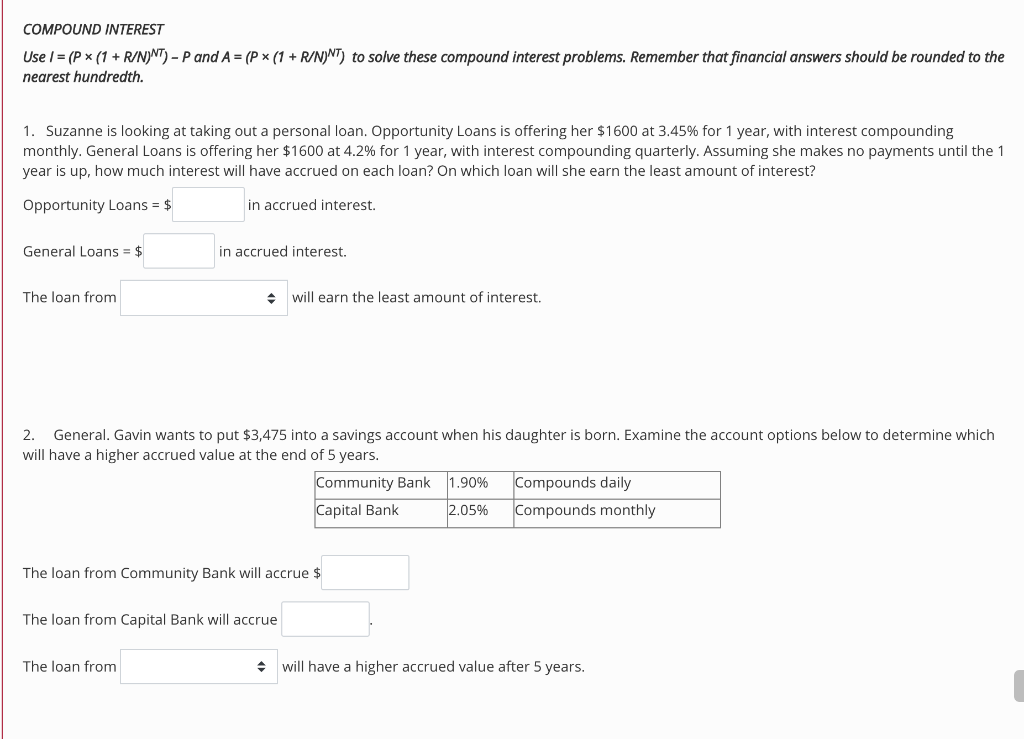
COMPOUND INTEREST Use I = (P x (1 + R/N)NT) - P and A = (P x (1 + R/N)NT) to solve these compound interest problems. Remember that financial answers should be rounded to the nearest hundredth. 1. Suzanne is looking at taking out a personal loan. Opportunity Loans is offering her $1600 at 3.45% for 1 year, with interest compounding monthly. General Loans is offering her $1600 at 4.2% for 1 year, with interest compounding quarterly. Assuming she makes no payments until the 1 year is up, how much interest will have accrued on each loan? On which loan will she earn the least amount of interest? Opportunity Loans = $ in accrued interest. General Loans = $ in accrued interest. The loan from will earn the least amount of interest. 2. General. Gavin wants to put $3,475 into a savings account when his daughter is born. Examine the account options below to determine which will have a higher accrued value at the end of 5 years. Community Bank 1.90% Compounds daily Capital Bank 2.05% Compounds monthly The loan from Community Bank will accrue $ The loan from Capital Bank will accrue The loan from will have a higher accrued value after 5 years
Step by Step Solution
There are 3 Steps involved in it

Get step-by-step solutions from verified subject matter experts
 Study Help