







Question: Computational and Application Exercises 1. Write the first three terms of the following sequences assuming a, will be the first term. a) an = 3n-5
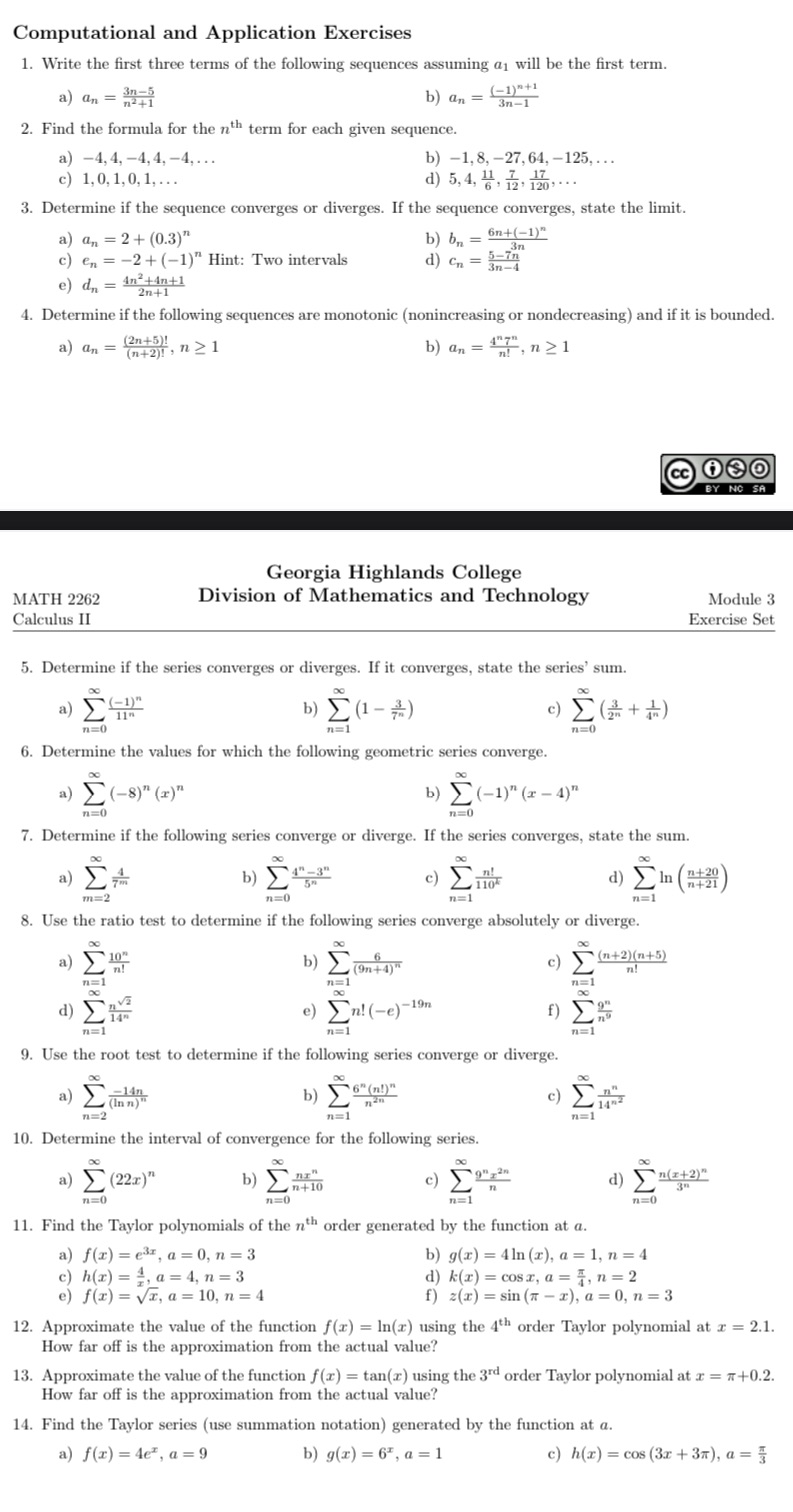
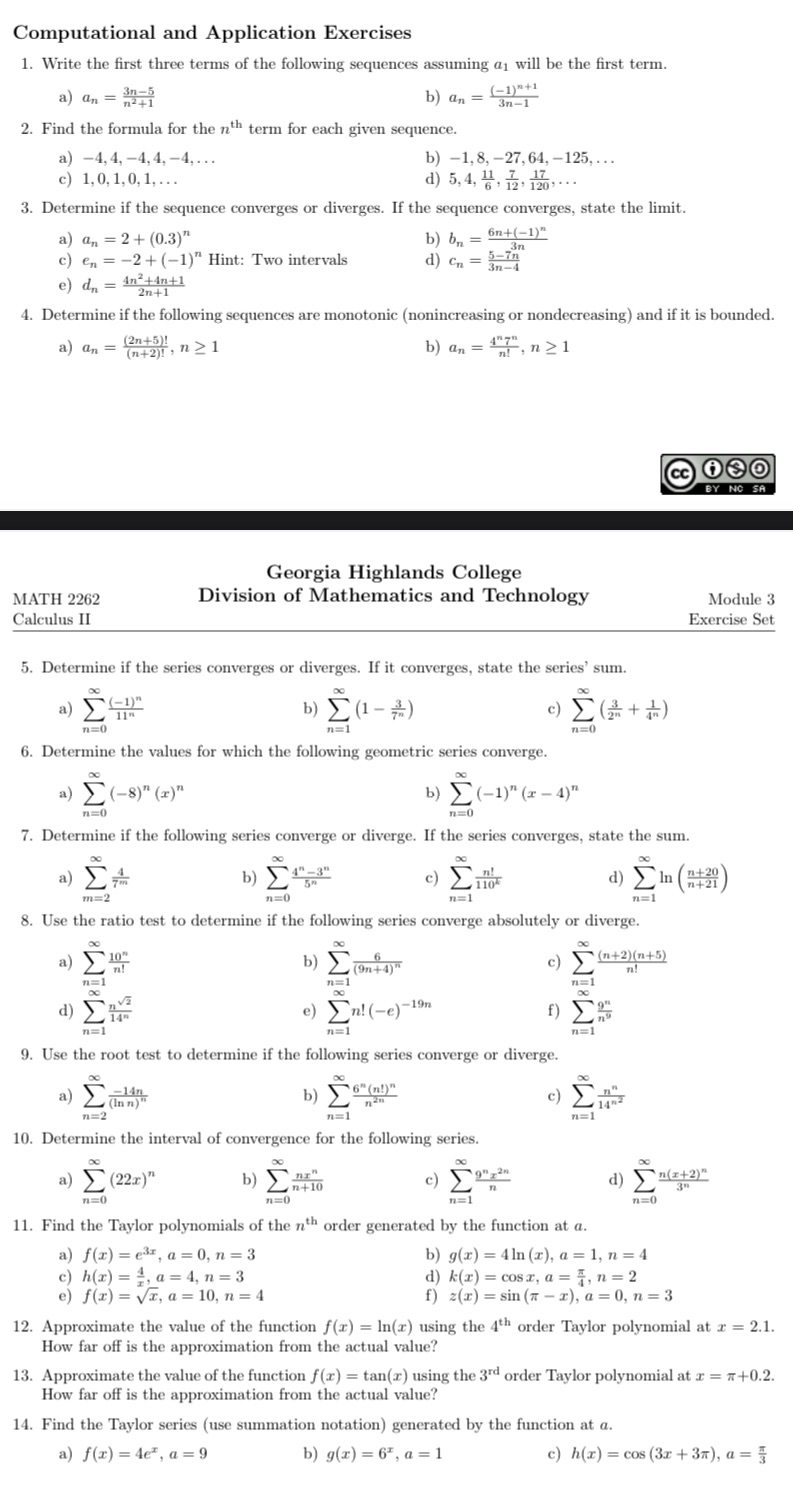
Computational and Application Exercises 1. Write the first three terms of the following sequences assuming a, will be the first term. a) an = 3n-5 b) an = [-it 3n-1 2. Find the formula for the nth term for each given sequence. a) -4,4, -4,4, -4, ... b) -1,8, -27, 64, -125, ... c) 1, 0, 1, 0, 1, ... d) 5,4, 11 6' 12: 120'. . . 3. Determine if the sequence converges or diverges. If the sequence converges, state the limit. a) an = 2 + (0.3)" b) b = 6n+(-1)" 3n c) en = -2+ (-1)" Hint: Two intervals d) Cn = =7n 3n-4 e) d, = in' 4 4n+1 2n+1 4. Determine if the following sequences are monotonic (nonincreasing or nondecreasing) and if it is bounded. a) an = (2n+5)1 (n+2)1 , n > 1 b) an = 17, n21 BY NO SA Georgia Highlands College MATH 2262 Division of Mathematics and Technology Module 3 Calculus II Exercise Set 5. Determine if the series converges or diverges. If it converges, state the series' sum. a) (-i" 11" b) E (1 - #) n=0 n=1 n=0 6. Determine the values for which the following geometric series converge. a) [ (-8)" (x)" b) (-1)" ( 2 -4)" n=0 2=0 7. Determine if the following series converge or diverge. If the series converges, state the sum. a) b) 4" -3" c ) d) In n+20 n=0 n=1 n=1 8. Use the ratio test to determine if the following series converge absolutely or diverge. a) 10" n! b) (On+4) " c) (n+2)(n+5) n! n=1 d) M 145 e) En!(-e)-19n f) n=1 n=1 n=1 9. Use the root test to determine if the following series converge or diverge. a) -14n b) [' 6" (n!)" (In n)" c) S n=2 n=1 n=1 10. Determine the interval of convergence for the following series. a) > (221)" b) [ a" c) "in Sn(z+2)" n+10 d) n=0 n=0 n=1 71=0 11. Find the Taylor polynomials of the nth order generated by the function at a. a) f(z) = 3z, a = 0, n = 3 b) g(x) = 4In (x), a = 1, n = 4 c) h(x) = =, a = 4, n = 3 d) k(x) = cosm, a = $, n = 2 e) f(x) = Vx, a = 10, n = 4 f) z(x) = sin (7 - x), a =0, n = 3 12. Approximate the value of the function f(x) = In(x) using the 4th order Taylor polynomial at z = 2.1. How far off is the approximation from the actual value? 13. Approximate the value of the function f(x) = tan(x) using the 3"d order Taylor polynomial at a = * +0.2. How far off is the approximation from the actual value? 14. Find the Taylor series (use summation notation) generated by the function at a. a) f(x) = 4e, a =9 b) g(z) = 67, a = 1 c) h(x) = cos (3x + 37), a =
Step by Step Solution
There are 3 Steps involved in it

Get step-by-step solutions from verified subject matter experts
 Study Help