







Question: Computer organization and architecture question plz solve both sides and each question. Homework Set 1 1.1 Convert the following binary numbers to decimal number: a)
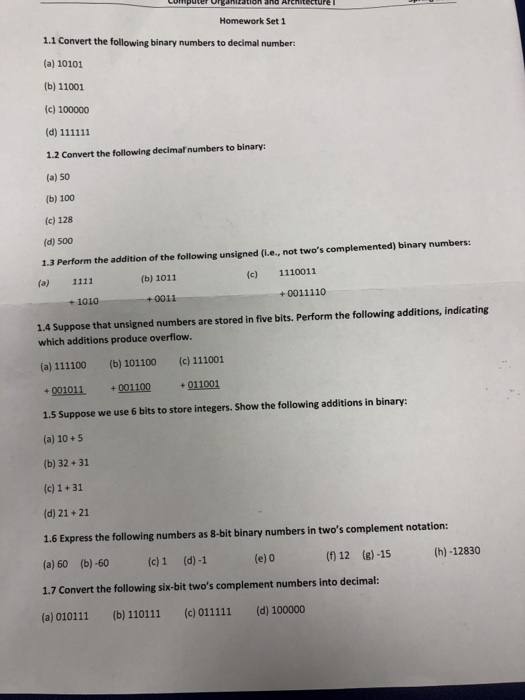
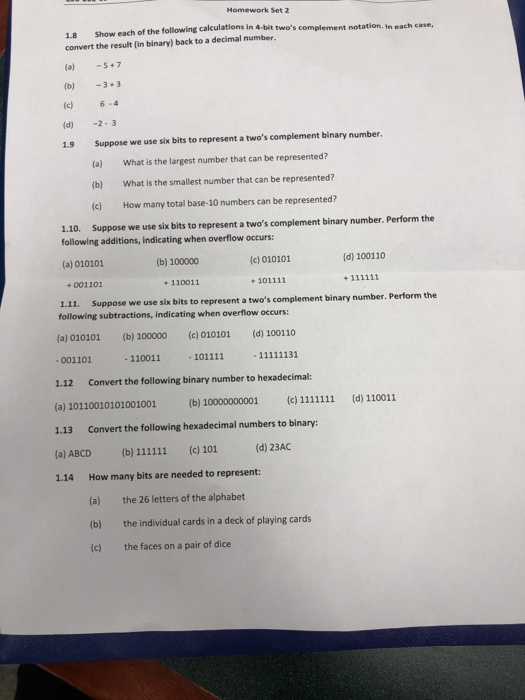
Homework Set 1 1.1 Convert the following binary numbers to decimal number: a) 10101 (b) 11001 (c) 100000 1.2 Convert the following decimar numbers to binary (a) 50 (b) 100 (c) 128 (d) 500 1.3 Perform the addition of the following unsigned (i.e., not two's complemented) binary numbers (a) 1111 (b) 1011 (c) 1110011 +1010 +0011 +0011110 1.4 Suppose that unsigned numbers are stored in five bits. Perform the following additions, indicating which additions produce overflow (a) 111100 (b) 101100 (c) 111001 001011+001100 011001 1.5 Suppose we use 6 bits to store integers. Show the following additions in binary: (a) 10+5 (b) 32+31 (c) 1+31 (d) 21+ 21 1.6 Express the following numbers as 8-bit binary numbers in two's complement notation (a) 60 (b)-60 (c)1 (d)-1 (e) o (0) 12 (8) -15 (h) -12830 1.7 Convert the following six-bit two's complement numbers into decimal: Homework Set 2 1.8 Show each of the following 4-bit two's convert the result (in binary) back to a decimal number (a) +7 (b) 3+3 (c) 6-4 (d) -2-3 1.9 Suppose we use six bits to represent a two's complement binary number calculations in 4-bit two's complement notation, In each case (a) (b) (c) Suppose we use six bits to represent a two's complement binary number. Perform the What is the largest number that can be represented? What is the smallest number that can be represented? How many total base-10 numbers can be represented? 1.10. following additions, indicating when overflow occurs (a) 010101 b) 100000 (c) 010101 (d) 100110 +001101 1.11. Suppose we use six bits to represent a two's complement binary number. Perform the following subtractions, indicating when overflow occurs (a) 010101 (b) 100000(c) 010101(d) 100110 001101 *110011 * 101111 - 110011 - 101111 1.12 Convert the following binary number to hexadecimal: (a) 10110010101001001 (b) 10000000001 (c) 1111111 1.13 Convert the following hexadecimal numbers to binary: (d) 110011 (d) 23AC How many bits are needed to represent: (a) the 26 letters of the alphabet (b) the individual cards in a deck of playing cards c) the faces on a pair of dice 1.14
Step by Step Solution
There are 3 Steps involved in it

Get step-by-step solutions from verified subject matter experts
 Study Help