







Question: Conduct a work analysis for the position wait staff at a local restaurant. This work analysis may benefit from interviewing incumbents (i.e, wait staff) as
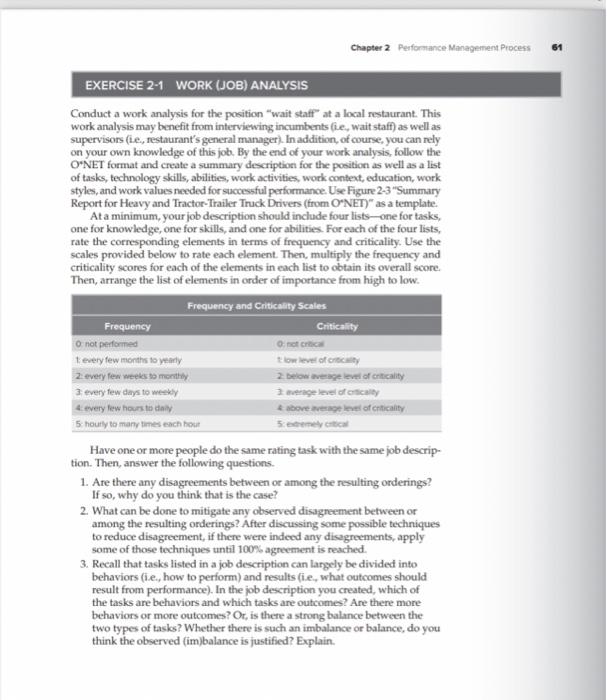
Conduct a work analysis for the position "wait staff" at a local restaurant. This work analysis may benefit from interviewing incumbents (i.e, wait staff) as well as supervisors (Le., restaurant's general manager). In addition, of course, you can rely on your own knowledge of this job. By the end of your work analysis, follow the O NET format and create a summary description for the position as well as a list of tasks, technology skills, abilities, work activities, work contedt, education, work styles, and work values needed for successful performance. Use Figure 2-3 "Summary Report for Heavy and Tractor-Trailer Truck Drivers (from O+NET as a template. At a minimum, your job description should include four lists-one for tasks, one for knowledge, one for skills, and one for abilities. For each of the four lists, rate the corresponding elements in terms of frequency and criticality. Use the scales prowided below to rate each element. Then, multiply the frequency and criticality scores for each of the elements in each list to obtain its overall score. Then, arrange the list of elements in order of importance from high to low. Have one or more people do the same rating task with the same job description. Then, answer the following questions. 1. Are there any disagreements between or among the resulting orderings? If so, why do you think that is the case? 2. What can be done to mitigate any observed disagreement between or among the resulting onderings? After discussing some possible techniques to reduce disagreement, if there were indeed any disagreements, apply some of those techniques until 100% s agreement is reached. 3. Recall that tasks listed in a job description can largely be divided into behaviors (i.e., how to perform) and results (i.e., what outcomes should result from performance). In the job description you created, which of the tasks are behaviors and which tasks are outcomes? Are there more behaviors or more outcomes? Or, is there a strong balance between the two types of tasks? Whether there is such an imbalance or balance, do you think the observed (im)balance is justified? Explain
Step by Step Solution
There are 3 Steps involved in it

Get step-by-step solutions from verified subject matter experts
 Study Help