Question: Conflicts are unavoidable in projects. What are potential conflicts in the Dam project (Dam Project from Textbook Project -Meredith.pdf). What are their possible causes? What
Conflicts are unavoidable in projects. What are potential conflicts in the Dam project (Dam Project from Textbook Project -Meredith.pdf). What are their possible causes? What are their potential impacts? Which action can a PM take to resolve those conflicts?
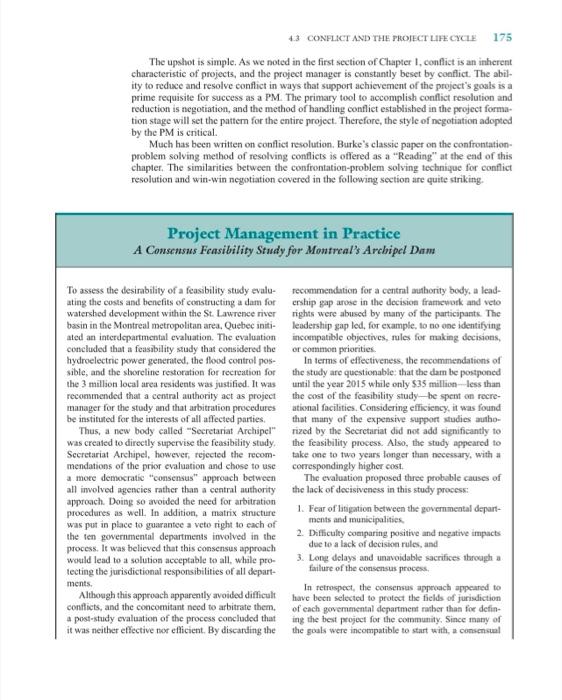
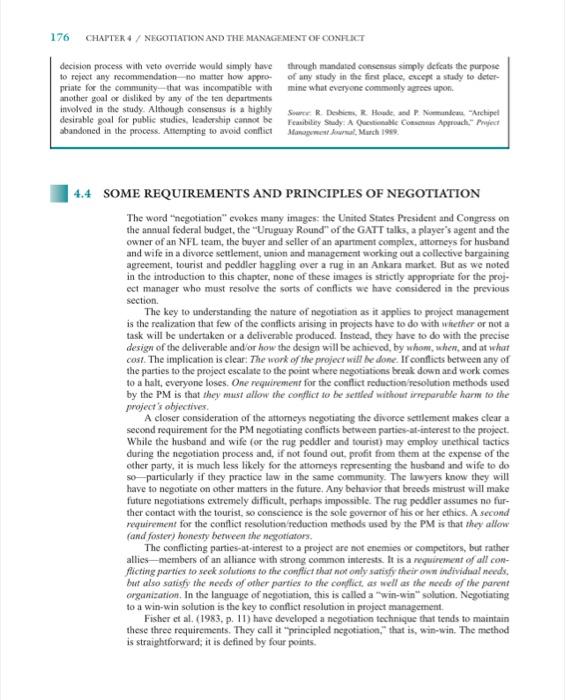
4.3 CONFLCT AND THE PHONCT LHECYCIE 175 The upshot is simple. As we noted in the first section of Chapser 1 , conflict is an inherent characteristic of projects, and the project manager is constantly beset by conflict. The ability to reduce and resolve conflict in ways that support achievement of the project's goals is a prime requisite for success as a PM. The primary tool to accomplish conflict resolution and reduction is negotiation, and the method of handling conflict established in the project formation stage will set the pattern for the entire project. Therefore, the style of negotiation adopted by the PM is critical. Much has been written on conflict resolution. Burke's classic paper on the confrontationproblem solving method of resolving conflicts is offered as a "Reading" at the end of this chapter. The similarities between the confrontation-problem solving technique for conflict resolution and win-win negotiation covered in the following section are quite striking. Project Management in Practice A Consensus Foasilility Study for Montreal's Archipcl Dam 176 CHAITEK 4 NECOTIATIONAND THE MANAGEMINT OF CONHBCT 4.4 SOME REQUIREMENTS AND PRINCIPLES OF NEGOTIATION The word "ncgotiation" evokes many images: the United States President and Congress on the annual federal budget, the "Uruguay Round" of the G.MTT talks, a player"s agent and the owner of an NFL team, the buyer and seller of an apariment consplex, attorneys for husband and wife in a divorce settlement, union and management working out a collective bargaining agreement, tourist and peddler haggling over a rag in an Ankara market. But as we noted in the introduction to this chapter, none of these images is strictly appropriate for the project manager who mast resolve the sorts of conflicts we have considered in the previous section. The key to understanding the nature of negotiation as it applies to project management is the realization that few of the conflicts arising in projects have to do with wiether or not a task will be undertaken or a deliverable produced. Instead, they have to do with the precise design of the deliverable andior how the design will be achicved, by whom, when, and at what cast. The implication is clear: The work of the project will be done. If conflicts between any of the parties to the project escalate to the point where negotiations becak denn and work comes to a halt, everyone loses. One negainement for the coaflict reduction resolution methods ased by the PM is that they maest allow the conflict to be setted without irreparable harm fo the poject's abjectives. A closer consideration of the atiomeys negotiating the divorce setnlement makes clear a second requirement for the PM negotiating conflicts betwecn parties-at-interest to the project. While the husband and wife (or the rug peddler and tourist) may employ unethical tactics during the negotiation process and, if not found out, profit from them at the expense of the other party, it is much less likely for the attorneys representing the husband and wife to do so-particularly if they practice law in the same conmunity. The lawyers know they will have to negotiate on other matters in the future. Any behavior that breeds mistrest will make future negotiations extremely difficult, perhags impossible. The rug peddler assumes no further contact with the tourist, so conscience is the sole governor of his or her cthics. A second wequirement for the conflict resolution'reduction methods used by the PM is that they aflow (and foster) honesty berween the necatiators. The conflicting parties-at-interest to a project are not enemies of competitoss, but rather allies-members of an alliance with strong common interests. It is a nequirememt of all conficting parties to seek solutions to the confict that not only satisfy their owm individual mecdly, but also sarisfy the needs of other parties to the conflict, as anell as the needs of the parent arganizarion, In the language of negotiution, this is called a "win-win " solution. Negotiating to a win-wia solution is the key to conflict resolution in project management. Fisher et al, (1983, p. 11) have developed a negotiation fechnique that tends to maintain these three requirements. They call it "principled negotiation," that is, win-win. The method is straightforward; it is defined by four points









 Study Help