







Question: Consider a 12-bit floating-point representation based on the IEEE floating-point format, with one sign bit, 5 exponent bits and 6 fraction bits. The exponent bias
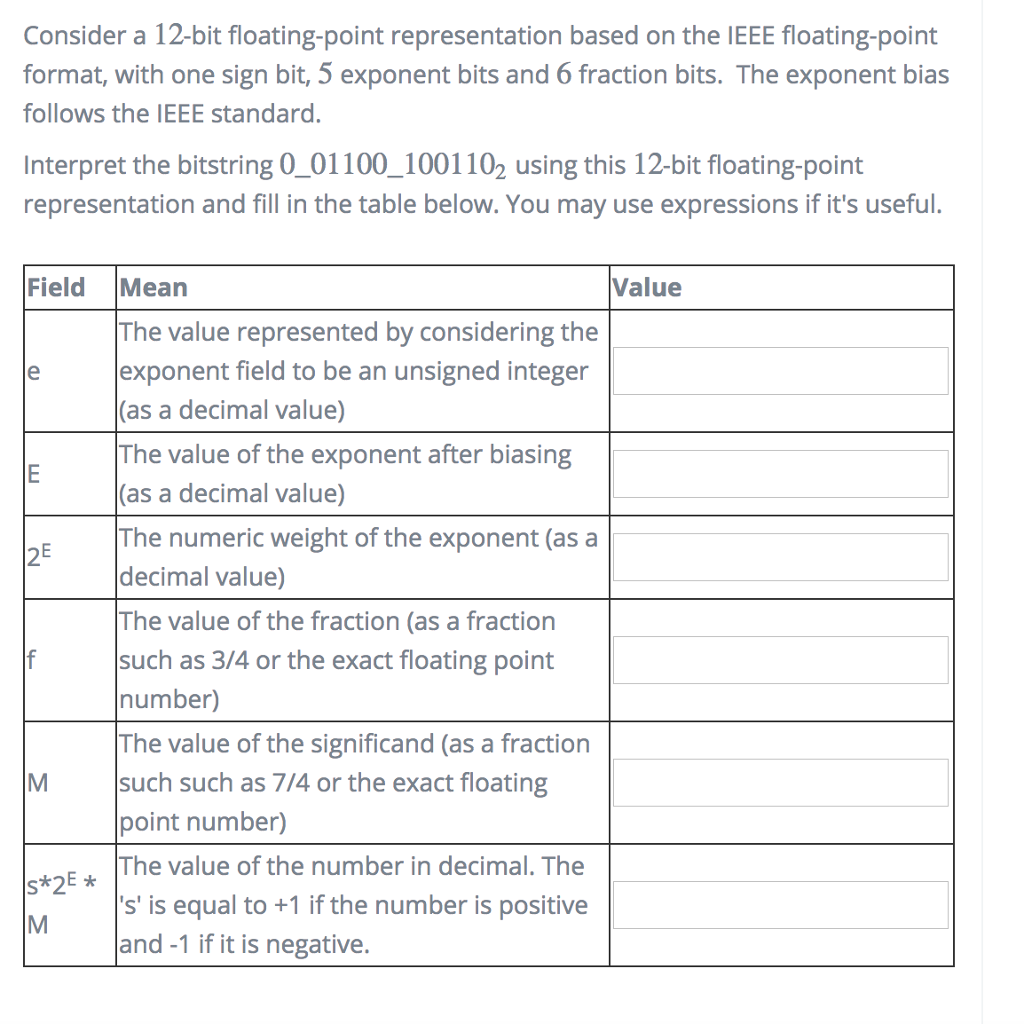
Consider a 12-bit floating-point representation based on the IEEE floating-point format, with one sign bit, 5 exponent bits and 6 fraction bits. The exponent bias follows the IEEE standard. Interpret the bitstring 0_01100_1001102 using this 12-bit floating-point representation and fill in the table below. You may use expressions if it's useful. Field Mean Value The value represented by considering the exponent field to be an unsigned integer (as a decimal value) The value of the exponent after biasing (as a decimal value) The numeric weight of the exponent (as a decimal value The value of the fraction (as a fraction such as 3/4 or the exact floating point number) The value of the significand (as a fraction such such as 7/4 or the exact floating point number) The value of the number in decimal. The s' is equal to +1 if the number is positive and -1 if it is negative. 2 s*2*
Step by Step Solution
There are 3 Steps involved in it

Get step-by-step solutions from verified subject matter experts
 Study Help