







Question: Consider a 9-bit floating-point representation based on the IEEE floating-point format, with one sign bit, four exponent bits (k 4). and four fraction bits (n-4).
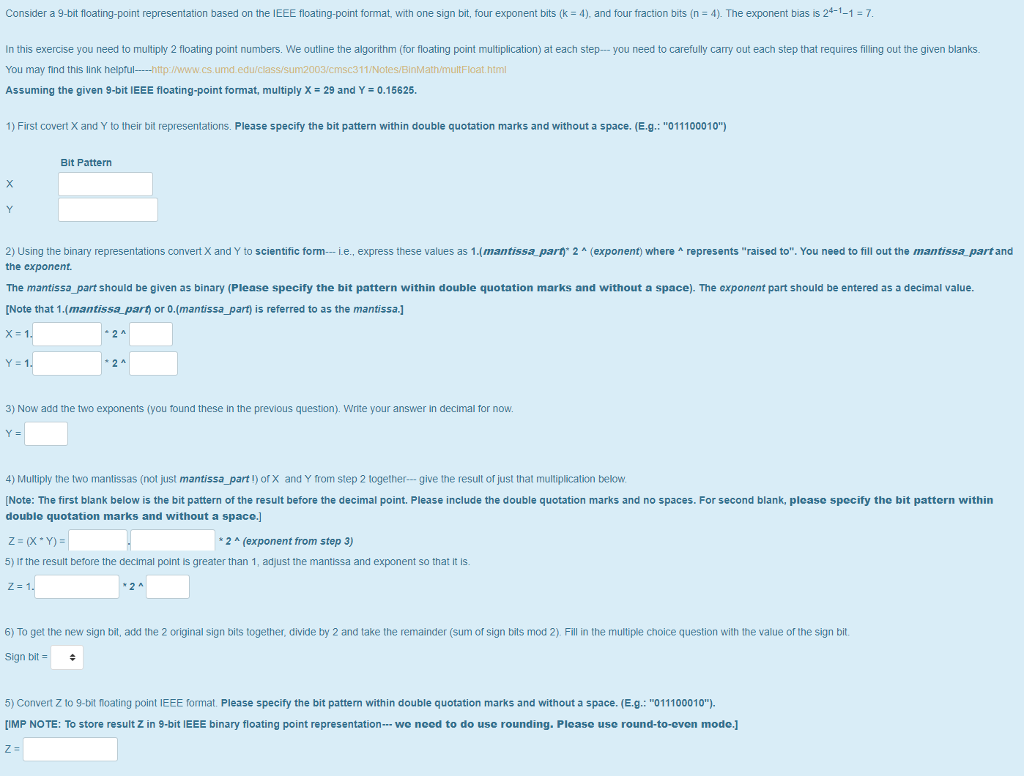
Consider a 9-bit floating-point representation based on the IEEE floating-point format, with one sign bit, four exponent bits (k 4). and four fraction bits (n-4). The exponent bias is 24-1-17 In this exercise you need to multiply 2 floating point numbers. We outline the algorithm (for floating point multiplication) at each step-you need to carefully carry out each step that requires filling out the given blanks. You may find this link Assuming the given 9-bit IEEE floating-point format, multiply X = 29 and Y 0.15625. www.cs umd 311/Notes/BinMath/multFloat. htm 1) First covert X and Y to their bit representations. Please specify the bit pattern within double quotation marks and without a space. (E.g "011100010") Bit Pattern 2) Using the binary representations convert X and Y to scientific fom Le, express these values as 1.(mantissa par2 "(exponent) where ^ represents "raised to". You need to fill out the mantissa part and the exponent. The mantissa part should be given as binary (Please specify the bit pattern within double quotation marks and without a space). The exponent part should be entered as a decimal value [Note that 1.(mantissa part or 0.(mantissa _part) is referred to as the mantissa.] 3) Now add the two exponents (you found these in the previous question). Write your answer in decimal for now 4) Multiply the two mantissas (not just mantissa part !) orx and Y from step 2 togethergive the result of just that multiplication below [Note: The first blank below is the bit pattern of the result before the decimal point. Please include the double quotation marks and no spaces. For second blank, please specify the bit pattern within double quotation marks and without a space.] 2 (exponent from step 3) 5) If the result before the decimal point is greater than 1, adjust the mantissa and exponent so that it is. 2 A 6) To get the new sign bit, add the 2 original sign bits together, divide by 2 and take the remainder (sum of sign bits mod 2). Fill in the multiple choice question with the value of the sign bit Sign bit 5) Convert Z to 9-bit oating point IEEE format. Please specify the bit pattern within double quotation marks and without a space. (E.g.: "011100010") [IMP NOTE: To store result Z in 9-bit IEEE binary floating point representation we need to do use rounding. Please use round-to-even mode.]
Step by Step Solution
There are 3 Steps involved in it

Get step-by-step solutions from verified subject matter experts
 Study Help