



Question: Consider a city with three consumers: 1, 2, and 3. The city provides park land for the enjoyment of its residents. Parks are a public
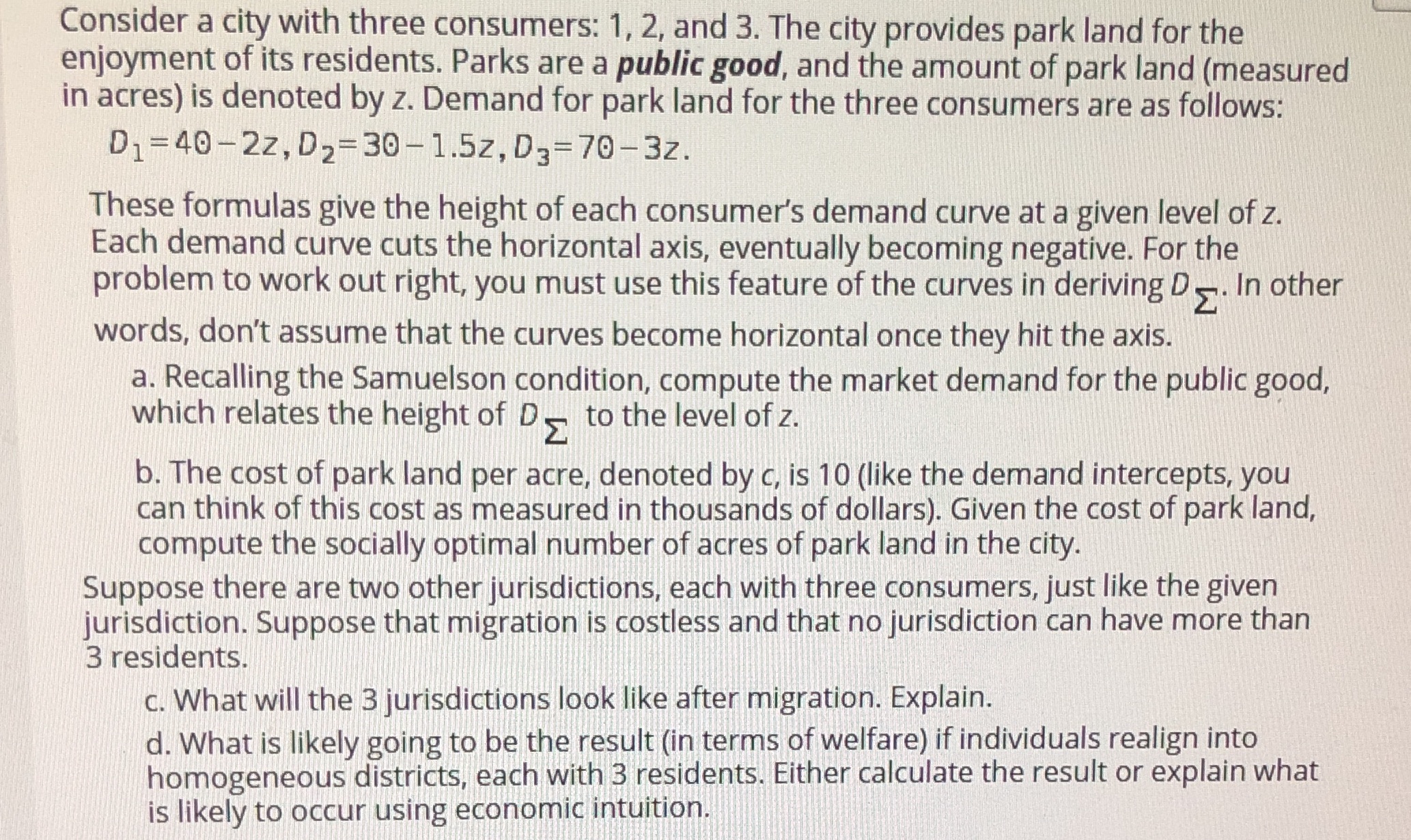
Consider a city with three consumers: 1, 2, and 3. The city provides park land for the enjoyment of its residents. Parks are a public good, and the amount of park land (measured in acres) is denoted by z. Demand for park land for the three consumers are as follows: D1 =40-2z, D2=30-1.5z, D3=70-3z. These formulas give the height of each consumer's demand curve at a given level of z. Each demand curve cuts the horizontal axis, eventually becoming negative. For the problem to work out right, you must use this feature of the curves in deriving D . In other words, don't assume that the curves become horizontal once they hit the axis. a. Recalling the Samuelson condition, compute the market demand for the public good, which relates the height of D, to the level of z. b. The cost of park land per acre, denoted by c, is 10 (like the demand intercepts, you can think of this cost as measured in thousands of dollars). Given the cost of park land, compute the socially optimal number of acres of park land in the city. Suppose there are two other jurisdictions, each with three consumers, just like the given jurisdiction. Suppose that migration is costless and that no jurisdiction can have more than 3 residents. c. What will the 3 jurisdictions look like after migration. Explain. d. What is likely going to be the result (in terms of welfare) if individuals realign into homogeneous districts, each with 3 residents. Either calculate the result or explain what is likely to occur using economic intuition
Step by Step Solution
There are 3 Steps involved in it

Get step-by-step solutions from verified subject matter experts