







Question: Consider a classical Simple Harmonic Oscillator, as defined in the course notes, that consists of a frictionless particle of mass of m bound by a
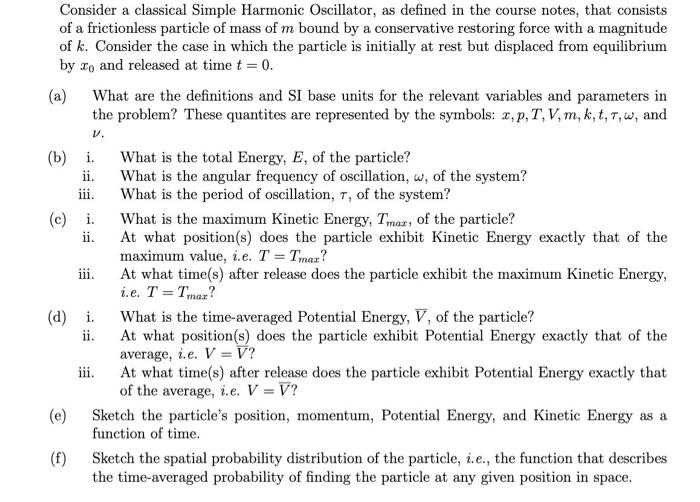
Consider a classical Simple Harmonic Oscillator, as defined in the course notes, that consists of a frictionless particle of mass of m bound by a conservative restoring force with a magnitude of k. Consider the case in which the particle is initially at rest but displaced from equilibrium by x0 and released at time t=0. (a) What are the definitions and SI base units for the relevant variables and parameters in the problem? These quantites are represented by the symbols: x,p,T,V,m,k,t,,, and . (b) i. What is the total Energy, E, of the particle? ii. What is the angular frequency of oscillation, , of the system? iii. What is the period of oscillation, , of the system? (c) i. What is the maximum Kinetic Energy, Tmax, of the particle? ii. At what position(s) does the particle exhibit Kinetic Energy exactly that of the maximum value, i.e. T=Tmax ? iii. At what time(s) after release does the particle exhibit the maximum Kinetic Energy, i.e. T=Tmax ? (d) i. What is the time-averaged Potential Energy, V, of the particle? ii. At what position(s) does the particle exhibit Potential Energy exactly that of the average, i.e. V=V ? iii. At what time(s) after release does the particle exhibit Potential Energy exactly that of the average, i.e. V=V ? (e) Sketch the particle's position, momentum, Potential Energy, and Kinetic Energy as a function of time. (f) Sketch the spatial probability distribution of the particle, i.e., the function that describes the time-averaged probability of finding the particle at any given position in space
Step by Step Solution
There are 3 Steps involved in it

Get step-by-step solutions from verified subject matter experts
 Study Help