







Question: Consider a control system which has an open - loop transfer function equal to: G ( s ) H ( s ) = K (
Consider a control system which has an openloop transfer function equal to:
Determine the roots of the characteristic equation of the system and sketch the root locus indicate the roots for the gain
Is this system stable? Justify.
Determine the value of gain which will provide a damping ratio of
Assume that the system experiences a disturbance in set point, at equal to the delta function, defined by for and for What is the Laplace transform of
What is the corresponding openloop control system output, ie in transformed variable
Calculate the inverse Laplace transform of
Determine the time at which the output is maximum and draw a sketch depicting the variation of for in response to the disturbance in set point.
Bode, Nyquist & root locus plots
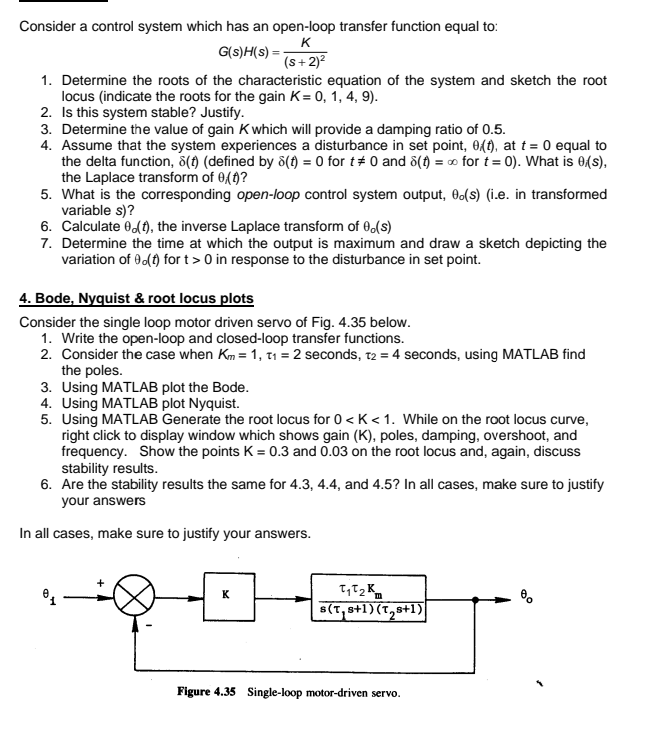
Consider the single loop motor driven servo of Fig. below.
Write the openloop and closedloop transfer functions.
Consider the case when seconds, seconds, using MATLAB find the poles.
Using MATLAB plot the Bode.
Using MATLAB plot Nyquist.
Using MATLAB Generate the root locus for While the root locus curve, right click display window which shows gain poles, damping, overshoot, and frequency. Show the points and the root locus and, again, discuss stability results.
Are the stability results the same for and all cases, make sure justify your answers
all cases, make sure justify your answers.
Step by Step Solution
There are 3 Steps involved in it
1 Expert Approved Answer
Step: 1 Unlock

Question Has Been Solved by an Expert!
Get step-by-step solutions from verified subject matter experts
Step: 2 Unlock
Step: 3 Unlock
 Study Help