







Question: Consider a financial model with two times, t = 0 and t = 1, and two stocks S and S that pay no dividends.
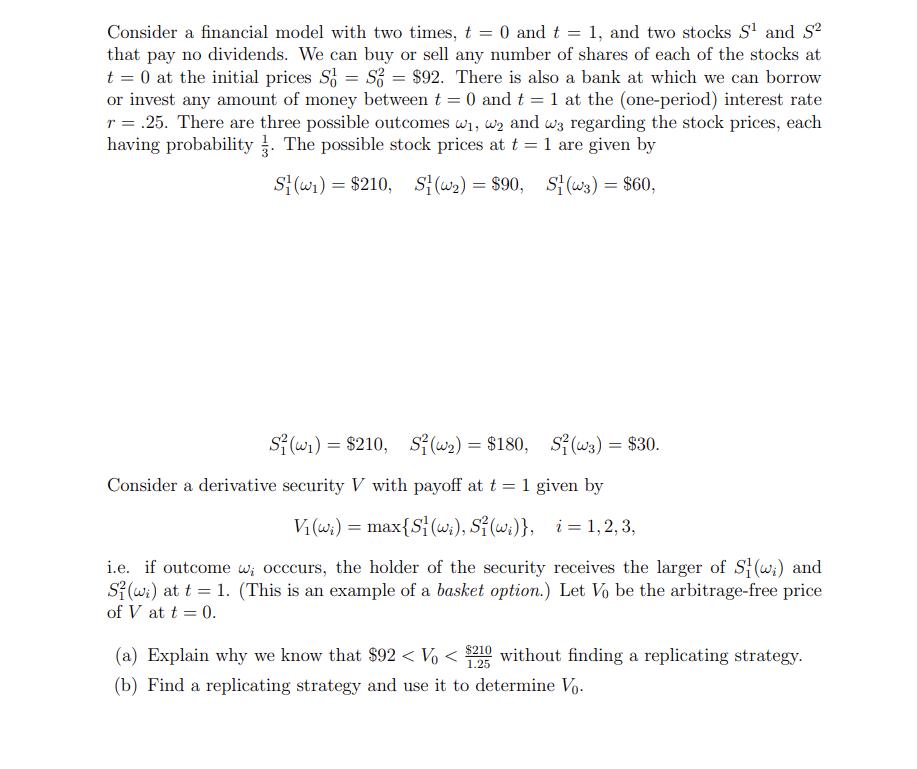
Consider a financial model with two times, t = 0 and t = 1, and two stocks S and S that pay no dividends. We can buy or sell any number of shares of each of the stocks at t = 0 at the initial prices S S = $92. There is also a bank at which we can borrow or invest any amount of money between t = 0 and t = 1 at the (one-period) interest rate r = .25. There are three possible outcomes w, and w regarding the stock prices, each having probability. The possible stock prices at t = 1 are given by S() $210, S (W) = $90, S (W3) = $60, = S() $210, S (W) = $180, S(w3) = $30. Consider a derivative security V with payoff at t = 1 given by V(wi) = max{S1 (wi), Si(wi)},i=1,2,3, i.e. if outcome w; occcurs, the holder of the security receives the larger of S(w) and S(w) at t= 1. (This is an example of a basket option.) Let Vo be the arbitrage-free price of V at t = 0. 1.25 (a) Explain why we know that $92 < Vo < $220 without finding a replicating strategy. (b) Find a replicating strategy and use it to determine Vo.
Step by Step Solution
3.50 Rating (160 Votes )
There are 3 Steps involved in it
a We can establish that 92 V0 210 without finding a replicating strategy by considering the possible ... View full answer

Get step-by-step solutions from verified subject matter experts
 Study Help