



Question: Consider a firm which produces a good, y , using two inputs or factors of production, x 1 and x 2. The firm's production function
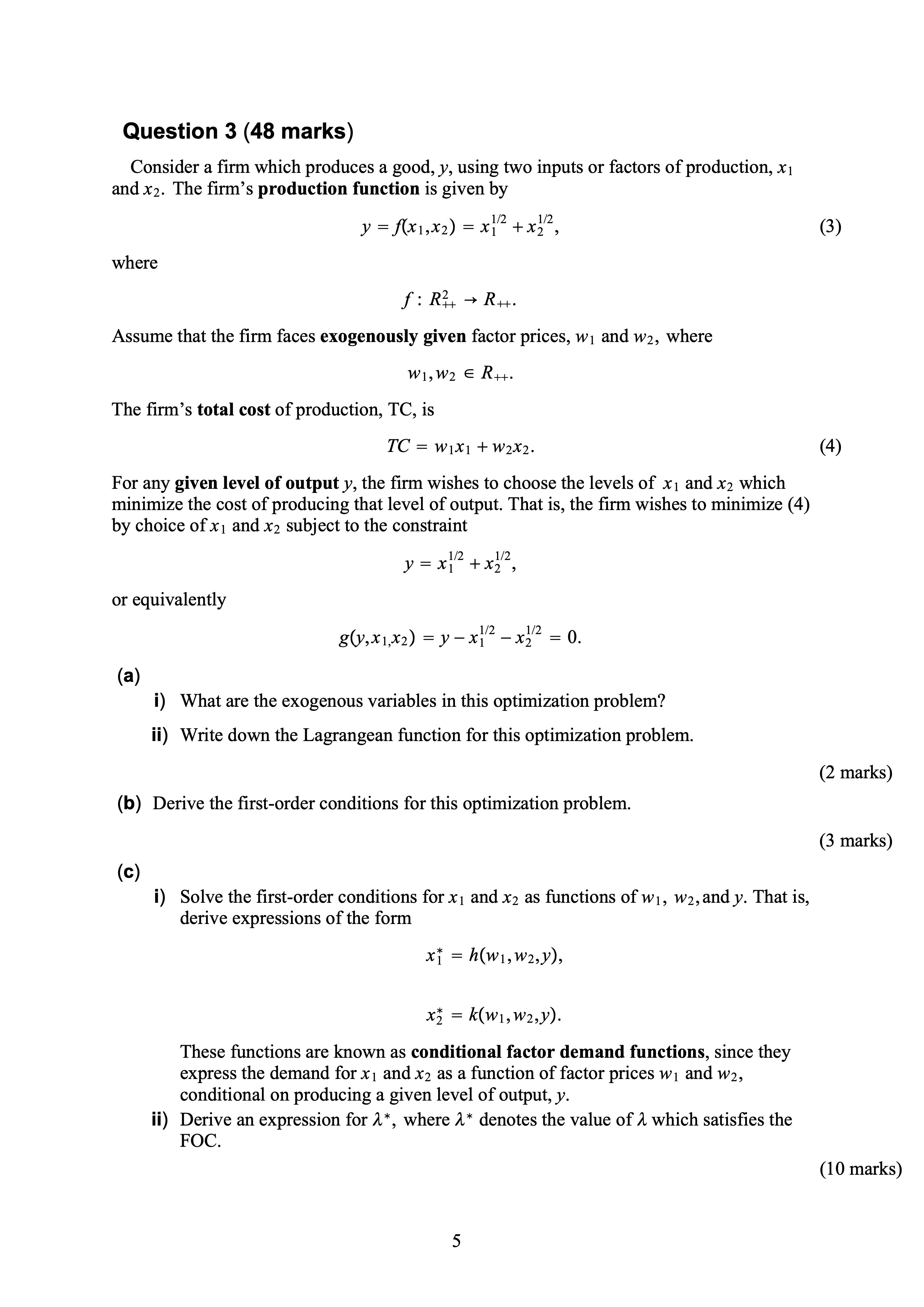
Consider a firm which produces a good, y, using two inputs or factors of production, x1 and x2. The firm's production function is given by
y=f(x1,x2)=x11/2+x21/2
where f: R2++->R++
Assume that the firm faces exogenously given factor prices, w1 and w2, where w1,w2 ? R++.
The firm's total cost of production, TC, is TC = w1x1 + w2x2. (4)
For any given level of output y, the firm wishes to choose the levels of x1 and x2 which minimize the cost of producing that level of output. That is, the firm wishes to minimize (4) by choice of x1 and x2 subject to the constraint y=x11/2+x21/2,
or equivalently g(y,x1,x2)=y?x11/2+x21/2=0.
(a)
i) What are the exogenous variables in this optimization problem?
ii) Write down the Lagrangean function for this optimization problem.
(b) Derive the first-order conditions for this optimization problem.
(c)
i) Solve the first-order conditions for x1 and x2 as functions of w1, w2,and y. That is, derive expressions of the form
x1*=h(w1, w2, y), x2*=k(w1, w2, y).
These functions are known as conditional factor demand functions, since they express the demand for x1 and x2 as a function of factor prices w1 and w2, conditional on producing a given level of output, y.
ii) Derive an expression for ?*, where ?* denotes the value of ? which satisfies the FOC.
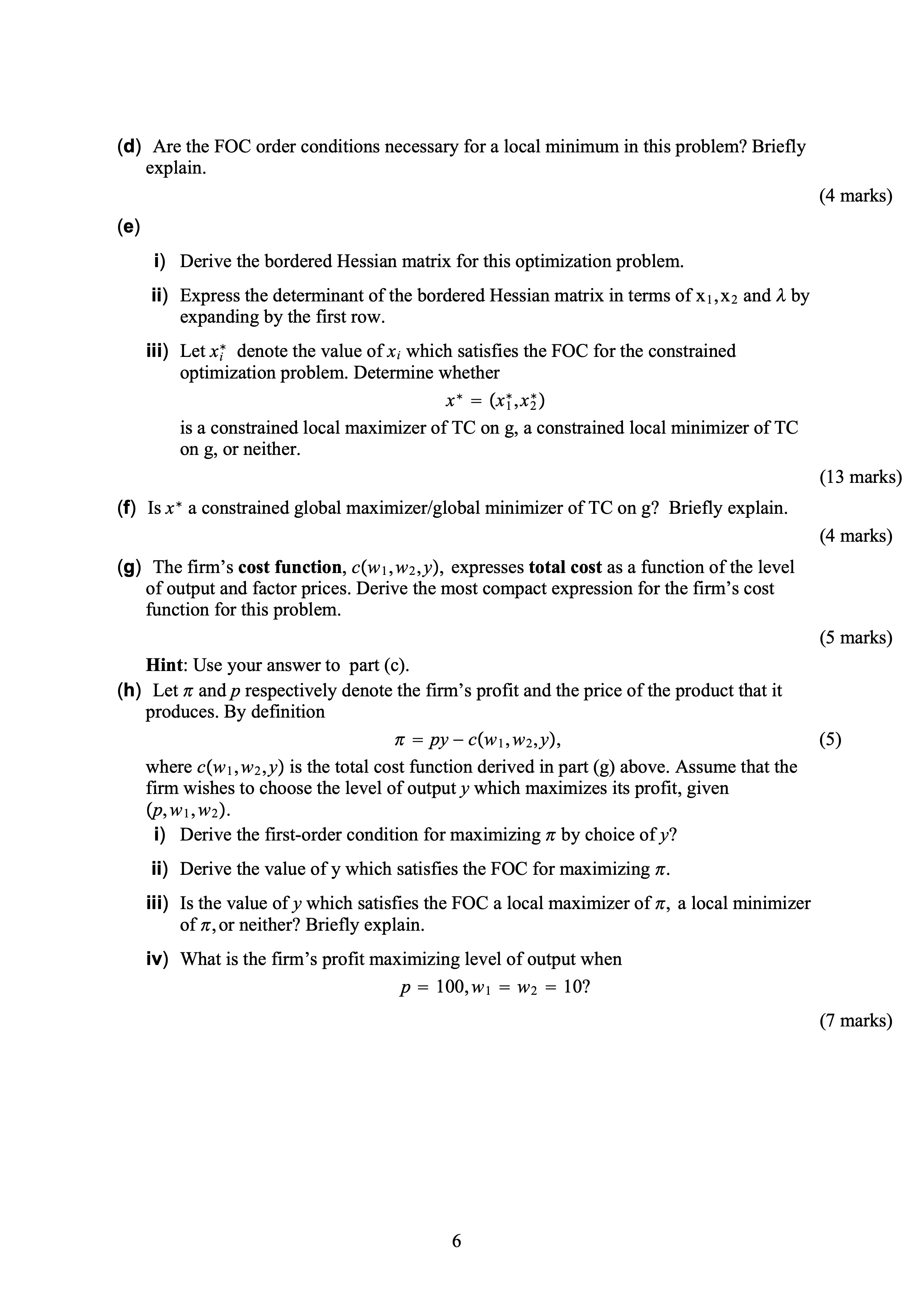
(d) Are the FOC order conditions necessary for a local minimum in this problem?Briefly explain.
(e)
i) Derive the bordered Hessian matrix for this optimization problem.
- ii)Express the determinant of the bordered Hessian matrix in terms of x1,x2 and ? by expanding by the first row.
- iii)Let xi* denote the value of xi which satisfies the FOC for the constrained optimization problem. Determine whetherx*=(x1*,x2*)
is a constrained local maximizer of TC on g, a constrained local minimizer of TC on g, or neither.
(f) Is x* a constrained global maximizer/global minimizer of TC on g? Briefly explain.
(g) The firm's cost function, c(w1,w2,y)_,expresses total cost as a function of the level of output and factor prices. Derive the most compact expression for the firm's cost function for this problem.
Hint: Use your answer to part (c).
(h) Let ? and p respectively denote the firm's profit and the price of the product that it produces. By definition?=py-c(w1,w2,y),
where c(w1,w2,y) is the total cost function derived in part (g) above. Assume that the firm wishes to choose the level of output y which maximizes its profit, given (p,w1,w2).
- i)Derive the first-order condition for maximizing ? by choice of y?
- ii)Derive the value of y which satisfies the FOC for maximizing ?.
- iii)Is the value of y which satisfies the FOC a local maximizer of ?, a local minimizer of ?, or neither? Briefly explain.
iv) What is the firm's profit maximizing level of output when p=100,w1 =w2 =10?
Question 3 (48 marks) Consider a firm which produces a good, y, using two inputs or factors of production, x 1 and x2. The firm's production function is given by y = f(x1, x2) = x12+x22, (3) where f : RH - R+. Assume that the firm faces exogenously given factor prices, w1 and w2, where W1 , W2 E R +. The firm's total cost of production, TC, is TC = WIX1 + W2x2. (4) For any given level of output y, the firm wishes to choose the levels of x1 and x2 which minimize the cost of producing that level of output. That is, the firm wishes to minimize (4) by choice of x 1 and x2 subject to the constraint *1/2 + x2 , y = x 1 or equivalently 8(V,x1, X2 ) = y -x1 2- x,2 = 0. (a) i) What are the exogenous variables in this optimization problem? ii) Write down the Lagrangean function for this optimization problem. (2 marks) (b) Derive the first-order conditions for this optimization problem. (3 marks) (c) i) Solve the first-order conditions for x 1 and x2 as functions of w1, w2, and y. That is, derive expressions of the form x1 = h(w1, w2,y), x2 = k(W1, w2,y). These functions are known as conditional factor demand functions, since they express the demand for x 1 and x2 as a function of factor prices w1 and w2, conditional on producing a given level of output, y. ii) Derive an expression for 1*, where a* denotes the value of 1 which satisfies the FOC. (10 marks) 5(d) Are the FOC order conditions necessary for a local minimum in this problem? Briefly explain. (4 marks) (e) i) Derive the bordered Hessian matrix for this optimization problem. i) Express the determinant of the bordered Hessian matrix in terms of x1, X2 and a by expanding by the first row. iii) Let x* denote the value of x; which satisfies the FOC for the constrained optimization problem. Determine whether x* = (x1, x2) is a constrained local maximizer of TC on g, a constrained local minimizer of TC on g, or neither. (13 marks) (f) Is x* a constrained global maximizer/global minimizer of TC on g? Briefly explain. (4 marks) (g) The firm's cost function, c(w1, w2, y), expresses total cost as a function of the level of output and factor prices. Derive the most compact expression for the firm's cost function for this problem. (5 marks) Hint: Use your answer to part (c). (h) Let it and p respectively denote the firm's profit and the price of the product that it produces. By definition It = Py - C(W1, W2,y), (5) where c(w1, w2,y) is the total cost function derived in part (g) above. Assume that the firm wishes to choose the level of output y which maximizes its profit, given (p, W1, W2). i) Derive the first-order condition for maximizing 7 by choice of y? ii) Derive the value of y which satisfies the FOC for maximizing . iii) Is the value of y which satisfies the FOC a local maximizer of 7, a local minimizer of n, or neither? Briefly explain. iv) What is the firm's profit maximizing level of output when p = 100, W1 = w2 = 10? (7 marks) 6
Step by Step Solution
There are 3 Steps involved in it

Get step-by-step solutions from verified subject matter experts