



Question: Consider a firm which produces a good, y, using two inputs or factors of production, x1 and x2. The firm's production function describes the mathematical
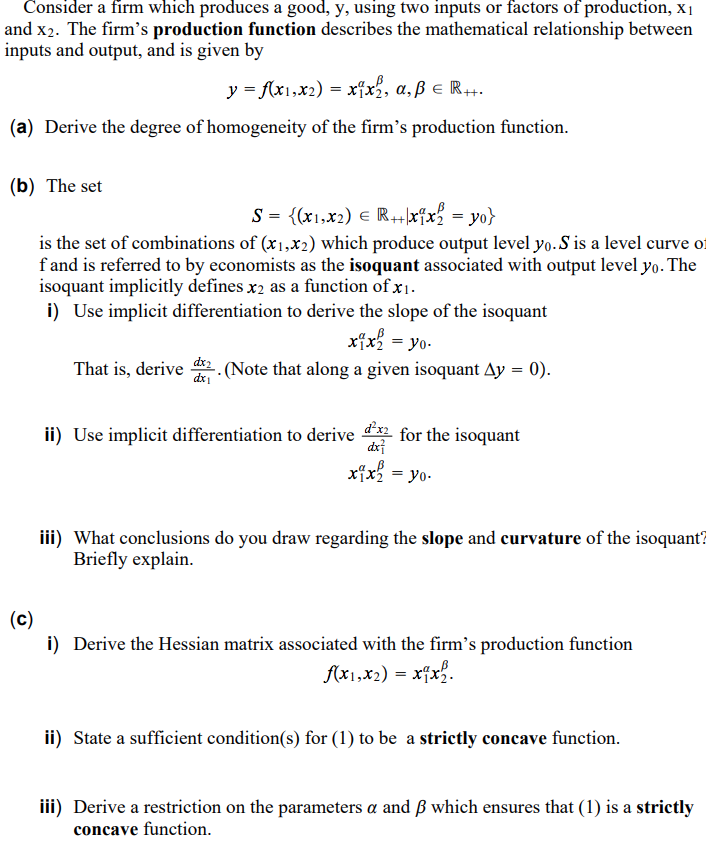
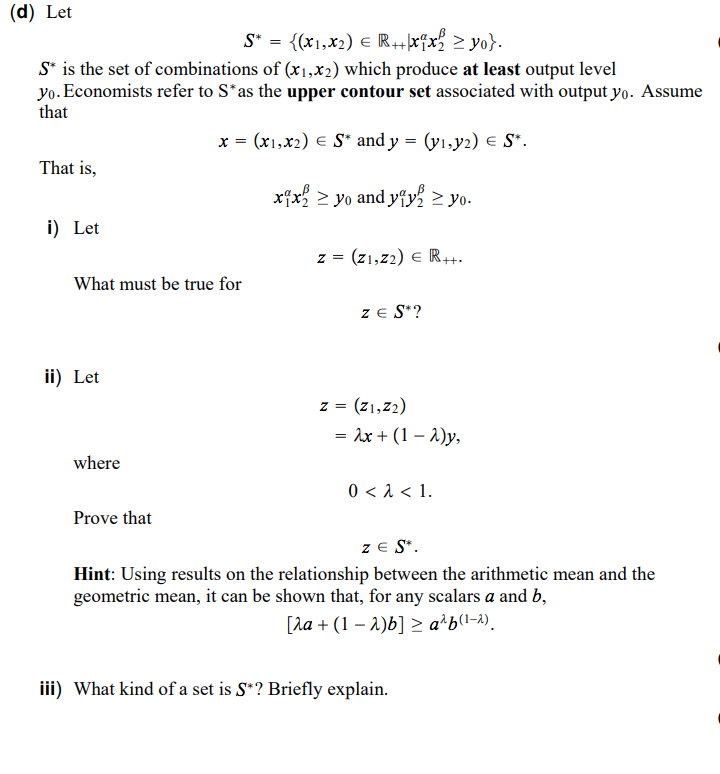
Consider a firm which produces a good, y, using two inputs or factors of production, x1 and x2. The firm's production function describes the mathematical relationship between inputs and output, and is given by y = A( x1, x2) = xqx2, a, BER+. (a) Derive the degree of homogeneity of the firm's production function. (b) The set S = {(X1,x2) E RHxix2 = yo} is the set of combinations of (x1,x2) which produce output level yo. S is a level curve o f and is referred to by economists as the isoquant associated with output level yo. The isoquant implicitly defines x2 as a function of x1. i) Use implicit differentiation to derive the slope of the isoquant xix2 = yo- That is, derive "2.(Note that along a given isoquant Ay = 0). ii) Use implicit differentiation to derive *2 for the isoquant xix2 = yo. iii) What conclusions do you draw regarding the slope and curvature of the isoquant? Briefly explain. (c) i) Derive the Hessian matrix associated with the firm's production function A(x1 , X2 ) = xqx2. ii) State a sufficient condition(s) for (1) to be a strictly concave function. iii) Derive a restriction on the parameters a and B which ensures that (1) is a strictly concave function.(d) Let 3* = {(151,352) 2 Raw? aye}. S" is the set of combinations of (x1 ,x2) which produce at least output level yo.Economists refer to S'as the upper contour set associated with output yo. Assume that x = (x1,x2) E S" andy = (yhyz) E 5". That is, x'fxg 2 ya and y'l'yz 2 yo- i) Let 2 = (21,22) E RH- What must be true for z e 8"? ii) Let 2 = (21,22) = 3.x + (l (Dy, where 0
Step by Step Solution
There are 3 Steps involved in it

Get step-by-step solutions from verified subject matter experts