







Question: Consider a hedonic game G = (N, 2) where N = {1,2,3} and players' preferences are as follows: (a) (b) (c) (d) : (1,2,3)
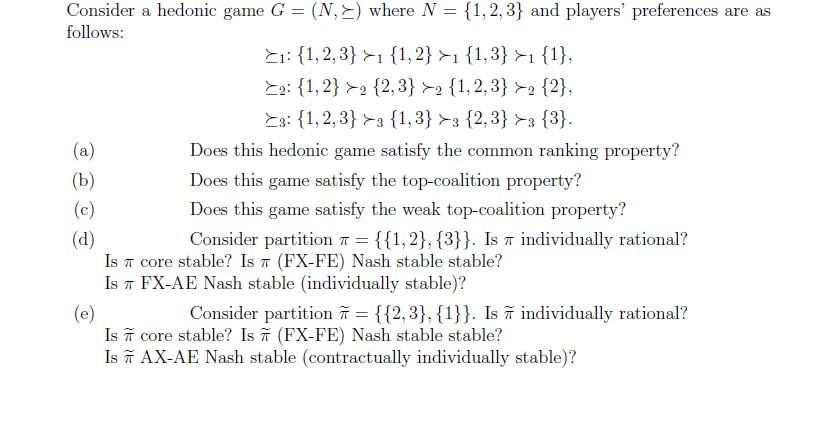
Consider a hedonic game G = (N, 2) where N = {1,2,3} and players' preferences are as follows: (a) (b) (c) (d) : (1,2,3) 1 {1,2} >1 {1,3} >1 {1}, 2:{1,2} 2 (2,3} {1,2,3} 2 {2}, 3: {1,2,3} {1,3} 3 {2,3} 3 {3}. Does this hedonic game satisfy the common ranking property? Does this game satisfy the top-coalition property? Does this game satisfy the weak top-coalition property? Consider partition = {{1,2}, {3}}. Is individually rational? Is 7 core stable? Is T (FX-FE) Nash stable stable? Is T FX-AE Nash stable (individually stable)? (e) Consider partition = {{2,3}, {1}}. Is Is core stable? Is (FX-FE) Nash stable stable? Is 7 AX-AE Nash stable (contractually individually stable)? individually rational?
Step by Step Solution
3.48 Rating (158 Votes )
There are 3 Steps involved in it
a A hedonic game satisfies the common ranking property if there exists a global order over the players such that each players preference ranking is in... View full answer

Get step-by-step solutions from verified subject matter experts
 Study Help