







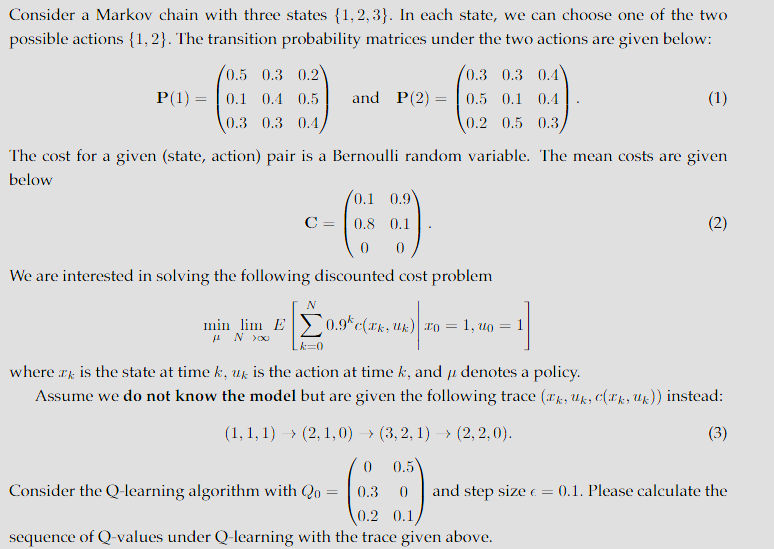
Question: Consider a Markov chain with three states { 1 , 2 , 3 } . In each state, we can choose one of the two
Consider a Markov chain with three states In each state, we can choose one of the two
possible actions The transition probability matrices under the two actions are given below:
and
The cost for a given state action pair is a Bernoulli random variable. The mean costs are given
below
We are interested in solving the following discounted cost problem
where is the state at time is the action at time and denotes a policy.
Assume we do not know the model but are given the following trace instead:
Consider the Qlearning algorithm with and step size Please calculate the
sequence of Qvalues under Qlearning with the trace given above.
Step by Step Solution
There are 3 Steps involved in it
1 Expert Approved Answer
Step: 1 Unlock

Question Has Been Solved by an Expert!
Get step-by-step solutions from verified subject matter experts
Step: 2 Unlock
Step: 3 Unlock
 Study Help