



Question: Consider a non-dividend-paying stock whose current price S(0) = S is $60. After each period, there is a 50% chance that the stock price goes
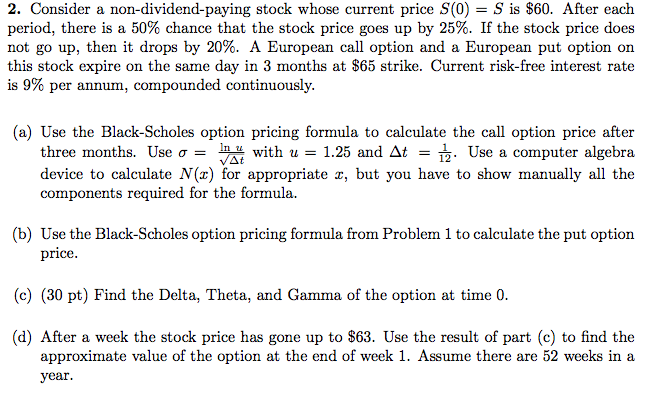
Consider a non-dividend-paying stock whose current price S(0) = S is $60. After each period, there is a 50% chance that the stock price goes up by 25%. If the stock price does not go up, then it drops by 20%. A European call option and a European put option on this stock expire on the same day in 3 months at $65 strike. Current risk-free interest rate is 9% per annum, compounded continuously Use the Black-Scholes option pricing formula to calculate the call option price after three months. Use sigma = ln u/Squareroot Delta t with u = 1.25 and Delta t = 1/12. Use a computer algebra device to calculate N(x) for appropriate x, but you have to show manually all the components required for the formula. Use the Black-Scholes option pricing formula from Problem 1 to calculate the put option price. Find the Delta, Theta, and Gamma of the option at time 0. After a week the stock price has gone up to $63. Use the result of part (c) to find the approximate value of the option at the end of week 1. Assume there are 52 weeks in a year. Consider a non-dividend-paying stock whose current price S(0) = S is $60. After each period, there is a 50% chance that the stock price goes up by 25%. If the stock price does not go up, then it drops by 20%. A European call option and a European put option on this stock expire on the same day in 3 months at $65 strike. Current risk-free interest rate is 9% per annum, compounded continuously Use the Black-Scholes option pricing formula to calculate the call option price after three months. Use sigma = ln u/Squareroot Delta t with u = 1.25 and Delta t = 1/12. Use a computer algebra device to calculate N(x) for appropriate x, but you have to show manually all the components required for the formula. Use the Black-Scholes option pricing formula from Problem 1 to calculate the put option price. Find the Delta, Theta, and Gamma of the option at time 0. After a week the stock price has gone up to $63. Use the result of part (c) to find the approximate value of the option at the end of week 1. Assume there are 52 weeks in a year
Step by Step Solution
There are 3 Steps involved in it

Get step-by-step solutions from verified subject matter experts