







Question: Consider a processor with the following parameters 2 GHz 100 ns 7% 12 cycles 3.5% 28 cycles 1.5% Calculate the CPI for the processor in
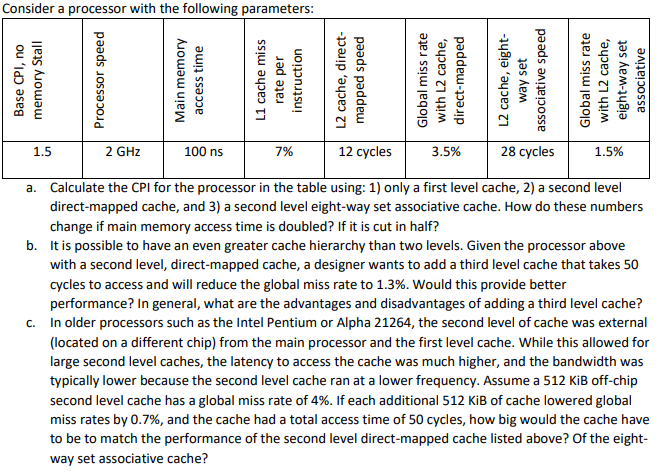
Consider a processor with the following parameters 2 GHz 100 ns 7% 12 cycles 3.5% 28 cycles 1.5% Calculate the CPI for the processor in the table using: 1) only a first level cache, 2) a second level direct-mapped cache, and 3) a second level eight-way set associative cache. How do these numbers change if main memory access time is doubled? If it is cut in half? It is possible to have an even greater cache hierarchy than two levels. Given the processor above with a second level, direct-mapped cache, a designer wants to add a third level cache that takes 50 cycles to access and will reduce the global miss rate to 1.3%. would this provide better performance? In general, what are the advantages and disadvantages of adding a third level cache? In older processors such as the Intel Pentium or Alpha 21264, the second level of cache was external (located on a different chip) from the main processor and the first level cache. While this allowed for large second level caches, the latency to access the cache was much higher, and the bandwidth was typically lower because the second level cache ran at a lower frequency. Assume a 512 KiB off-chip second level cache has a global miss rate of 4%. If each additional 512 KiB of cache lowered global miss rates by 0.7%, and the cache had a total access time of 50 cycles, how big would the cache have to be to match the performance of the second level direct-mapped cache listed above? Of the eight way set associative cache? a. b. c
Step by Step Solution
There are 3 Steps involved in it

Get step-by-step solutions from verified subject matter experts
 Study Help