







Question: Consider a representative consumer who maximizes his life-time utility: 1 max log C + - log C, C1,C 1+p where C and C denote
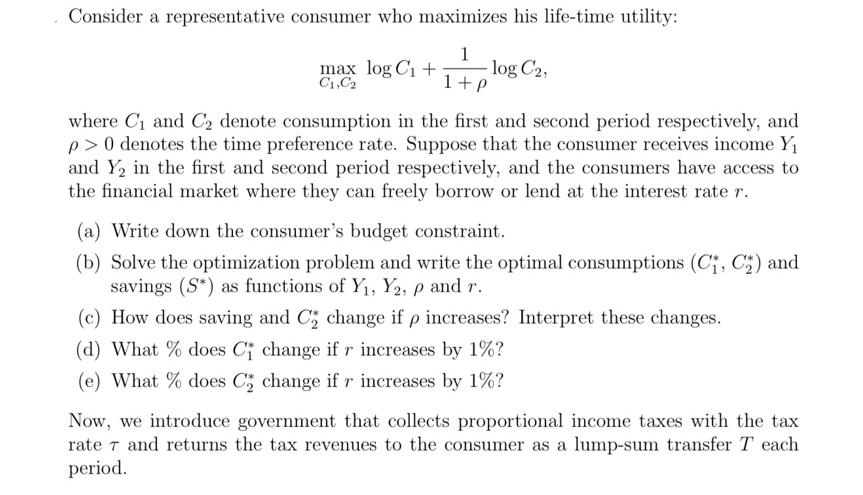
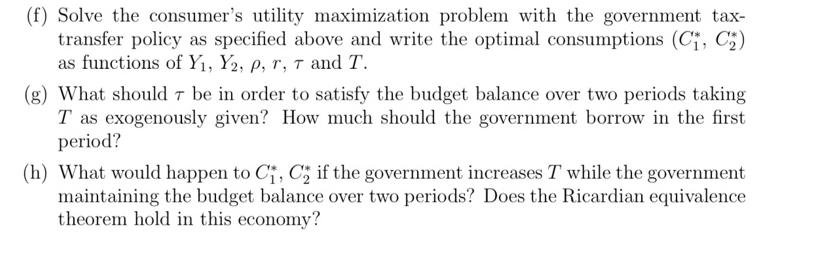
Consider a representative consumer who maximizes his life-time utility: 1 max log C + - log C, C1,C 1+p where C and C denote consumption in the first and second period respectively, and p> 0 denotes the time preference rate. Suppose that the consumer receives income Y and Y in the first and second period respectively, and the consumers have access to the financial market where they can freely borrow or lend at the interest rate r. (a) Write down the consumer's budget constraint. (b) Solve the optimization problem and write the optimal consumptions (C, C) and savings (S*) as functions of Y, Y2, p and r. (c) How does saving and C change if p increases? Interpret these changes. (d) What % does C change if r increases by 1%? (e) What % does C change if r increases by 1%? Now, we introduce government that collects proportional income taxes with the tax rate 7 and returns the tax revenues to the consumer as a lump-sum transfer Teach period. (f) Solve the consumer's utility maximization problem with the government tax- transfer policy as specified above and write the optimal consumptions (C+, C) as functions of Y, Y2, p, r, 7 and T. (g) What should be in order to satisfy the budget balance over two periods taking T as exogenously given? How much should the government borrow in the first period? (h) What would happen to C, C if the government increases T while the government maintaining the budget balance over two periods? Does the Ricardian equivalence theorem hold in this economy?
Step by Step Solution
3.35 Rating (164 Votes )
There are 3 Steps involved in it
a The budget constraint is C1 S Y1 C2 Y2 1rS b The Lagrangean is L logC1 11logC2 Y1 C1 S Y2 1... View full answer

Get step-by-step solutions from verified subject matter experts
 Study Help