







Question: Consider a single-server queueing system with infinite waiting room and suppose jobs arrive according to PP(1). Each job's service time is exponentially distributed with rate
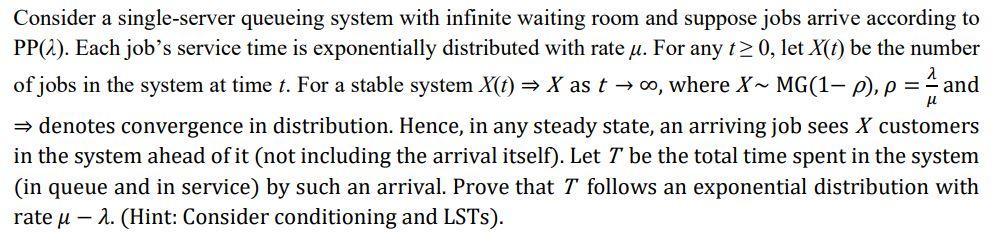
Consider a single-server queueing system with infinite waiting room and suppose jobs arrive according to PP(1). Each job's service time is exponentially distributed with rate u. For any t> 0, let X(t) be the number of jobs in the system at time t. For a stable system X(t) = X as t+, where X~ MG(1-P), p =-- and = denotes convergence in distribution. Hence, in any steady state, an arriving job sees X customers in the system ahead of it (not including the arrival itself). Let T be the total time spent in the system (in queue and in service) by such an arrival. Prove that I follows an exponential distribution with rate u 1. (Hint: Consider conditioning and LSTs). Consider a single-server queueing system with infinite waiting room and suppose jobs arrive according to PP(1). Each job's service time is exponentially distributed with rate u. For any t> 0, let X(t) be the number of jobs in the system at time t. For a stable system X(t) = X as t+, where X~ MG(1-P), p =-- and = denotes convergence in distribution. Hence, in any steady state, an arriving job sees X customers in the system ahead of it (not including the arrival itself). Let T be the total time spent in the system (in queue and in service) by such an arrival. Prove that I follows an exponential distribution with rate u 1. (Hint: Consider conditioning and LSTs)
Step by Step Solution
There are 3 Steps involved in it

Get step-by-step solutions from verified subject matter experts
 Study Help