







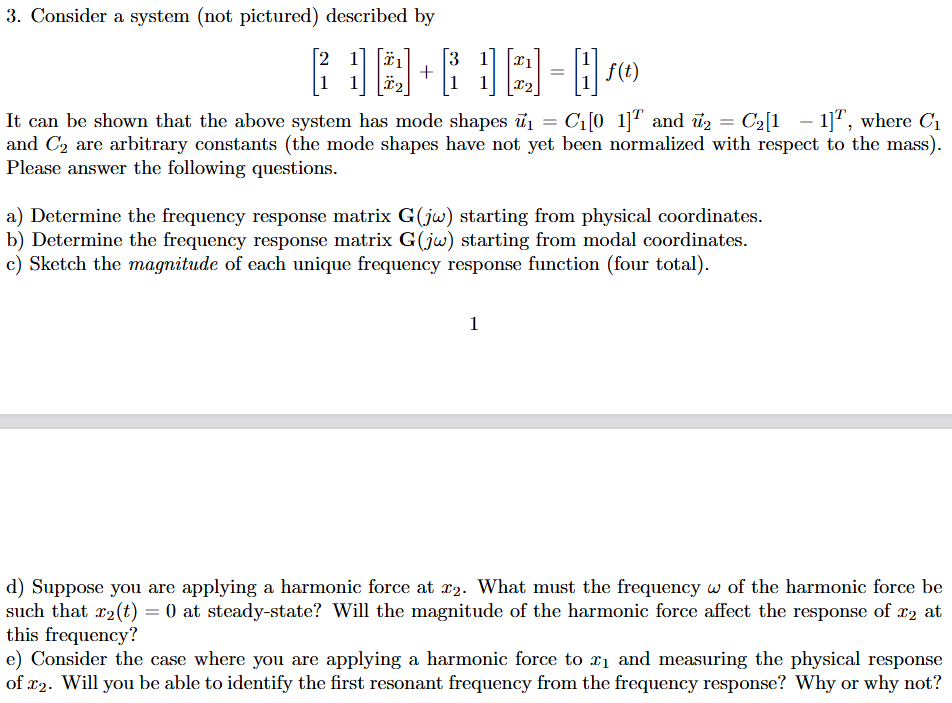
Question: Consider a system ( not pictured ) described by [ [ 2 , 1 ] , [ 1 , 1 ] ] [ [ x
Consider a system not pictured described by
xxxxft
It can be shown that the above system has mode shapes vecuCT and vecuCT where C
and C are arbitrary constants the mode shapes have not yet been normalized with respect to the mass
Please answer the following questions.
aGjomega starting from physical coordinates.
bGjomega starting from modal coordinates.
cx What must the frequency omega of the harmonic force be
such that xt at steadystate? Will the magnitude of the harmonic force affect the response of x at
this frequency?
ex and measuring the physical response
of x Will you be able to identify the first resonant frequency from the frequency response? Why or why not?
Step by Step Solution
There are 3 Steps involved in it
1 Expert Approved Answer
Step: 1 Unlock

Question Has Been Solved by an Expert!
Get step-by-step solutions from verified subject matter experts
Step: 2 Unlock
Step: 3 Unlock
 Study Help