







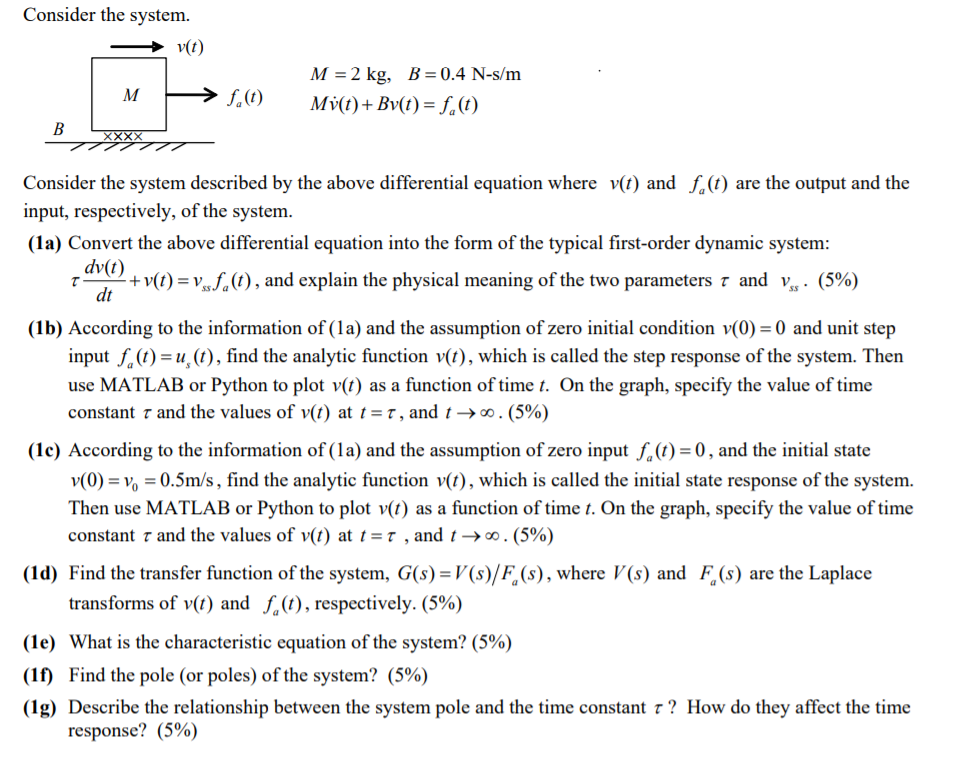
Question: Need matlab code for this please. Consider the system. v(t) M f.lt) M = 2 kg, B=0.4 N-s/m Mv(t)+Bv(t) = f(t) B XXXX 27 Te
Need matlab code for this please.
Consider the system. v(t) M f.lt) M = 2 kg, B=0.4 N-s/m Mv(t)+Bv(t) = f(t) B XXXX 27 Te Consider the system described by the above differential equation where y(t) and fu(t) are the output and the input, respectively, of the system. (1a) Convert the above differential equation into the form of the typical first-order dynamic system: dv(t) +v(t) =vsfe(t), and explain the physical meaning of the two parameters t and Vs. (5%) dt (1b) According to the information of (la) and the assumption of zero initial condition v(0) = 0 and unit step input fu(t)=u, (t), find the analytic function v(t), which is called the step response of the system. Then use MATLAB or Python to plot v(t) as a function of time t. On the graph, specify the value of time constant t and the values of v(t) at t=t, and t +0.(5%) (1c) According to the information of (la) and the assumption of zero input f(t)=0, and the initial state v(O) = v) = 0.5m/s, find the analytic function v(t), which is called the initial state response of the system. Then use MATLAB or Python to plot v(t) as a function of time t. On the graph, specify the value of time constant t and the values of v(t) at t=t, and t0.(5%) (1d) Find the transfer function of the system, G(s) =V(s)/F,(s), where V (s) and F,(s) are the Laplace transforms of v(t) and f(t), respectively. (5%) (le) What is the characteristic equation of the system? (5%) (1f) Find the pole (or poles) of the system? (5%) (1g) Describe the relationship between the system pole and the time constant 7 ? How do they affect the time response? (5%)
Step by Step Solution
There are 3 Steps involved in it

Get step-by-step solutions from verified subject matter experts
 Study Help