







Question: Consider a three-period decision problem: max u(co) + 3u(c)+B*u(cz) subject to the flow budget constraints for t = 0, 1, 2: bt+1 = =
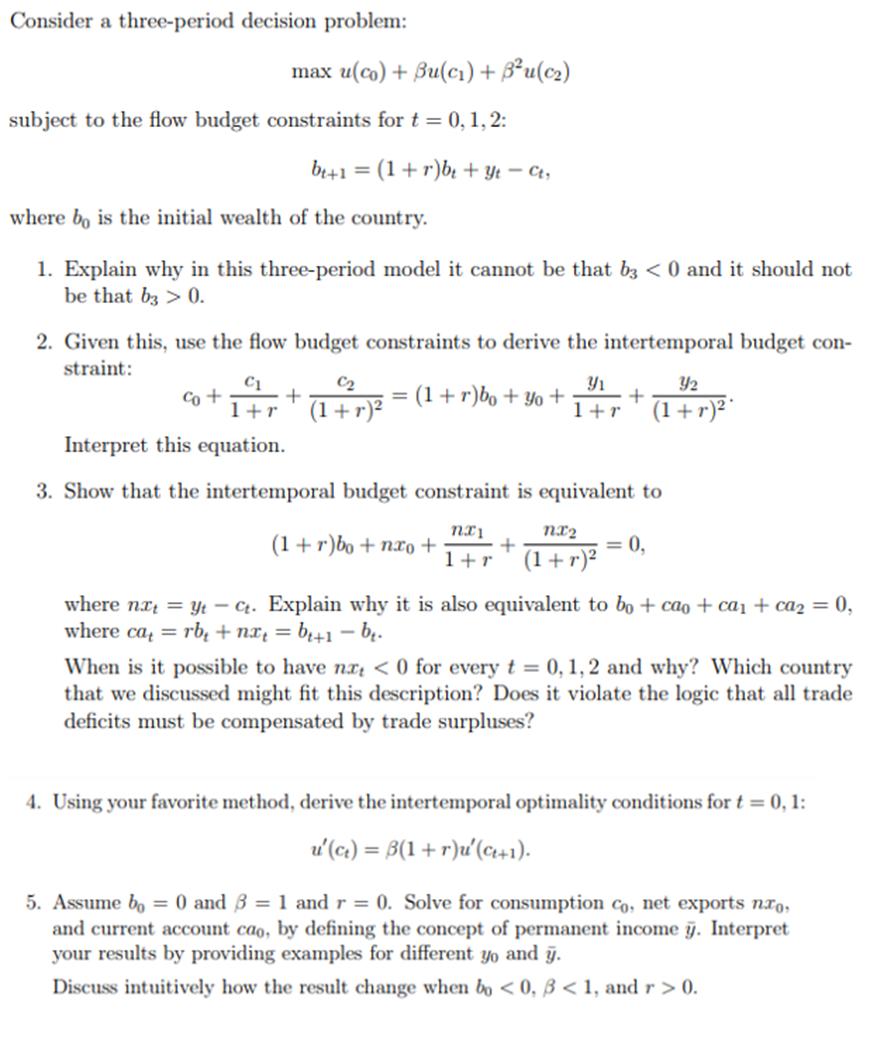
Consider a three-period decision problem: max u(co) + 3u(c)+B*u(cz) subject to the flow budget constraints for t = 0, 1, 2: bt+1 = = (1 + r)bt + Yt - Ct, where bo is the initial wealth of the country. 1. Explain why in this three-period model it cannot be that b3 0. 2. Given this, use the flow budget constraints to derive the intertemporal budget con- straint: C1 C2 Y2 Co + = (1 + r)bo + yo + + 1+r (1+r) + Y1 1+r (1+r) Interpret this equation. 3. Show that the intertemporal budget constraint is equivalent to nxi NX2 (1+r)bo+nxo + + = 0, 1+r (1+r) where nx=yt - c. Explain why it is also equivalent to bo + cao + cai + ca = 0, where carb, +nx = b+1b. When is it possible to have nx < 0 for every t = 0, 1, 2 and why? Which country that we discussed might fit this description? Does it violate the logic that all trade deficits must be compensated by trade surpluses? 4. Using your favorite method, derive the intertemporal optimality conditions for t= 0, 1: u'(c) = B(1 + r)u' (C+1). 5. Assume bo = 0 and 3 = 1 and r = 0. Solve for consumption co, net exports no, and current account cao, by defining the concept of permanent income y. Interpret your results by providing examples for different yo and y. Discuss intuitively how the result change when bo < 0, 3 < 1, and r> 0.
Step by Step Solution
3.32 Rating (152 Votes )
There are 3 Steps involved in it
At the period of period 3 when t 2 Using the given equation b 3 1rb 2 y 2 c 2 t 2 The world ends after period 3 and thus no one would be available to ... View full answer

Get step-by-step solutions from verified subject matter experts
 Study Help