







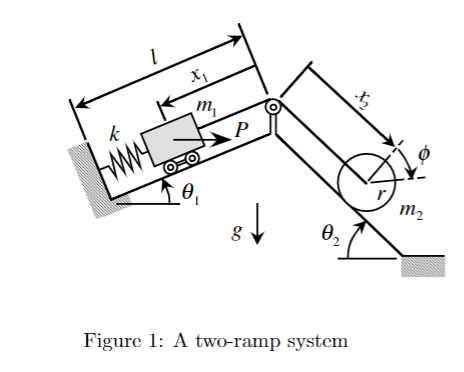
Question: Consider a two - ramp system shown in Fig. 1 . The left and right ramps make an angle of theta _ ( 1
Consider a tworamp system shown in Fig. The left and right ramps make an angle of theta
and theta with the horizontal plane, respectively. At the top where the two ramps meet is a
massless pulley that is free to rotate. On the left ramp, a cart is supported by a spring and
the length of the ramp is l The cart has mass m and slides on the left ramp without friction.
In addition, the position of the cart from the pulley is x The spring is linear with stiffness
k and has a free length l Also, the cart is subjected to a horizontal force P On the right
ramp, a cylinder of radius r rolls without slipping. The cylinder is uniform and has mass m;
therefore, its centroidal moment of inertia is mr The motion of the cylinder is described
via its center position x from the pulley as well as an angle of rotation phi in the clockwise
sense. When the spring is at its free length, the corresponding phi An inextensible string
of constant length d wrapping around the pulley, connects a cart on the left ramp and a
cylinder on the right ramp. Answer the following questions.
a Derive constraint equations of the tworamp systems. Are the constraints rheonomic or
scleronomic? How do virtual displacements delta xdelta x and delta phi are related to one another?
b Apply the principle of virtual work to derive an equation that governs equilibrium of the
cart, the spring, the cylinder, and the force P Figure : A tworamp system
Step by Step Solution
There are 3 Steps involved in it
1 Expert Approved Answer
Step: 1 Unlock

Question Has Been Solved by an Expert!
Get step-by-step solutions from verified subject matter experts
Step: 2 Unlock
Step: 3 Unlock
 Study Help