



Question: Consider a two-period, small, open, endowment economy with durable con- sumption goods. Purchases of durable consumption goods in period 1, de- noted C, continue
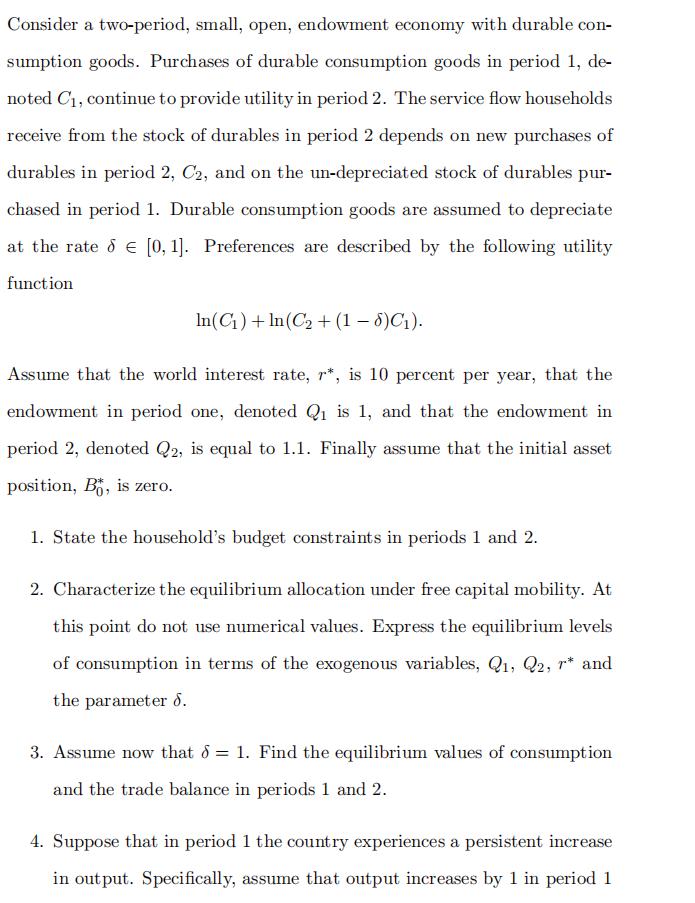
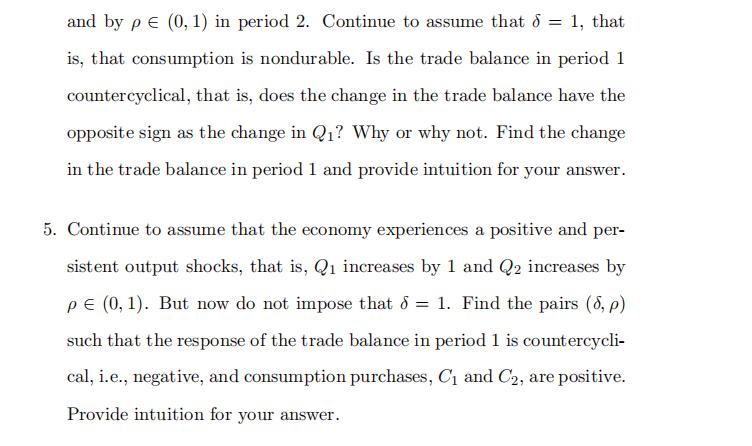
Consider a two-period, small, open, endowment economy with durable con- sumption goods. Purchases of durable consumption goods in period 1, de- noted C, continue to provide utility in period 2. The service flow households receive from the stock of durables in period 2 depends on new purchases of durables in period 2, C2, and on the un-depreciated stock of durables pur- chased in period 1. Durable consumption goods are assumed to depreciate at the rate 8 [0, 1]. Preferences are described by the following utility function In(C) + In (C + (1 - 8)C). Assume that the world interest rate, r*, is 10 percent per year, that the endowment in period one, denoted Q is 1, and that the endowment in period 2, denoted Q2, is equal to 1.1. Finally assume that the initial asset position, B, is zero. 1. State the household's budget constraints in periods 1 and 2. 2. Characterize the equilibrium allocation under free capital mobility. At this point do not use numerical values. Express the equilibrium levels of consumption in terms of the exogenous variables, Q, Q2, r* and the parameter 8. 3. Assume now that 8 = 1. Find the equilibrium values of consumption and the trade balance in periods 1 and 2. 4. Suppose that in period 1 the country experiences a persistent increase in output. Specifically, assume that output increases by 1 in period 1 and by p (0, 1) in period 2. Continue to assume that d = 1, that is, that consumption is nondurable. Is the trade balance in period 1 countercyclical, that is, does the change in the trade balance have the opposite sign as the change in Q? Why or why not. Find the change in the trade balance in period 1 and provide intuition for your answer. 5. Continue to assume that the economy experiences a positive and per- sistent output shocks, that is, Q increases by 1 and Q2 increases by pe (0, 1). But now do not impose that 8 = 1. Find the pairs (8, p) such that the response of the trade balance in period 1 is countercycli- cal, i.e., negative, and consumption purchases, C and C2, are positive. Provide intuition for your answer.
Step by Step Solution
3.38 Rating (157 Votes )
There are 3 Steps involved in it
1 Household budget constraints in periods 1 and 2 Period 1 C1 B0 Q1 Period 2 C2 1 dB0 Q2 1 rB1 2 Equ... View full answer

Get step-by-step solutions from verified subject matter experts