



Question: Consider an object moving along a line with the following velocity and initial position. v(t)=16-12 on [0,5]; s(0) = -3 Determine the position function
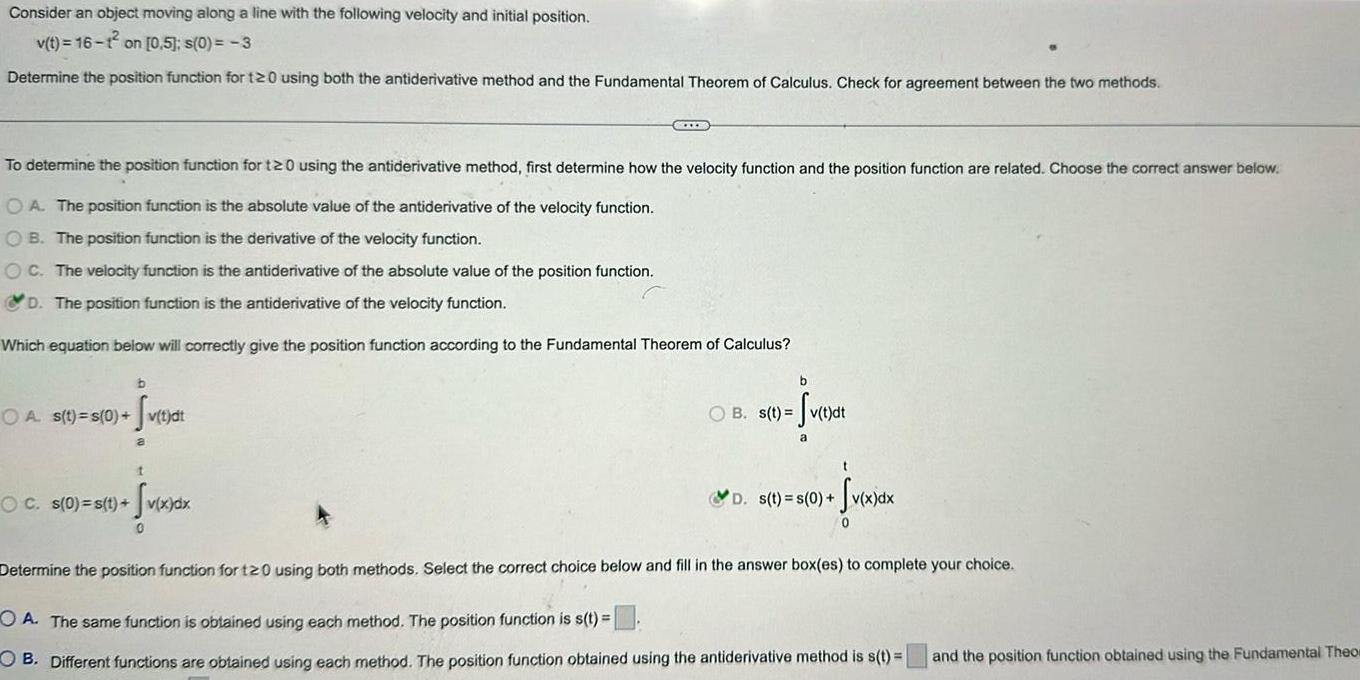
Consider an object moving along a line with the following velocity and initial position. v(t)=16-12 on [0,5]; s(0) = -3 Determine the position function for t20 using both the antiderivative method and the Fundamental Theorem of Calculus. Check for agreement between the two methods. To determine the position function for t 0 using the antiderivative method, first determine how the velocity function and the position function are related. Choose the correct answer below. OA. The position function is the absolute value of the antiderivative of the velocity function. B. The position function is the derivative of the velocity function. OC. The velocity function is the antiderivative of the absolute value of the position function. D. The position function is the antiderivative of the velocity function. Which equation below will correctly give the position function according to the Fundamental Theorem of Calculus? b OA s(t) = s(0) + v(t)dt a B. s(t)= a v(t)dt OC. s(0) = s(t)+ v(x)dx D. s(t)=s(0)+ t Sv(x)dx Determine the position function for t20 using both methods. Select the correct choice below and fill in the answer box(es) to complete your choice. OA. The same function is obtained using each method. The position function is s(t)=| B. Different functions are obtained using each method. The position function obtained using the antiderivative method is s(t)= | and the position function obtained using the Fundamental Theor
Step by Step Solution
There are 3 Steps involved in it

Get step-by-step solutions from verified subject matter experts