







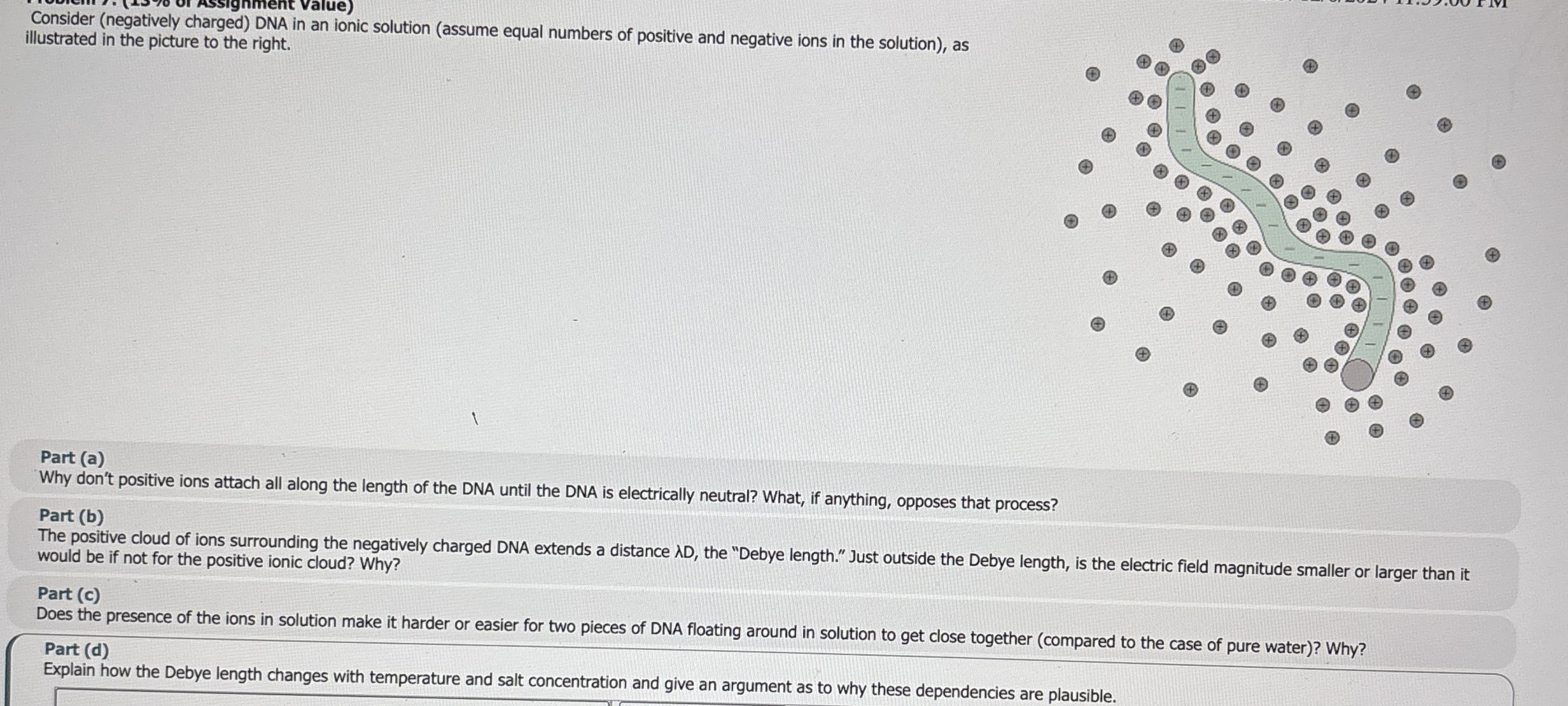
Question: Consider ( negatively charged ) DNA in an ionic solution ( assume equal numbers of positive and negative ions in the solution ) , as
Consider negatively charged DNA in an ionic solution assume equal numbers of positive and negative ions in the solution as illustrated in the picture to the right.
Part a
Why don't positive ions attach all along the length of the DNA until the DNA is electrically neutral? What, if anything, opposes that process?
Part b
The positive cloud of ions surrounding the negatively charged DNA extends a distance the "Debye length." Just outside the Debye length, is the electric field magnitude smaller or larger than it would be if not for the positive ionic cloud? Why?
Part c
Does the presence of the ions in solution make it harder or easier for two pieces of DNA floating around in solution to get close together compared to the case of pure water Why?
Part d
Explain how the Debye length changes with temperature and salt concentration and give an argument as to why these dependencies are plausible.
Step by Step Solution
There are 3 Steps involved in it
1 Expert Approved Answer
Step: 1 Unlock

Question Has Been Solved by an Expert!
Get step-by-step solutions from verified subject matter experts
Step: 2 Unlock
Step: 3 Unlock
 Study Help