







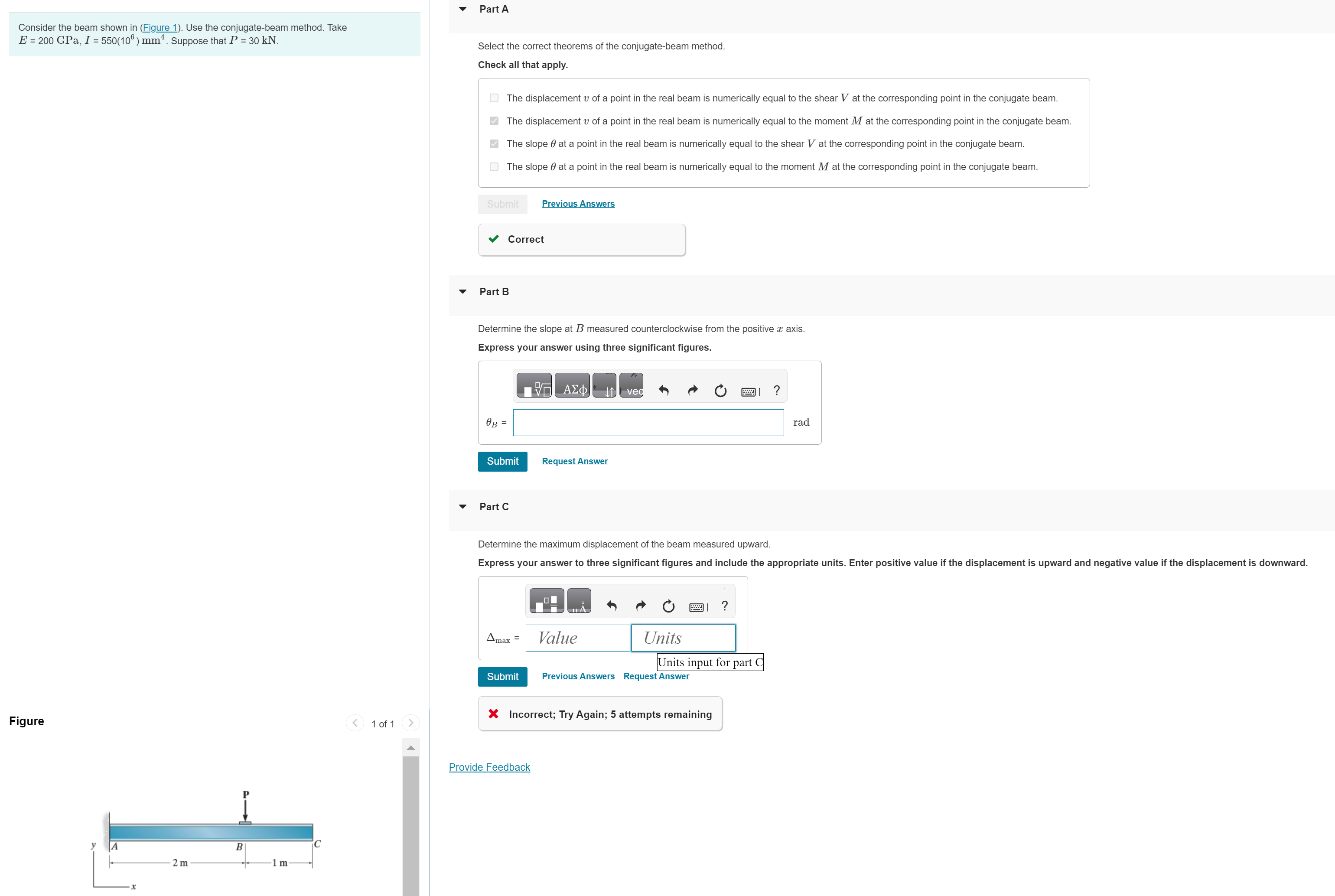
Question: Consider the beam shown in ( Figure 1 ) . Use the conjugate - beam method. Take ( E = 2 0 0
Consider the beam shown in Figure Use the conjugatebeam method. Take EmathrmGPa Ileftrightmathrmmm Suppose that PmathrmkN
Part A
Select the correct theorems of the conjugatebeam method.
Check all that apply.
The displacement v of a point in the real beam is numerically equal to the shear V at the corresponding point in the conjugate beam.
The displacement v of a point in the real beam is numerically equal to the moment M at the corresponding point in the conjugate beam.
The slope theta at a point in the real beam is numerically equal to the shear V at the corresponding point in the conjugate beam.
The slope theta at a point in the real beam is numerically equal to the moment M at the corresponding point in the conjugate beam.
Previous Answers
Correct
Part B
Determine the slope at B measured counterclockwise from the positive x axis.
Express your answer using three significant figures.
thetaB
ad
Part C
Determine the maximum displacement of the beam measured upward.
Express your answer to three significant figures and include the appropriate units. Enter positive value if the displacement is upward and negative value if the displacement is downward.
Figure
Step by Step Solution
There are 3 Steps involved in it
1 Expert Approved Answer
Step: 1 Unlock

Question Has Been Solved by an Expert!
Get step-by-step solutions from verified subject matter experts
Step: 2 Unlock
Step: 3 Unlock
 Study Help