



Question: Consider the constrained utility maximization problem of maximizing?(?,?) u(x,y)subject to the budget constraint pxx+pyy=I. 7. Consider the constrained utility maximization problem of maximizing u (x,
Consider the constrained utility maximization problem of maximizing?(?,?)
u(x,y)subject to the budget constraint
pxx+pyy=I.
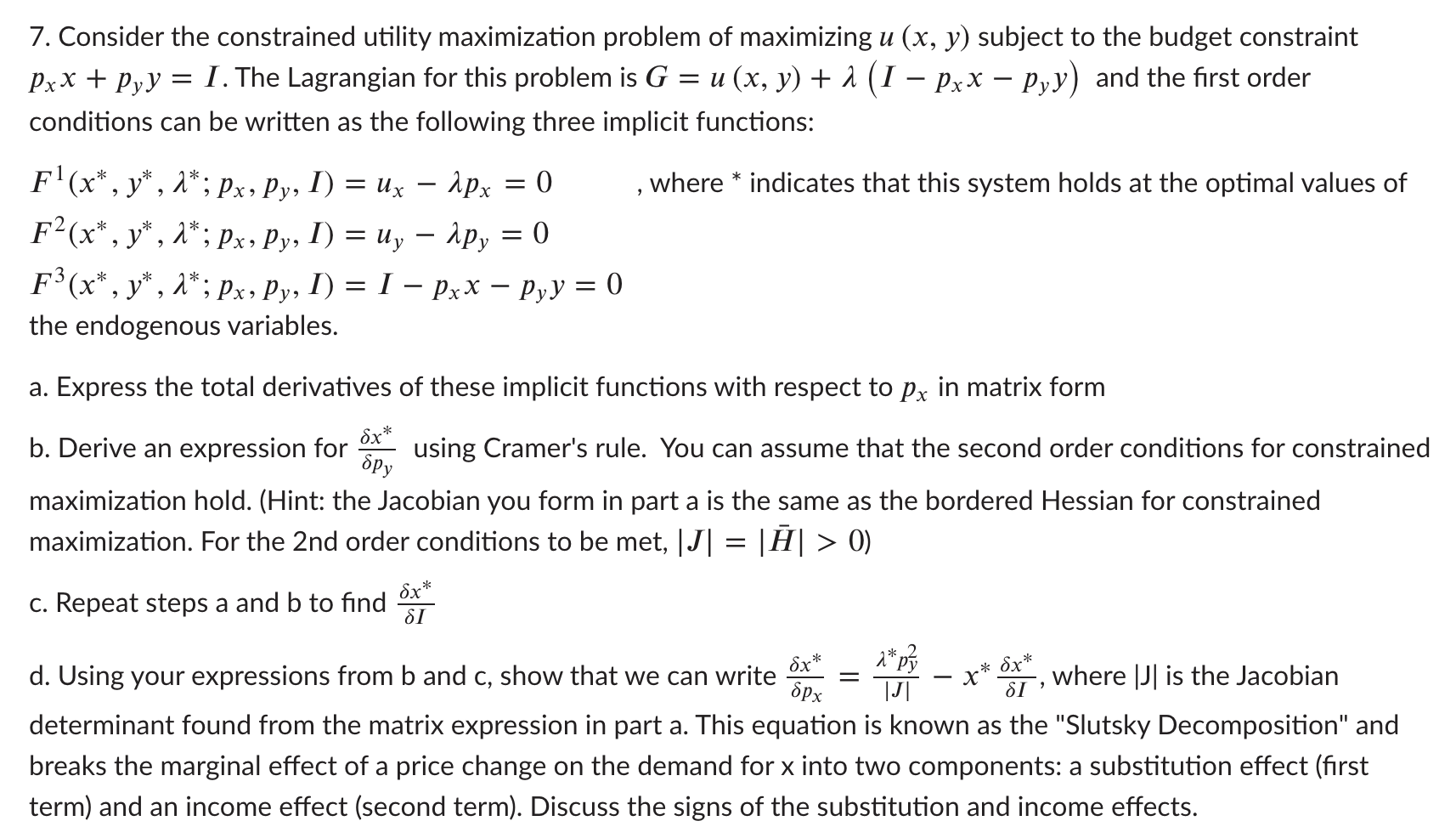
7. Consider the constrained utility maximization problem of maximizing u (x, y) subject to the budget constraint Pxx + pyy = I. The Lagrangian for this problem is G = u (x, y) + 1 (I - Pxx - pyy) and the first order conditions can be written as the following three implicit functions: F1 (x* , y* , A*; Px, Py, I) = Ux - Apx = 0 , where * indicates that this system holds at the optimal values of F2 (x* , y* , A*; Px, Py, I) = uy - Apy = 0 F3 (x*, y* , A* ; Px, Py, I) = I - Pxx - Pyy = 0 the endogenous variables. a. Express the total derivatives of these implicit functions with respect to px in matrix form b. Derive an expression for Spy using Cramer's rule. You can assume that the second order conditions for constrained maximization hold. (Hint: the Jacobian you form in part a is the same as the bordered Hessian for constrained maximization. For the 2nd order conditions to be met, | J| = | H| > 0) c. Repeat steps a and b to find Sx* d. Using your expressions from b and c, show that we can write A* PY Spx Irl 67 , where |J| is the Jacobian determinant found from the matrix expression in part a. This equation is known as the "Slutsky Decomposition" and breaks the marginal effect of a price change on the demand for x into two components: a substitution effect (first term) and an income effect (second term). Discuss the signs of the substitution and income effects
Step by Step Solution
There are 3 Steps involved in it

Get step-by-step solutions from verified subject matter experts