







Question: Consider the cubic equation: f(x) = Ax^3 + Bx^2 + Cx + D. The inflections (turning points) of the curve will occur where the derivative
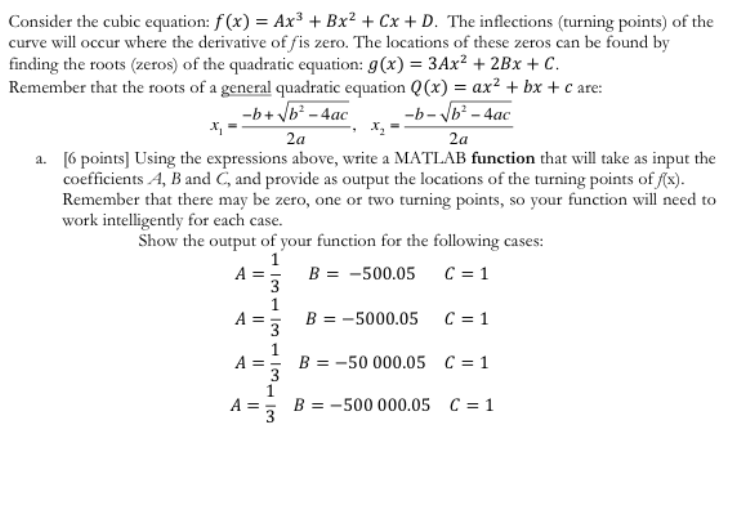
Consider the cubic equation: f(x) = Ax^3 + Bx^2 + Cx + D. The inflections (turning points) of the curve will occur where the derivative of f is zero. The locations of these zeros can be found by finding the roots (zeros) of the quadratic equation: g(x) = 3Ax^2 + 2Bx + C. Remember that the roots of a general quadratic equation Q(x) = ax^2 + bx + C are: x_1 = -b + Squreroot b^2 - 4ac/2a, x_2 -b-squareroot b^2 - 4ac/2a. Using the expressions above, write a MATLAB function that will take as input the coefficients A, B and C, and provide as output the locations of the turning points of f(x). Remember that there may be zero, one or two turning points, so your function will need to work intelligently for each case. Show the output of vour function for the following cases: A = 1/3 B = -500.05 C = 1 A = 1/3 B = -5000.05 C = 1 A = 1/3 B = -50 000.05 C = 1 a = 1/3 B = -500 000.05 C = 1
Step by Step Solution
There are 3 Steps involved in it

Get step-by-step solutions from verified subject matter experts
 Study Help