







Question: Consider the following capital allocation problem having the net cash-flow estimates and PW values shown in the following table. MARR is 12% per year, and
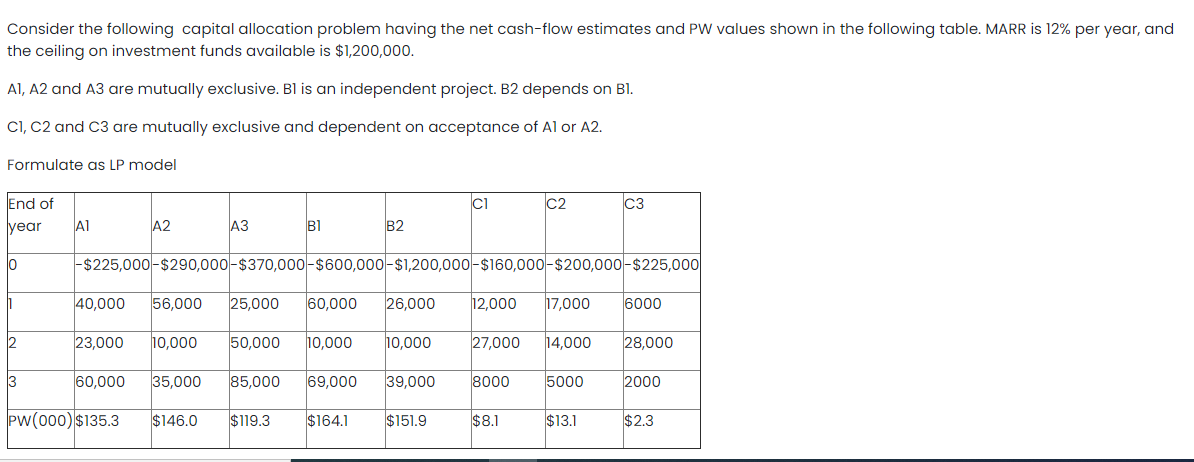 Consider the following capital allocation problem having the net cash-flow estimates and PW values shown in the following table. MARR is 12% per year, and the ceiling on investment funds available is $1,200,000.
A1, A2 and A3 are mutually exclusive. B1 is an independent project. B2 depends on B1.
C1, C2 and C3 are mutually exclusive and dependent on acceptance of A1 or A2.
Formulate as LP model
| End of year | A1 | A2 | A3 | B1 | B2 | C1 | C2 | C3 |
| 0 | -$225,000 | -$290,000 | -$370,000 | -$600,000 | -$1,200,000 | -$160,000 | -$200,000 | -$225,000 |
| 1 | 40,000 | 56,000 | 25,000 | 60,000 | 26,000 | 12,000 | 17,000 | 6000 |
| 2 | 23,000 | 10,000 | 50,000 | 10,000 | 10,000 | 27,000 | 14,000 | 28,000 |
| 3 | 60,000 | 35,000 | 85,000 | 69,000 | 39,000 | 8000 | 5000 | 2000 |
| PW(000) | $135.3 | $146.0 | $119.3 | $164.1 | $151.9 | $8.1 | $13.1 | $2.3 |
Consider the following capital allocation problem having the net cash-flow estimates and PW values shown in the following table. MARR is 12% per year, and the ceiling on investment funds available is $1,200,000. A1, A2 and A3 are mutually exclusive. Bl is an independent project. B2 depends on BI. CI, C2 and C3 are mutually exclusive and dependent on acceptance of Al or A2. Formulate as LP model cl C2 C3 End of lyear Al A2 A3 BI B2 Jo -$225,000-$290,000-$370,000-$600,000-$1,200,000-$160,000-$200,000-$225,000 n 40,000 56,000 25,000 60,000 26,000 12,000 17,000 6000 12 23,000 10,000 50,000 10,000 10,000 27,000 14,000 28,000 3 60,000 35,000 85,000 69,000 39,000 8000 5000 2000 pw(000) $135.3 $146.0 $119.3 $164.1 $151.9 $8.1 $13.1 $2.3
Step by Step Solution
There are 3 Steps involved in it

Get step-by-step solutions from verified subject matter experts
 Study Help