







Question: Consider the following java code class Node { int item; Node next; Node (int item, Node next) { this.item = item; this.item = next; }
Consider the following java code
class Node { int item; Node next;
Node (int item, Node next) { this.item = item; this.item = next; }
Node duplicate () { Node nextduplicated = (next == null) ? null ; next.duplicate (); Node result - new Node (item, nextDuplicated); return result; } } class NodeExt extends Node { NodeExt (int item, Node next){ super (item, next); } Node duplicate (){ Node result = super.duplicate (); return result; } } Public class Driver { public static void main (string{} args){ Node node1 = new Node (1, new NodeEXT (2, new Node (3, new NodeEXT (4, new Node (5, null))))); Node node2 = node1.duplicate (); } }
In the creation of node 2 how often will the duplicate method within NodeExt be called
1) 0
2) 5
3) 2
4) 4
5) 3 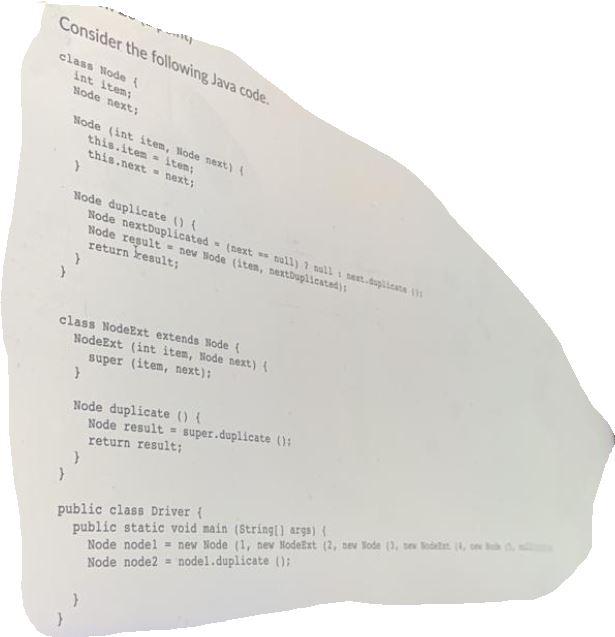
5) 3
Consider the following Java code. class Mode 1 int Luen sode text: Mode (int item, lode text) this item = items this.next next > Node duplicate 03 Node nextDuplicated next s tall)? mall 1 sente in Bode result = new lode titen, neatbulientes return result: > class ModeExt extends Node { NodeExt (int item, sode next) { super (item, next); } Node duplicate () Node result = super duplicate 0); return result; } public class Driver public static void main (Stringt] args) { Node nodel = new Node (1y nev Hodetst (2, tev Node). Node node2 = nodel.duplicate 0)
Step by Step Solution
There are 3 Steps involved in it

Get step-by-step solutions from verified subject matter experts
 Study Help