







Question: Consider the following linear program which maximizes profit for two products, Regular (R), and Super (S): Z= MAX SOR + 755 S.t. 1.2R+ 1.65
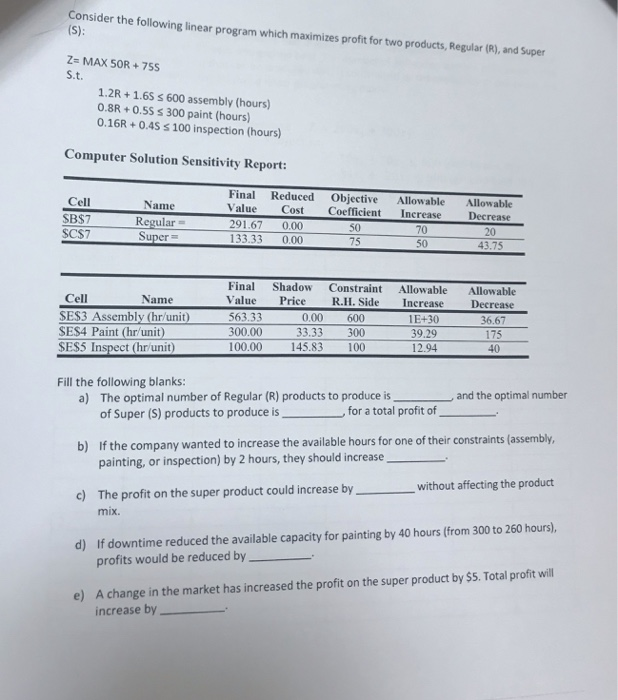
Consider the following linear program which maximizes profit for two products, Regular (R), and Super (S): Z= MAX SOR + 755 S.t. 1.2R+ 1.65 600 assembly (hours) 0.8R+0.55 300 paint (hours) 0.16R+0.45 100 inspection (hours) Computer Solution Sensitivity Report: Cell $B$7 $C$7 Name Regular- Super= Cell Name SE$3 Assembly (hr/unit) SE$4 Paint (hr/unit) $E$5 Inspect (hr/unit) Final Reduced Objective Allowable Value Cost Coefficient Increase 50 75 291.67 0.00 133.33 0.00 Final Shadow Constraint Value Price 563.33 300.00 100.00 Allowable R.H. Side Increase 0.00 600 33.33 300 145.83 100 Fill the following blanks: a) The optimal number of Regular (R) products to produce is of Super (S) products to produce is, 70 50 1E+30 39.29 12.94 for a total profit of c) The profit on the super product could increase by mix. Allowable Decrease 20 43.75 Allowable Decrease 36.67 175 40 , and the optimal number b) If the company wanted to increase the available hours for one of their constraints (assembly, painting, or inspection) by 2 hours, they should increase, without affecting the product d) If downtime reduced the available capacity for painting by 40 hours (from 300 to 260 hours), profits would be reduced by e) A change in the market has increased the profit on the super product by $5. Total profit will increase by.
Step by Step Solution
3.45 Rating (152 Votes )
There are 3 Steps involved in it
a Looking at the sensitivity analysis given the first table with column Final Value gives the optimal solution Profit 50R 75S 5029167 7513333 2458325 ... View full answer

Get step-by-step solutions from verified subject matter experts
 Study Help