







Question: Consider the following two dimensional problem: J-V (a(z)Vu(x)) +u(x) = f(x) 8, u(r) = 0 nC R is a bounded domain, / and a
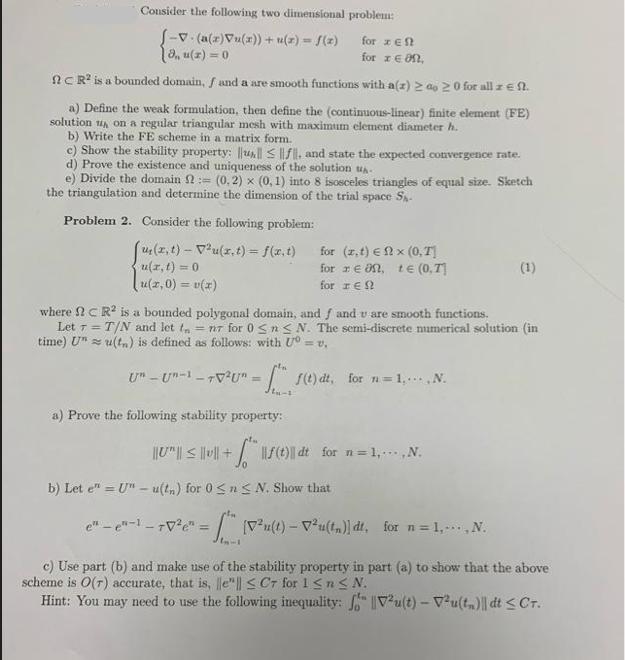
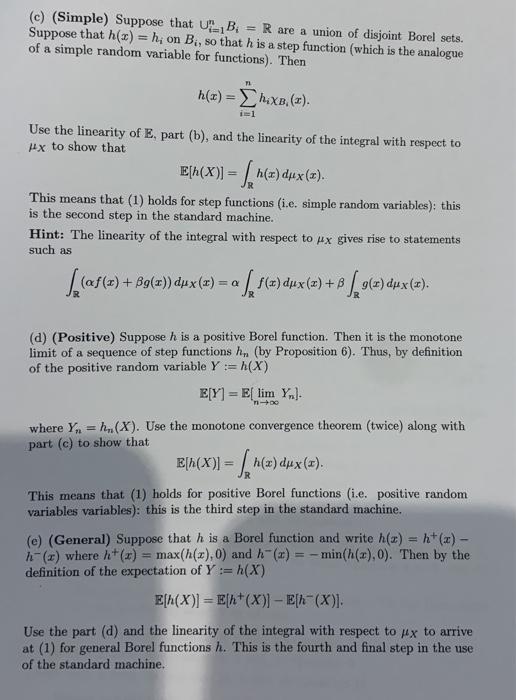
Consider the following two dimensional problem: J-V (a(z)Vu(x)) +u(x) = f(x) 8, u(r) = 0 nC R is a bounded domain, / and a are smooth functions with a(z) 2 ao 20 for all z e ft. a) Define the weak formulation, then define the (continuous-linear) finite element (FE) solution , on a regular triangular mesh with maximum element diameter h. b) Write the FE scheme in a matrix form. c) Show the stability property: lul Sf, and state the expected convergence rate. d) Prove the existence and uniqueness of the solution UA- e) Divide the domain 2: (0, 2)x (0, 1) into 8 isosceles triangles of equal size. Sketch the triangulation and determine the dimension of the trial space S- Problem 2. Consider the following problem: [ur(x, t) - u(x.t) = f(x.t) u(x, t) = 0 u(2,0) = v(x) for ref for 1 on, 2-1 a) Prove the following stability property: for (z,t) eftx (0,T] for re an, te (0,7] for where 2 C R is a bounded polygonal domain, and f and v are smooth functions. Let 7 = T/N and let tn=n7 for 0 SnN. The semi-discrete numerical solution (in time) Uzu(tn) is defined as follows: with U = v. Un-Un-1-7"=f(t) dt, for n=1,...,.N. ||||||||+(t)\ dt for n = 1,.., N. (1) b) Let e" = U" -u(tn) for 0 n N. Show that e" - e- - 7e" = "" [n(t) - u(tn)]dt, for n = 1,-, N. c) Use part (b) and make use of the stability property in part (a) to show that the above scheme is O (7) accurate, that is, le"] CT for 1 n N. Hint: You may need to use the following inequality: "Vu(t) - Vu(tn) dt CT. (c) (Simple) Suppose that UB, R are a union of disjoint Borel sets. Suppose that h(x) = h, on B, so that h is a step function (which is the analogue of a simple random variable for functions). Then 11 h(x) = hix.(z). i=1 Use the linearity of E, part (b), and the linearity of the integral with respect to "x to show that E[h(X)] = [h(z) dux (z). This means that (1) holds for step functions (i.e. simple random variables): this is the second step in the standard machine. Hint: The linearity of the integral with respect to #x gives rise to statements such as [(af(x) - ) + Bg(x)) dx (x) = a f(x) dx(z) + [9(z) dux (x). (d) (Positive) Suppose h is a positive Borel function. Then it is the monotone limit of a sequence of step functions h, (by Proposition 6). Thus, by definition of the positive random variable Y := h(X) E[Y] = E[lim Y]. n-x where Y = hn(X). Use the monotone convergence theorem (twice) along with part (c) to show that E[h(X)] = h(x) dux (x). This means that (1) holds for positive Borel functions (i.e. positive random variables variables): this is the third step in the standard machine. (e) (General) Suppose that h is a Borel function and write h(z)= h+ (x) - h(z) where ht(x) = max(h(z),0) and h(z)= -min(h(z), 0). Then by the definition of the expectation of Y := h(X) E[h(X)] = E[ht (X)] - E[h (X)]. Use the part (d) and the linearity of the integral with respect to x to arrive at (1) for general Borel functions h. This is the fourth and final step in the use of the standard machine.
Step by Step Solution
3.45 Rating (155 Votes )
There are 3 Steps involved in it
a The weak formulation of the problem can be defined as follows Find u in the function space V such ... View full answer

Get step-by-step solutions from verified subject matter experts
 Study Help