







Question: Consider the following two - period overlapping generations model. The size o f each cohort i s normalised t o 1 and there i s
Consider the following twoperiod overlapping generations model. The size
each cohort normalised and there population growth. Young
agents supply one unit labour inelastically and save, while old agents
retire and consume. Agents maximise expected consumption when old
Final output produced a large number firms according
follows that Moreover, capital depreciated
entirely after one period.
Assume that there are productive and unproductive agents, denoted
and respectively. Both types agents differ with respect their
productivity build physical capital the sense that marginal
product capital just a share marginal product. The population
share agents the one agents
Young agents have the additional option purchasing bubbles
schemes where denotes the stock existing bubbles until and
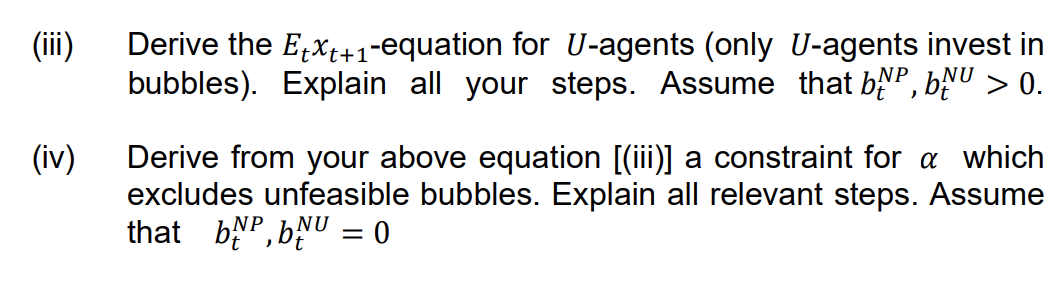
represents the stock new bubbles created Derive the equation for agents invest
Derive from your above equation a constraint for
excludes unfeasible bubbles. Explain all relevant steps. Assume
that
Step by Step Solution
There are 3 Steps involved in it
1 Expert Approved Answer
Step: 1 Unlock

Question Has Been Solved by an Expert!
Get step-by-step solutions from verified subject matter experts
Step: 2 Unlock
Step: 3 Unlock
 Study Help