





Question: Consider the following two queueing systems depicted below and answer the 5 questions that follow. System 1: 1 = 32, u = 20 System 2:
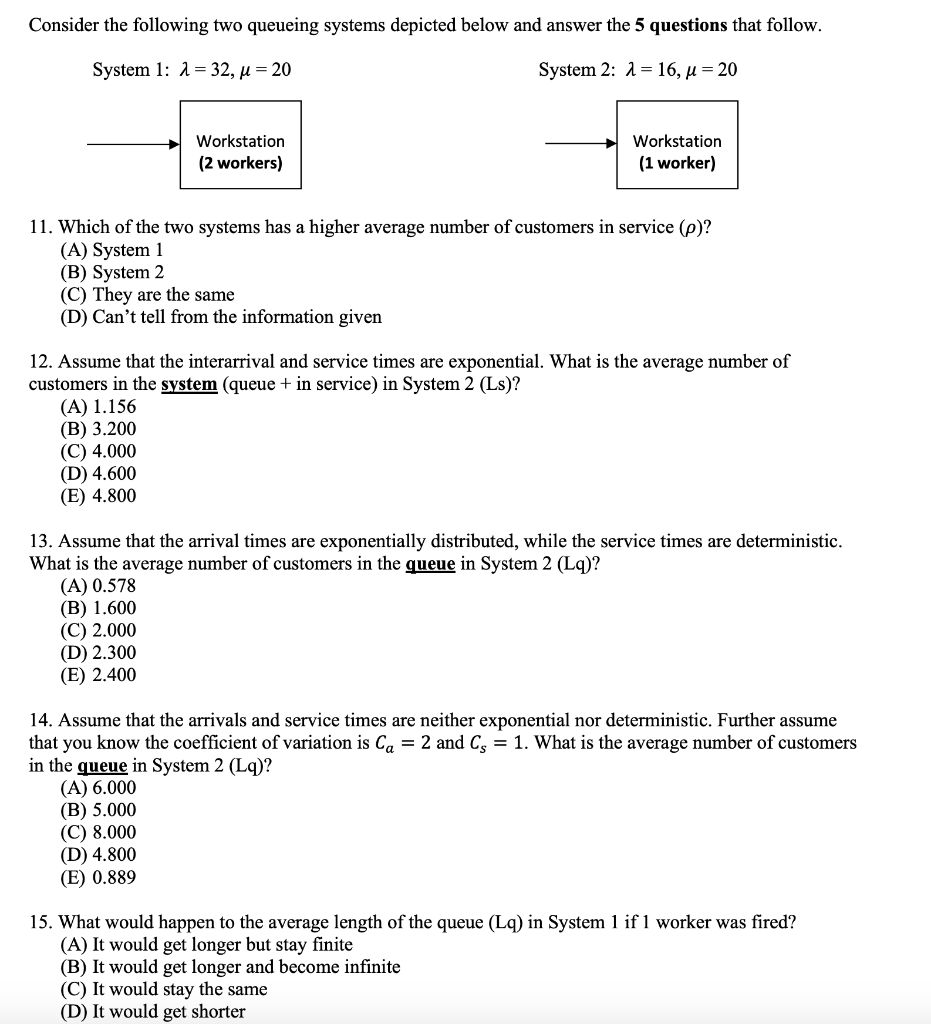
Consider the following two queueing systems

Consider the following two queueing systems depicted below and answer the 5 questions that follow. System 1: 1 = 32, u = 20 System 2: 1 = 16, u = 20 Workstation (2 workers) Workstation (1 worker) 11. Which of the two systems has a higher average number of customers in service ()? (A) System 1 (B) System 2 (C) They are the same (D) Can't tell from the information given 12. Assume that the interarrival and service times are exponential. What is the average number of customers in the system (queue + in service) in System 2 (Ls)? (A) 1.156 (B) 3.200 (C) 4.000 (D) 4.600 (E) 4.800 13. Assume that the arrival times are exponentially distributed, while the service times are deterministic. What is the average number of customers in the queue in System 2 (La)? (A) 0.578 (B) 1.600 (C) 2.000 (D) 2.300 (E) 2.400 14. Assume that the arrivals and service times are neither exponential nor deterministic. Further assume that you know the coefficient of variation is Ca = 2 and Cs = 1. What is the average number of customers in the queue in System 2 (Lq)? (A) 6.000 (B) 5.000 (C) 8.000 (D) 4.800 (E) 0.889 15. What would happen to the average length of the queue (Lq) in System 1 if I worker was fired? (A) It would get longer but stay finite (B) It would get longer and become infinite (C) It would stay the same (D) It would get shorter

Step by Step Solution

There are 3 Steps involved in it

1 Expert Approved Answer
Step: 1 Unlock blur-text-image

Question Has Been Solved by an Expert!

Get step-by-step solutions from verified subject matter experts

Step: 2 Unlock
Step: 3 Unlock

Students Have Also Explored These Related General Management Questions!