







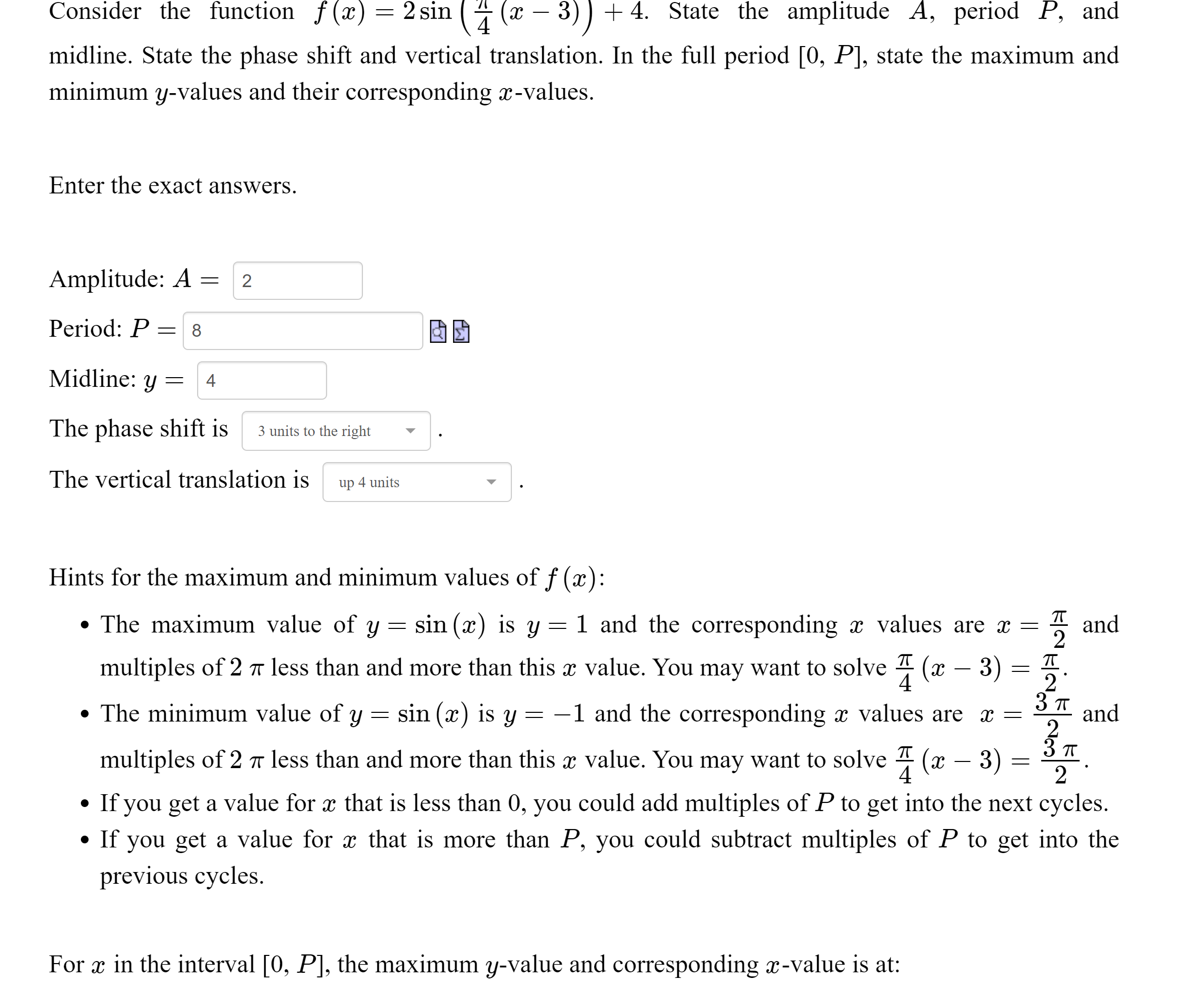
Question: Consider the function f(a:) = 25in ki (cc 3)) +4. State the amplitude A, period P, and midline. State the phase shift and vertical translation.
![vertical translation. In the ll] period [0, P], state the maximum and](https://s3.amazonaws.com/si.experts.images/answers/2024/06/667641b052618_096667641b031ab9.jpg)
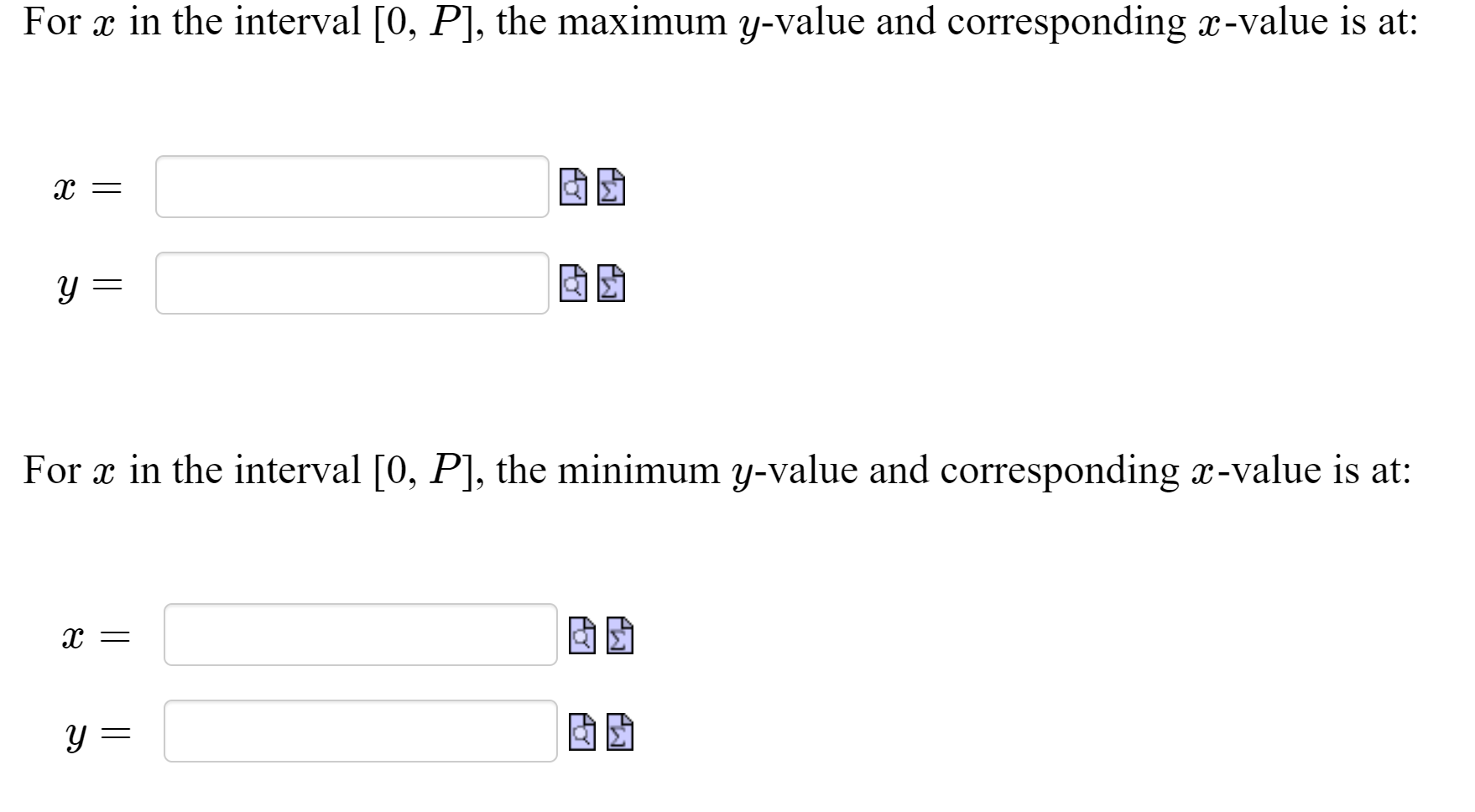
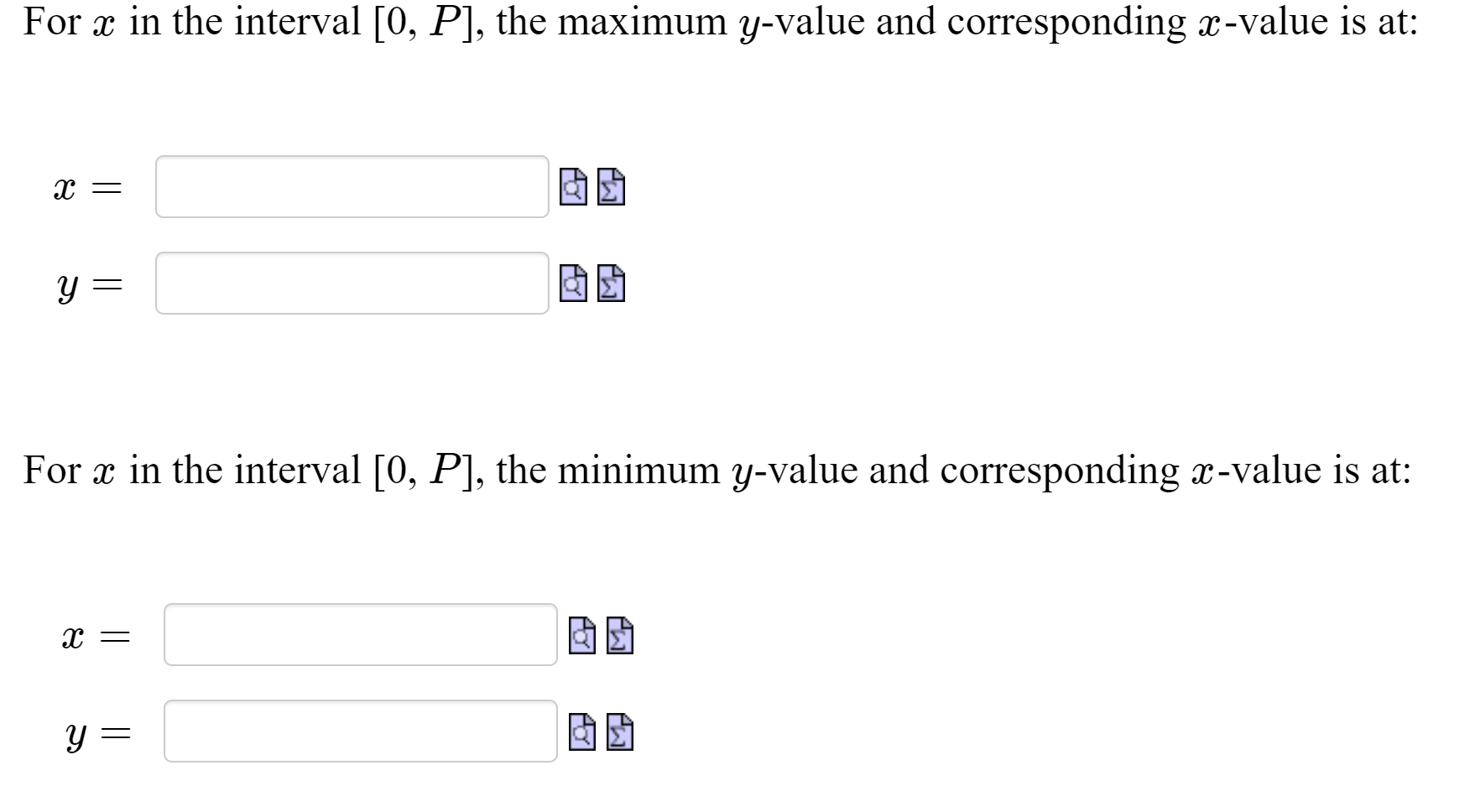
Consider the function f(a:) = 25in ki (cc 3)) +4. State the amplitude A, period P, and midline. State the phase shift and vertical translation. In the ll] period [0, P], state the maximum and minimum yvalues and their corresponding m-values. Enter the exact answers. Amplitude: A = 2 Period: P = 8 5, a Midline: y = 4 The phase shift is 3 units to the right v The vertical translation is up 4 units v Hints for the maximum and minimum values of f (m): 0 The maximum value of y = sin (m) is y = 1 and the corresponding x values are m = g and multiples of 2 7? less than and more than this x value. You may want to solve % (ac 3) = g. 0 The minimum value of y = sin (93) is y = 1 and the corresponding :3 values are m = 3T\" and multiples of 2 7r less than and more than this a: value. You may want to solve % (a: 3) = 37 0 If you get a value for cc that is less than 0, you could add multiples of P to get into the next cycles. 0 If you get a value for as that is more than P, you could subtract multiples of P to get into the previous cycles. For a: in the interval [0, P], the maximum y-value and corresponding m-value is at: For .7; in the interval [0, P], the maximum yValue and corresponding m-value is at: :13: la y: la For as in the interval [0, P], the minimum y-value and corresponding mvalue is at: w: @E 1/: @
Step by Step Solution
There are 3 Steps involved in it

Get step-by-step solutions from verified subject matter experts
 Study Help