



Question: Consider the Helmholtz equation 2 2 - (3H +31r) #02 = ates). 3.1:? 33:3 dened in the unit square with homogeneous Dirichlet boundary conditions. (a)
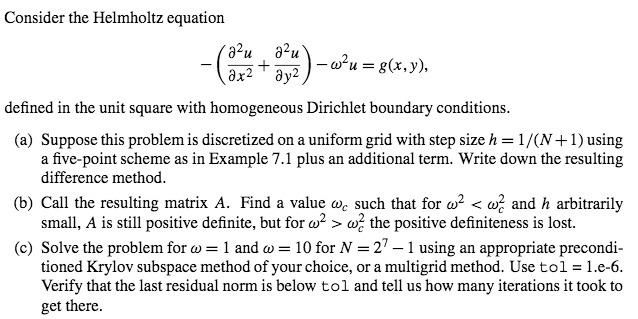
Consider the Helmholtz equation 2 2 - (3H +31r) #02\" = ates). 3.1:? 33:3 dened in the unit square with homogeneous Dirichlet boundary conditions. (a) Suppose this problem is discretized on a uniform grid with step size is = 1f(N + 1) using a ve-point scheme as in Example 7'11 plus an additional term. 1nitrite down the resulting difference method. (13} Call the resulting matrix A. Find a value m: such that for a? s: so? and h arbitrarilyr small, A is still positive denite, but for so: 2:- mg the positive deniteness is lost. (c) Solve the problem for a: = l and n;- = 10 for N = 2? 1 using an appropriate precondi- tioned Krylov subspace method of your choice. or a multigrid method. Use tol = l.e-6. Verify that the last residual norm is belov.r to l and tell us how man},r iterations it took to get there
Step by Step Solution
There are 3 Steps involved in it

Get step-by-step solutions from verified subject matter experts