







Question: Consider the matrix equation AX-B where: A = e^t cos(t) sin(t) e^t - sin(t) cos(t) e^t-cos(t)-sin(t) B = 0 2 0 a) Calculate det(A)
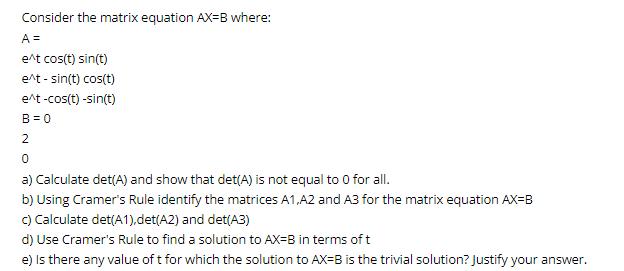
Consider the matrix equation AX-B where: A = e^t cos(t) sin(t) e^t - sin(t) cos(t) e^t-cos(t)-sin(t) B = 0 2 0 a) Calculate det(A) and show that det(A) is not equal to 0 for all. b) Using Cramer's Rule identify the matrices A1,A2 and A3 for the matrix equation AX-B c) Calculate det(A1),det(A2) and det(A3) d) Use Cramer's Rule to find a solution to AX-B in terms of t e) Is there any value of t for which the solution to AX-B is the trivial solution? Justify your answer.
Step by Step Solution
There are 3 Steps involved in it
1 Expert Approved Answer
Step: 1 Unlock

Question Has Been Solved by an Expert!
Get step-by-step solutions from verified subject matter experts
Step: 2 Unlock
Step: 3 Unlock
 Study Help