







Question: Consider the network topology below, which depicts a Source and a Destination connected by two intermediate routers. The Source transmits a file of size
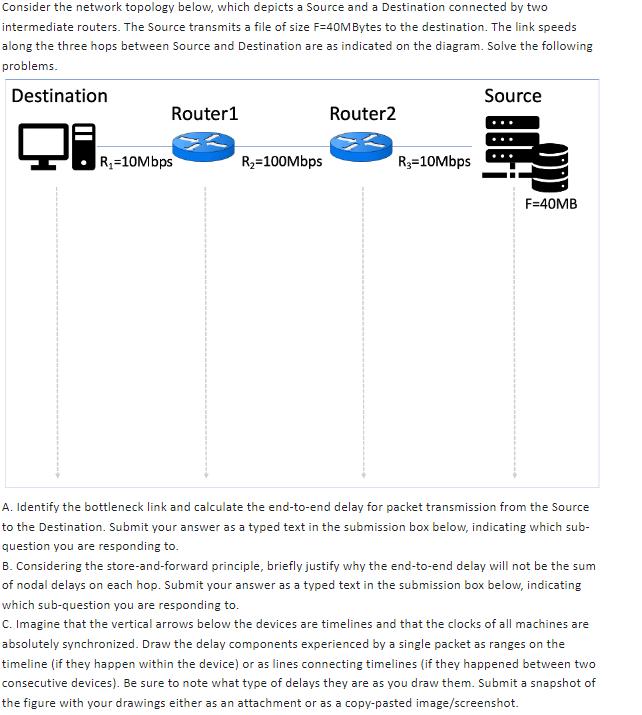
Consider the network topology below, which depicts a Source and a Destination connected by two intermediate routers. The Source transmits a file of size F-40MBytes to the destination. The link speeds along the three hops between Source and Destination are as indicated on the diagram. Solve the following problems. Destination Router1 R-10Mbps R=100Mbps Router2 R=10Mbps Source F=40MB A. Identify the bottleneck link and calculate the end-to-end delay for packet transmission from the Source to the Destination. Submit your answer as a typed text in the submission box below, indicating which sub- question you are responding to. B. Considering the store-and-forward principle, briefly justify why the end-to-end delay will not be the sum of nodal delays on each hop. Submit your answer as a typed text in the submission box below, indicating which sub-question you are responding to. C. Imagine that the vertical arrows below the devices are timelines and that the clocks of all machines are absolutely synchronized. Draw the delay components experienced by a single packet as ranges on the timeline (if they happen within the device) or as lines connecting timelines (if they happened between two consecutive devices). Be sure to note what type of delays they are as you draw them. Submit a snapshot of the figure with your drawings either as an attachment or as a copy-pasted image/screenshot.
Step by Step Solution
There are 3 Steps involved in it
Answer The endtoend delay total delay can be calculated using the formula for the total delay Total Delay Transmission Delay Propagation Delay Processing Delay Queuing Delay Transmission Delay This is ... View full answer

Get step-by-step solutions from verified subject matter experts
 Study Help