







Question: Consider the nominal transfer function, Go(s)=(s+2)(s1)s3 a) Using pole placement, synthesize a bi-proper controller with integral action for this process. The characteristic equation of the
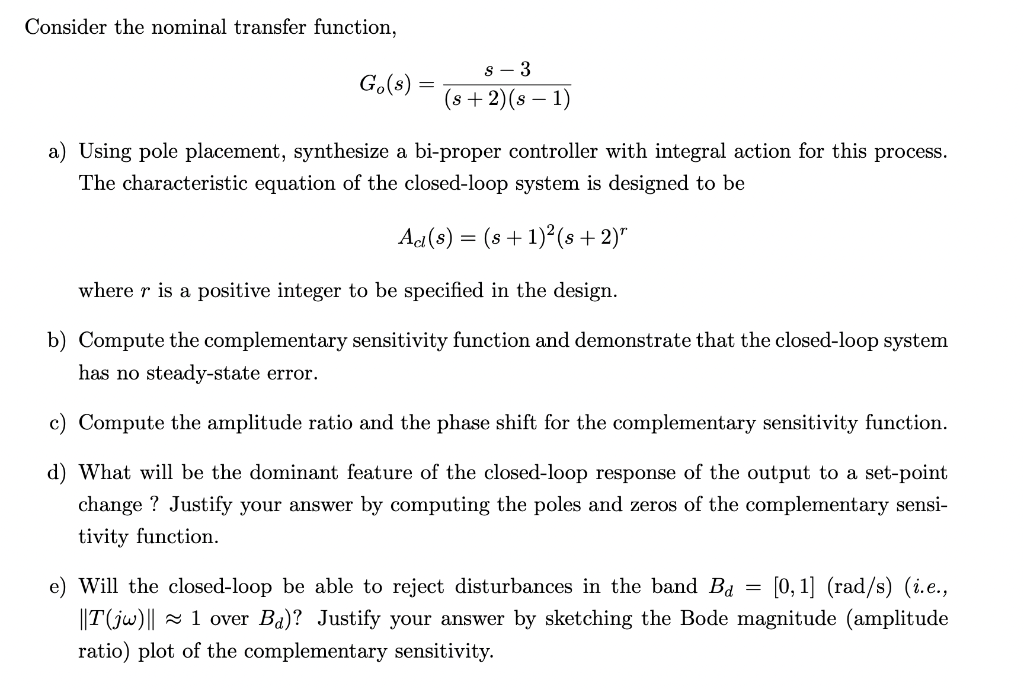
Consider the nominal transfer function, Go(s)=(s+2)(s1)s3 a) Using pole placement, synthesize a bi-proper controller with integral action for this process. The characteristic equation of the closed-loop system is designed to be Acl(s)=(s+1)2(s+2)r where r is a positive integer to be specified in the design. b) Compute the complementary sensitivity function and demonstrate that the closed-loop system has no steady-state error. c) Compute the amplitude ratio and the phase shift for the complementary sensitivity function. d) What will be the dominant feature of the closed-loop response of the output to a set-point change ? Justify your answer by computing the poles and zeros of the complementary sensitivity function. e) Will the closed-loop be able to reject disturbances in the band Bd=[0,1](rad/s) (i.e., T(j)1 over Bd) ? Justify your answer by sketching the Bode magnitude (amplitude ratio) plot of the complementary sensitivity. Consider the nominal transfer function, Go(s)=(s+2)(s1)s3 a) Using pole placement, synthesize a bi-proper controller with integral action for this process. The characteristic equation of the closed-loop system is designed to be Acl(s)=(s+1)2(s+2)r where r is a positive integer to be specified in the design. b) Compute the complementary sensitivity function and demonstrate that the closed-loop system has no steady-state error. c) Compute the amplitude ratio and the phase shift for the complementary sensitivity function. d) What will be the dominant feature of the closed-loop response of the output to a set-point change ? Justify your answer by computing the poles and zeros of the complementary sensitivity function. e) Will the closed-loop be able to reject disturbances in the band Bd=[0,1](rad/s) (i.e., T(j)1 over Bd) ? Justify your answer by sketching the Bode magnitude (amplitude ratio) plot of the complementary sensitivity
Step by Step Solution
There are 3 Steps involved in it

Get step-by-step solutions from verified subject matter experts
 Study Help