







Question: Consider the stack-based program below: 1. PUSH #11 2. PUSH #12 3. PUSH #13 4. PUSH #14 5. PUSH #15 6. ADD 7. MUL 8.
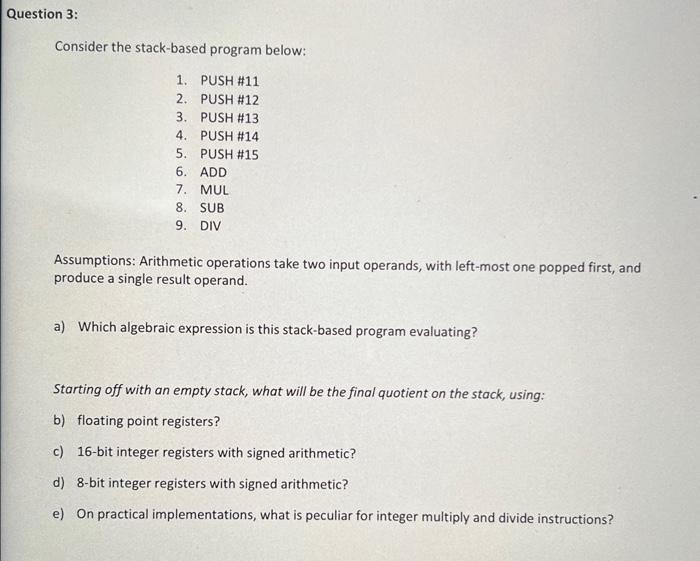
Consider the stack-based program below: 1. PUSH \#11 2. PUSH \#12 3. PUSH #13 4. PUSH #14 5. PUSH \#15 6. ADD 7. MUL 8. SUB 9. DIV Assumptions: Arithmetic operations take two input operands, with left-most one popped first, and produce a single result operand. a) Which algebraic expression is this stack-based program evaluating? Starting off with an empty stack, what will be the final quotient on the stack, using: b) floating point registers? c) 16-bit integer registers with signed arithmetic? d) 8-bit integer registers with signed arithmetic? e) On practical implementations, what is peculiar for integer multiply and divide instructions
Step by Step Solution
There are 3 Steps involved in it
1 Expert Approved Answer
Step: 1 Unlock

Question Has Been Solved by an Expert!
Get step-by-step solutions from verified subject matter experts
Step: 2 Unlock
Step: 3 Unlock
 Study Help