







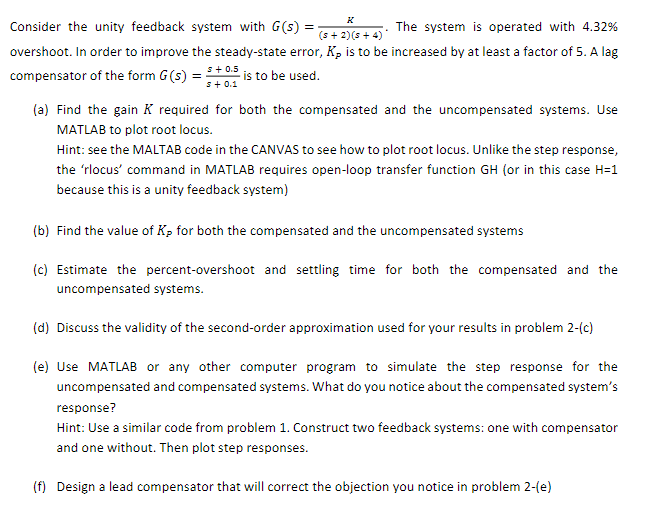
Question: Consider the unity feedback system with ( G ( s ) = frac { K } { ( s + 2 ) (
Consider the unity feedback system with GsfracKss The system is operated with overshoot. In order to improve the steadystate error, KP is to be increased by at least a factor of A lag compensator of the form Gsfracss is to be used.
a Find the gain K required for both the compensated and the uncompensated systems. Use MATLAB to plot root locus.
Hint: see the MALTAB code in the CANVAS to see how to plot root locus. Unlike the step response, the 'rlocus' command in MATLAB requires openloop transfer function GH or in this case mathrmH because this is a unity feedback system
b Find the value of KP for both the compensated and the uncompensated systems
c Estimate the percentovershoot and settling time for both the compensated and the uncompensated systems.
d Discuss the validity of the secondorder approximation used for your results in problem c
e Use MATLAB or any other computer program to simulate the step response for the uncompensated and compensated systems. What do you notice about the compensated system's response?
Hint: Use a similar code from problem Construct two feedback systems: one with compensator and one without. Then plot step responses.
f Design a lead compensator that will correct the objection you notice in problem e
Step by Step Solution
There are 3 Steps involved in it
1 Expert Approved Answer
Step: 1 Unlock

Question Has Been Solved by an Expert!
Get step-by-step solutions from verified subject matter experts
Step: 2 Unlock
Step: 3 Unlock
 Study Help