Question: Consider two different implementations of the same instruction set architecture. The instructions can be divided into four classes according to their CPI. They might, for
Consider two different implementations of the same instruction set architecture. The instructions can be divided into four classes according to their CPI. They might, for example, be integer instructions, floating point instructions, load/store instructions and control instruction like jump and branch.
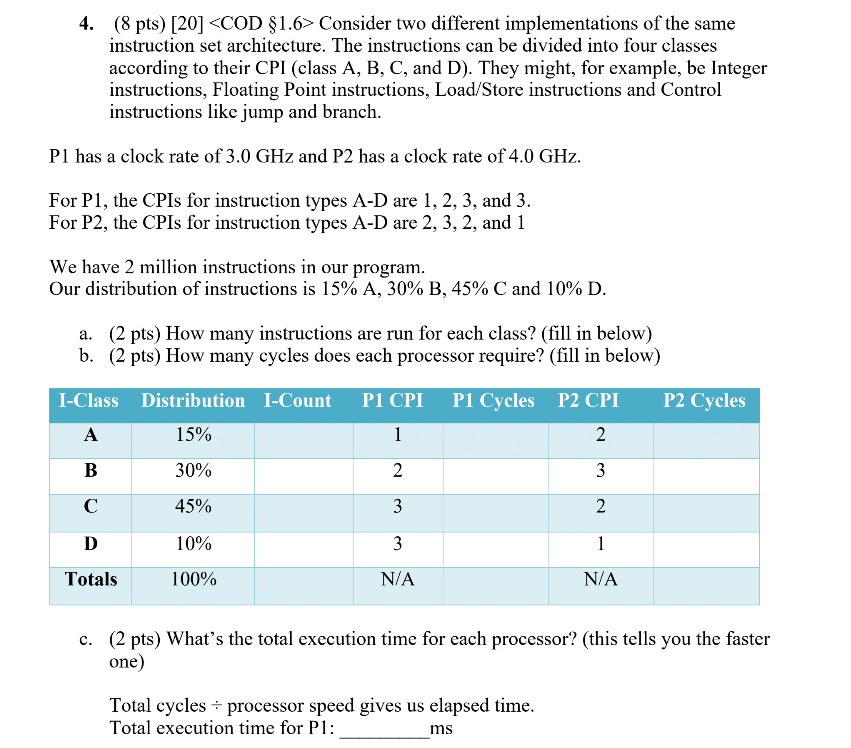
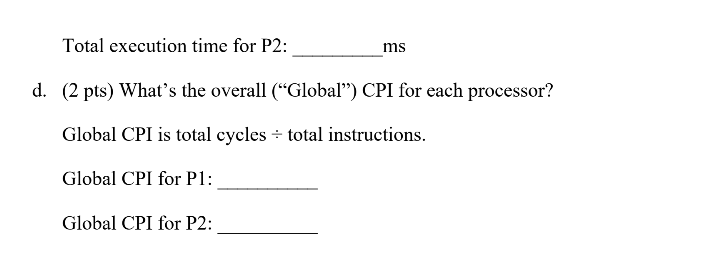
4. (8 pts) [20] Consider two different implementations of the same instruction set architecture. The instructions can be divided into four classes according to their CPI (class A, B, C, and D). They might, for example, be Integer instructions, Floating Point instructions, Load/Store instructions and Control instructions like jump and branch P1 has a clock rate of 3.0 GHz and P2 has a clock rate of 4.0 GHz For P1, the CPIs for instruction types A-D are 1, 2, 3, and 3 For P2, the CPIs for instruction types A-D are 2, 3, 2, and 1 We have 2 million instructions in our program Our distribution of instructions is 15% A, 30% B, 45% C and 10% D (2 pts) How many instructions are run for each class? (fill in below) a. b. (2 pts) How many cycles does each processor require? (fill in below) I-Class Distribution I-Count P1 CPI P1 Cvcles P2 CPI P2 Cycles 15% 30% 45% 10% 100% Totals N/A N/A (2 pts) What's the total execution time for each processor? (this tells you the faster one c. Total cycles+ processor speed gives us elapsed time Total execution time for P1: ms Total execution time for P2: ms d. (2 pts) What's the overall "Global") CPI for each processor? Global CPI is total cycles + total instructions. Global CPI for P1: Global CPI for P2









 Study Help