







Question: Consider X1, X2, ... , In E {0,1}, and let denote the NOT operator. An n-variable logic function f* (x1, X2, ... , Xn) is
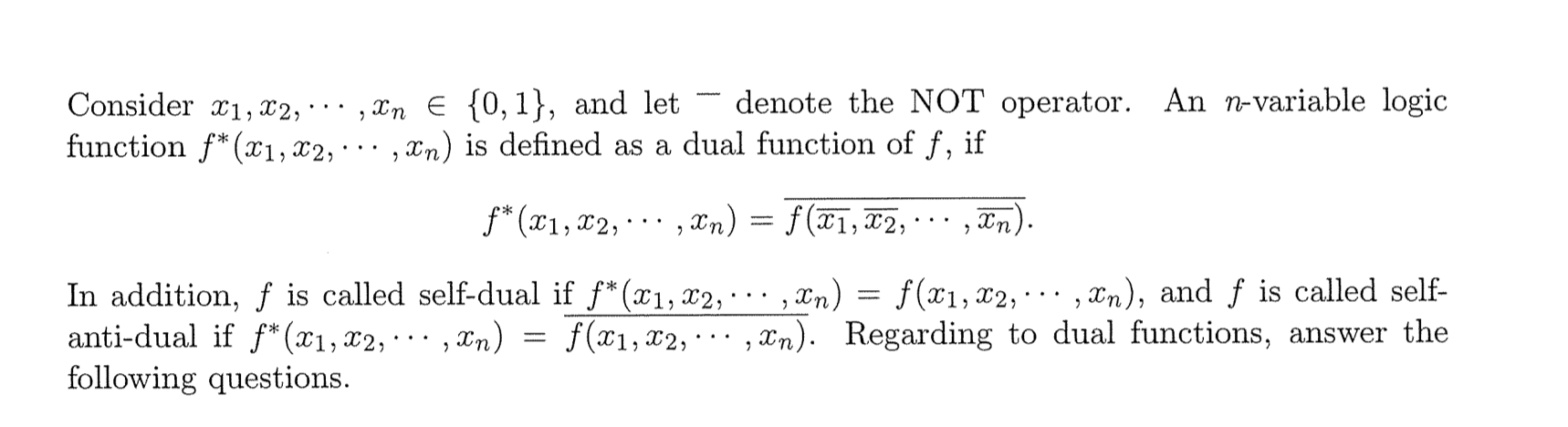

Consider X1, X2, ... , In E {0,1}, and let denote the NOT operator. An n-variable logic function f* (x1, X2, ... , Xn) is defined as a dual function of f, if $*(x1,x2,..., Un) = f (T1, T2, ... , Tn). In addition, f is called self-dual if f* (x1, x2,...,xn) = f(x1, X2, ... , Xn), and f is called self- anti-dual if f* (x1, x2,...,xn) = f(x1, X2, ... , Xn). Regarding to dual functions, answer the following questions. (4) Show that fi f2 is a self-anti-dual function if the n-variable logic functions f1 and f2 are self-anti-dual, where o denotes the Exclusive-OR operator. Consider X1, X2, ... , In E {0,1}, and let denote the NOT operator. An n-variable logic function f* (x1, X2, ... , Xn) is defined as a dual function of f, if $*(x1,x2,..., Un) = f (T1, T2, ... , Tn). In addition, f is called self-dual if f* (x1, x2,...,xn) = f(x1, X2, ... , Xn), and f is called self- anti-dual if f* (x1, x2,...,xn) = f(x1, X2, ... , Xn). Regarding to dual functions, answer the following questions. (4) Show that fi f2 is a self-anti-dual function if the n-variable logic functions f1 and f2 are self-anti-dual, where o denotes the Exclusive-OR operator
Step by Step Solution
There are 3 Steps involved in it

Get step-by-step solutions from verified subject matter experts
 Study Help