







Question: Constrained optimization a) = = 3x* + 4y- xy subject to:x + y = 21 b) = = -10x7 + y subject to:x - y
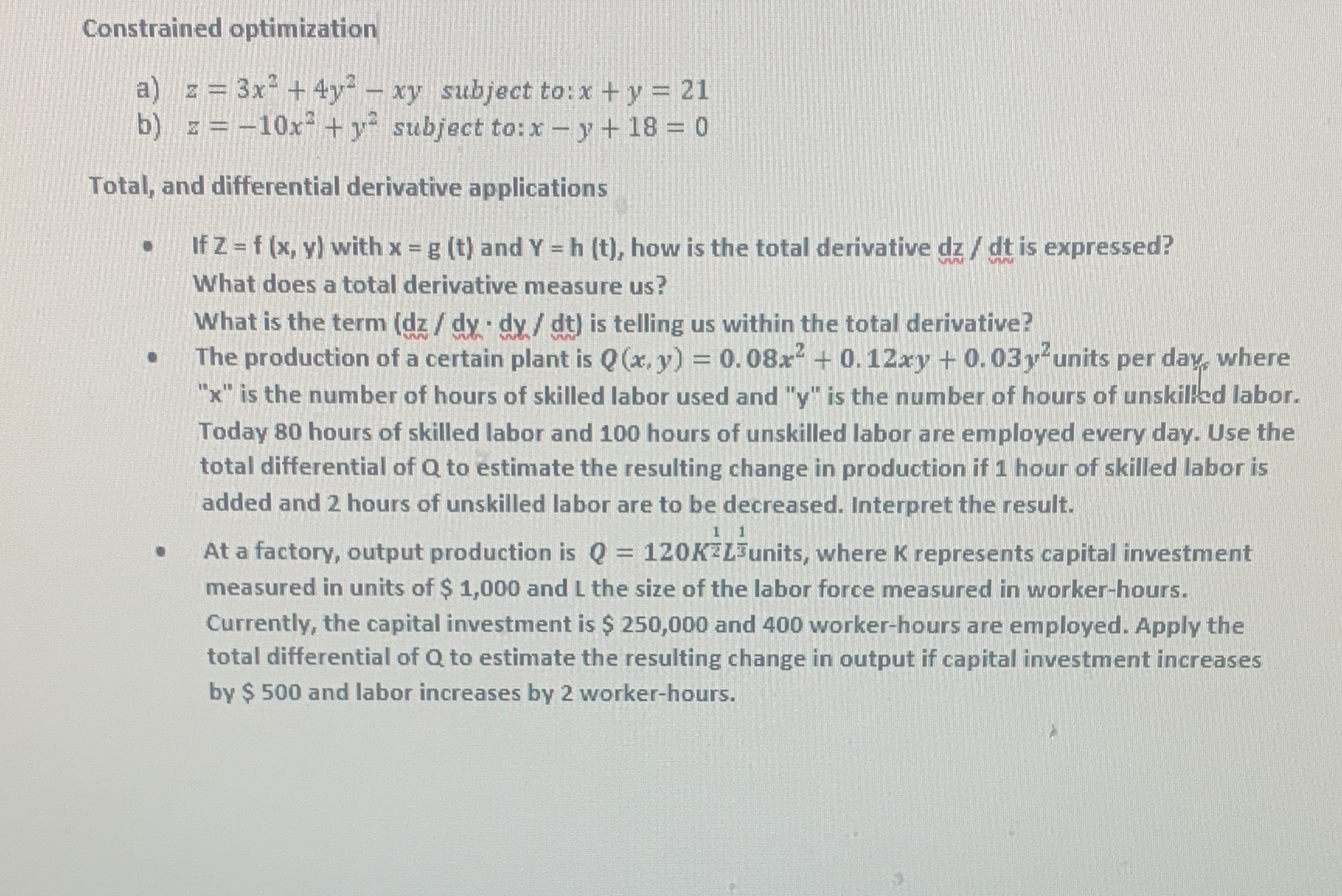
Constrained optimization a) = = 3x* + 4y- xy subject to:x + y = 21 b) = = -10x7 + y subject to:x - y + 18 = 0 Total, and differential derivative applications If Z = f (x, y) with x = g (t) and Y = h (t), how is the total derivative dz / dt is expressed? What does a total derivative measure us? What is the term (dz / dy . dy / dt) is telling us within the total derivative? The production of a certain plant is Q (x, y) = 0. 08x- + 0. 12xy + 0. 03y units per day, where "x" is the number of hours of skilled labor used and "y" is the number of hours of unskilled labor. Today 80 hours of skilled labor and 100 hours of unskilled labor are employed every day. Use the total differential of Q to estimate the resulting change in production if 1 hour of skilled labor is added and 2 hours of unskilled labor are to be decreased. Interpret the result. . At a factory, output production is Q = 120X?LIunits, where K represents capital investment measured in units of $ 1,000 and L the size of the labor force measured in worker-hours. Currently, the capital investment is $ 250,000 and 400 worker-hours are employed. Apply the total differential of Q to estimate the resulting change in output if capital investment increases by $ 500 and labor increases by 2 worker-hours
Step by Step Solution
There are 3 Steps involved in it

Get step-by-step solutions from verified subject matter experts
 Study Help