







Question: Convert the following decimal integers to twos complement binary values. Assume a 16 bit length for the integers. 125 -64 32767 -128 the following number
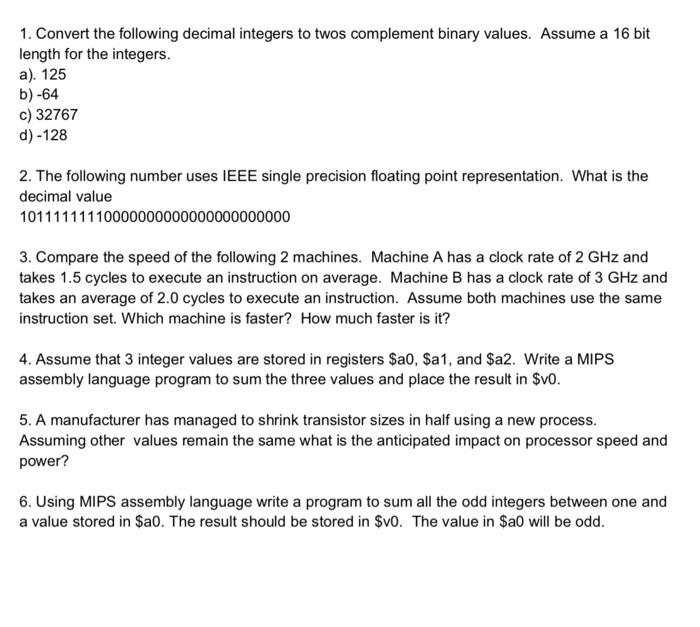
Convert the following decimal integers to twos complement binary values. Assume a 16 bit length for the integers. 125 -64 32767 -128 the following number uses IEEE single precision floating point representation. What is the decimal value 10111111110000000000000000000000 Compare the speed of the following 2 machines? Machine A has a clock rate of 2 GHz and takes 1.5 cycles to execute an instruction on average. Machine B has a clock rate of 3 GHz and takes an average of 2.0 cycles to execute an instruction. Assume both machines use the same instruction set. Which machine is faster? How much faster is it? Assume that 3 integer values are stored in registers $a0, $a1, and $a2. Write a MIPS assembly language program to sum the three values and place the result in $v0. A manufacturer has managed to shrink transistor sizes in half using a new process. Assuming other values remain, the same what is the anticipated impact on processor speed and power? Using MIPS assembly language write a program to sum all the odd integers between one and a value stored in $a0. the result should be stored in $v0. the value in $a0 will be odd
Step by Step Solution
There are 3 Steps involved in it

Get step-by-step solutions from verified subject matter experts
 Study Help