







Question: Convert the following relations to 2NF. Functional dependencies, except for trivial ones and those for which the primary key is a determinant, are shown
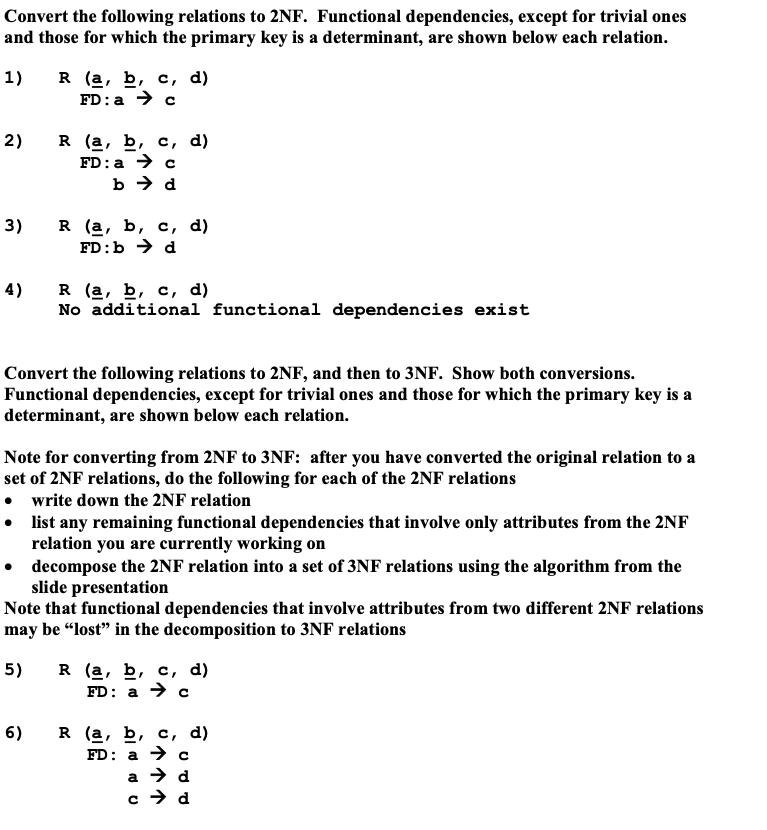
Convert the following relations to 2NF. Functional dependencies, except for trivial ones and those for which the primary key is a determinant, are shown below each relation. 1) 2) 3) 4) R (a, b, c, d) FD: a c R (a, b, c, d) FD: ac b d 6) R (a, b, c, d) FD: bd R (a, b, c, d) No additional functional dependencies exist Convert the following relations to 2NF, and then to 3NF. Show both conversions. Functional dependencies, except for trivial ones and those for which the primary key is a determinant, are shown below each relation. Note for converting from 2NF to 3NF: after you have converted the original relation to a set of 2NF relations, do the following for each of the 2NF relations write down the 2NF relation list any remaining functional dependencies that involve only attributes from the 2NF relation you are currently working on decompose the 2NF relation into a set of 3NF relations using the algorithm from the slide presentation Note that functional dependencies that involve attributes from two different 2NF relations may be "lost" in the decomposition to 3NF relations 5) R (a, b, c, d) FD: a c R (a, b, c, d) FD: ac a d c d
Step by Step Solution
There are 3 Steps involved in it
Alright lets work through these step by step Relation Ra b c d FD a c This relation is already in 2N... View full answer

Get step-by-step solutions from verified subject matter experts
 Study Help