



Question: Could someone provide help for 19 and 20 please? 19. The firms Ford Motor and General Motors (GM) are bargaining over the selling price of
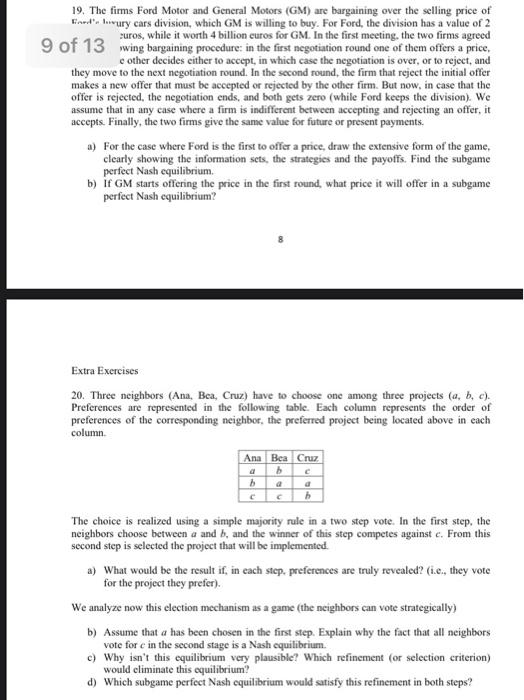
19. The firms Ford Motor and General Motors (GM) are bargaining over the selling price of Find.'. lewury cars division, which GM is willing to buy. For Ford, the division has a value of 2 suros, while it worth 4 billion earos for GM. In the first meeting, the two firms agreed swing bargaining procedure: in the first negotiation round one of them offers a price, e other decides either to accept, in which case the negotiation is over, or to reject, and they move to the next negotiation round. In the second round, the firm that reject the initial offer makes a new offer that must be accepted or rejected by the other firm. But now, in case that the offer is rejected, the negotiation ends, and both gets zero (while Ford keeps the division). We assume that in any case where a firm is indifferent between accepting and rejecting an offer, it accepts. Finally, the two firms give the same value for future or present payments. a) For the case where Ford is the first to offer a price, draw the extensive form of the game, clearly showing the information sets, the strategies and the payoffs. Find the subgame perfect Nash cquilibrium. b) If GM starts offering the price in the first round, what price it will offer in a subgame perfect Nash equilibrium? Extra Exercises 20. Three neighbors (Ana, Bea, Cruz) have to choose one among three projects (a,b,c). Preferences are represented in the following table. Each column represents the order of preferences of the corresponding neighbor. the preferred project being located above in each column. The choice is realized using a simple majority rule in a two step vote. In the first step, the neighbors choose between a and b, and the winner of this step competes against c. From this second step is selected the project that will be implemented. a) What would be the result if, in each step, preferences are truly revealed? (i.c., they vote for the project they prefer). We analyze now this clection mechanism as a game (the neighbors can vote strategically) b) Assume that a has been chosen in the first step. Explain why the fact that all neighbors vote for c in the second stage is a Nash equilibrium. c) Why isn't this equilibrium very plausible? Which refinement (or selection criterion) would climinate this equilibrium? d) Which subgame perfect Nash cquilibrium would satisfy this refinement in both steps? 19. The firms Ford Motor and General Motors (GM) are bargaining over the selling price of Find.'. lewury cars division, which GM is willing to buy. For Ford, the division has a value of 2 suros, while it worth 4 billion earos for GM. In the first meeting, the two firms agreed swing bargaining procedure: in the first negotiation round one of them offers a price, e other decides either to accept, in which case the negotiation is over, or to reject, and they move to the next negotiation round. In the second round, the firm that reject the initial offer makes a new offer that must be accepted or rejected by the other firm. But now, in case that the offer is rejected, the negotiation ends, and both gets zero (while Ford keeps the division). We assume that in any case where a firm is indifferent between accepting and rejecting an offer, it accepts. Finally, the two firms give the same value for future or present payments. a) For the case where Ford is the first to offer a price, draw the extensive form of the game, clearly showing the information sets, the strategies and the payoffs. Find the subgame perfect Nash cquilibrium. b) If GM starts offering the price in the first round, what price it will offer in a subgame perfect Nash equilibrium? Extra Exercises 20. Three neighbors (Ana, Bea, Cruz) have to choose one among three projects (a,b,c). Preferences are represented in the following table. Each column represents the order of preferences of the corresponding neighbor. the preferred project being located above in each column. The choice is realized using a simple majority rule in a two step vote. In the first step, the neighbors choose between a and b, and the winner of this step competes against c. From this second step is selected the project that will be implemented. a) What would be the result if, in each step, preferences are truly revealed? (i.c., they vote for the project they prefer). We analyze now this clection mechanism as a game (the neighbors can vote strategically) b) Assume that a has been chosen in the first step. Explain why the fact that all neighbors vote for c in the second stage is a Nash equilibrium. c) Why isn't this equilibrium very plausible? Which refinement (or selection criterion) would climinate this equilibrium? d) Which subgame perfect Nash cquilibrium would satisfy this refinement in both steps
Step by Step Solution
There are 3 Steps involved in it

Get step-by-step solutions from verified subject matter experts